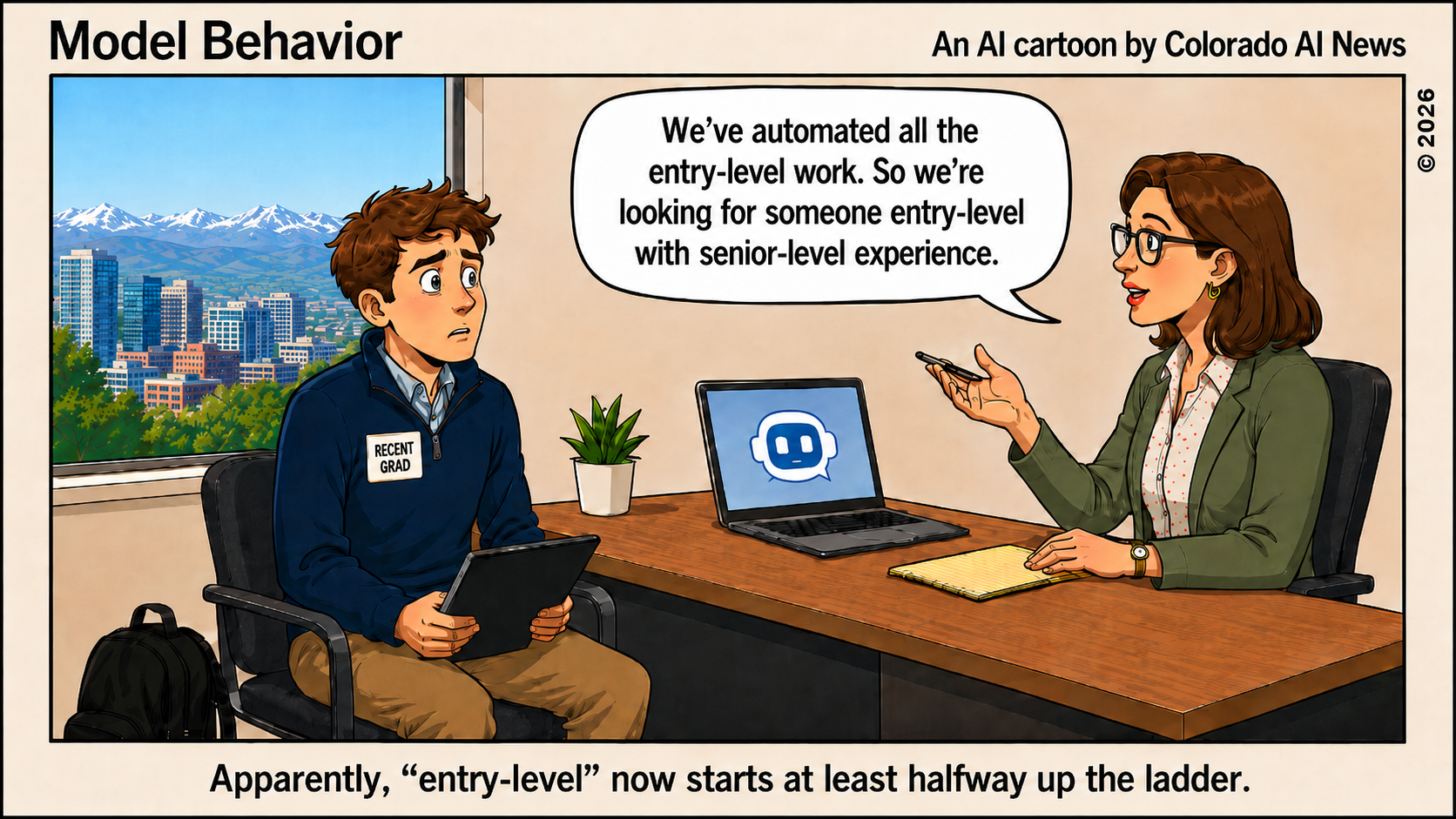
The hiring manager in this month's Model Behavior cartoon is exaggerating when she says her company wants an entry-level employee with senior-level experience. But the gap between the joke and the data is narrower than it should be.
A new word for it: 'seniorization'
Consider the language employers themselves are now using. In its 2026 AI Jobs Barometer, released in mid-June, the consulting firm PwC analyzed more than a billion job postings across six continents and found that entry-level roles in the occupations most exposed to AI are now seven times more likely to demand skills that used to appear much later in a career – strategic judgment, stakeholder management, and leadership. PwC even gave the pattern a name: "seniorization." In the most AI-exposed fields, 52% of the new skills showing up in entry-level postings were ones traditionally associated with experienced workers. In the least exposed fields, that figure was just 7%.
The shape of the market has shifted to match. By PwC's count, openings for these redrawn, higher-skill entry-level roles have grown 35% since 2019, even as traditional entry-level openings shrank 10%.
The reason isn't mysterious: The tasks that once filled a junior employee's first year – summarizing research, formatting reports, drafting first passes, basic coding, data entry – are precisely the tasks generative AI now does quickly and cheaply. What's left in the job description is the harder, judgment-heavy work that used to take years to earn. As PwC's global workforce leader, Pete Brown, put it, AI is stripping out the routine work that "once acted as an apprenticeship," while demanding judgment and adaptability far earlier in a career.
PwC is not alone in noticing this trend. Laura Ullrich, lead economist at the job site Indeed, has described the same phenomenon as "experience creep": employers asking for more experience for jobs that once existed to help people acquire it. A Harvard working paper this spring labeled the underlying dynamic "seniority-biased technological change," and found that where it is happening, the decline at the bottom is driven less by laying off junior staff than by simply not hiring them in the first place.
As The Washington Post reported last month, entry-level openings in technology, finance, and consulting had fallen 33% from 2015 levels, while openings for more experienced workers in those fields rose 67%. Asked why companies were raising the bar, Ullrich offered a blunt explanation: "Because they can."
To be clear, AI is not the sole driver of all this. Higher interest rates, economic uncertainty, a hangover from pandemic-era over-hiring, and ordinary cost-cutting have all made companies cautious about adding headcount. But AI is concentrating that caution at the bottom of the ladder, because the bottom of the ladder is where the automatable work lives.
Not a collapse, but a missing first rung
It would be easy to read all of this as a story about a collapsing white-collar job market. It isn't. By most measures the broader market has held up — the U.S. has added millions of white-collar jobs since 2022, and several occupations once forecast as AI's first casualties have instead grown. The squeeze is specific and structural: It falls on the first rung, not the whole ladder.
And that is the real problem the cartoon is pointing at. Companies may need fewer people to do entry-level work, but the people they do hire are expected to arrive with the judgment that employees used to develop by doing exactly that work. The rung that taught people how to climb is the rung being pulled out.
Again, the mismatch was already visible a year ago. In a July 2025 article on AI and the new grad job market titled, "AI Is Wrecking an Already Fragile Job Market for College Graduates," The Wall Street Journal reported that some companies were thinning their junior ranks in favor of more seasoned hires. Rebecca Price, a partner at Primary Venture Partners, told the Journal that junior engineers who once needed only basic coding ability might now also be expected to spot vulnerabilities, judge whether AI-generated work can be trusted, and learn fast. "The bar is higher and the system hasn't caught up," she said.
Who teaches the next generation?
The answer cannot simply be to tell graduates to show up with more experience. Today's graduates can see which rung is vanishing. This spring, members of the Class of 2026 booed commencement speakers who stood up to tell them AI was their opportunity – a reaction Colorado AI News columnist Crys Black explored earlier this June.
Someone still has to give new grads the chance to get the experience they need. PwC's own framing is that AI does not have to be a job killer; it can be used to expand what a company does rather than used only to cut costs. In other words, AI can be a job creator – but only if employers redesign the path into work, not just the work itself.
In fact, a few business leaders have started to say this out loud. As Fast Company reported in May, Reddit's CEO recently indicated the company would lean into hiring new graduates precisely because they are "AI-native." The alternative is the world of our Model Behavior cartoon, where "entry level" jobs keep drifting upward until the people they were meant for no longer have a chance of obtaining them.