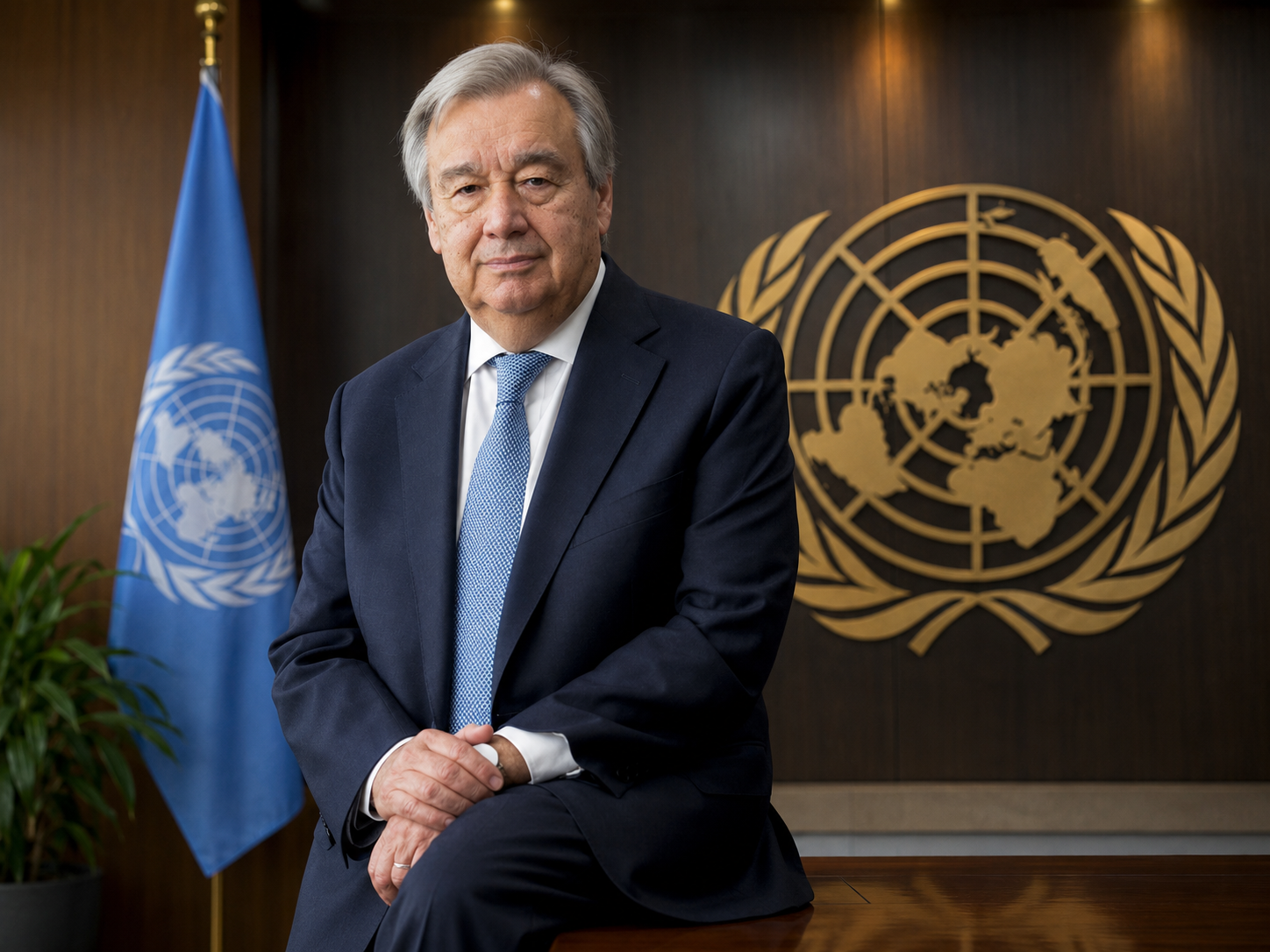
"We do not let medicine reach a child until it is proven safe. We test every toy. Yet AI has reached our children – their learning, their friendships, their most private questions – before anyone asked what it would do to them." – António Guterres, United Nations secretary-general, speaking July 6 at the first government-level U.N. Global Dialogue on AI Governance in Geneva.
Guterres' analogy does something most AI governance rhetoric doesn't: It names an ordinary, uncontroversial fact – we don't let untested medicine or toys near kids – and points out that AI skipped that step entirely. No trial period, no age-appropriate safety review. It just arrived, in classrooms and bedrooms and the late-night questions kids used to bring to a person instead.
This was not a new alarm. Guterres has warned about AI's societal risks since 2017, and last Monday's speech built on years of UN groundwork: a 2023 advisory-body report, the 2024 Global Digital Compact, and a scientific panel whose preliminary findings were briefed to heads of state that same morning. The panel's co-chairs, Nobel laureate Maria Ressa and Turing Award winner Yoshua Bengio, told delegates that AI capabilities are approaching or surpassing human ability in many domains, with no sign of the pace slowing.
The panel also gave Guterres' metaphor real weight. Ressa told delegates about a 14-year-old boy who died by suicide in 2024 after months of conversation with a chatbot produced by Character AI. The chatbot never broke character or urged the boy to seek help even as he was in crisis — a case his mother testified about to Congress and that was settled earlier this year. That's not a hypothetical risk. It's the reason the toys-and-medicine comparison has teeth: a real child, a real system that didn't stop, a real settlement.
Guterres tied the moment to a specific ask: an AI Child Safety Pledge requiring companies to prove systems are safe before children can reach them, a ban on AI-generated child sexual abuse material, and a rule that any system detecting a child in crisis must connect them to a real person.
But whether any of that becomes more than a pledge depends on governments that have already signaled they won't be bound by it. Speaking for the U.S. at last September's UN Security Council session that launched this whole process, Director Michael Kratsios of the White House's Office of Society and Technology Policy said the U.S. "totally reject[s] all efforts by international bodies to assert centralized control and global governance of AI," arguing that the path forward lies in national sovereignty, not "bureaucratic management." He's repeated versions of that line at multiple summits since, at one point saying that too many international AI-safety forums maintain a general "atmosphere of fear" around speculative risk.
That dissent isn't just rhetorical posturing. The panel's own preliminary report bears this out: It found the U.S. controls roughly 75% of the computing power among the world's 500 most capable AI supercomputers, with China accounting for 15%. The report itself notes that most countries – including many advanced economies – lack the technical expertise to assess the most capable frontier models or participate meaningfully in governing them, leaving most nations dependent on systems built elsewhere that they can't inspect, audit, or adapt to local needs.
A global safety standard — including the one meant to protect children – only works in practice if the two countries holding nearly all that capacity choose to cooperate with it. And at least for now, that cooperation is explicitly not guaranteed by the country holding three-quarters of it.