Fireworks are hard to beat. They're bright and colorful, communal and nostalgic, and thoroughly woven into the American idea of the Fourth of July. For many people, the Fourth of July without fireworks doesn't quite feel like Independence Day.
But this year’s holiday also makes the drawbacks harder to ignore.
In Washington, D.C., Saturday night’s 250th-anniversary celebration is expected to include what organizers have billed as the largest pyrotechnic display in history, with about 850,000 fireworks launched over roughly 40 minutes. As The Washington Post reported this week, internal National Park Service modeling predicts hazardous pollution around the National Mall and “very unhealthy” conditions across central D.C. and Arlington, Virginia.
The concern is not just haze hanging over a patriotic spectacle. Fireworks produce fine particulate matter, known as PM2.5, that can travel deep into the lungs. The Post reported that the Park Service modeling projected elevated pollution for three to six hours after the show in some affected areas.
Colorado’s Fourth meets fire danger
In Colorado, the problem is different but no less familiar. Colorado Springs canceled all planned July Fourth fireworks displays this week because of “extreme fire danger.” City officials cited low fuel moisture, weather forecasts, an active burn ban, and pressure on statewide firefighting resources. Nearby Palmer Lake and Cripple Creek also canceled their shows.
For Colorado, fire danger is not an abstract concern. A spark that produces a few seconds of beauty in the sky can become something far more dangerous when it lands in dry grass, brush, or forest.
Which raises a question that is not anti-fireworks so much as pro-celebration: Can communities preserve the spectacle without the smoke, sparks, and fire risk?
Increasingly, one possible solution may be drones.
A different way to light up the sky
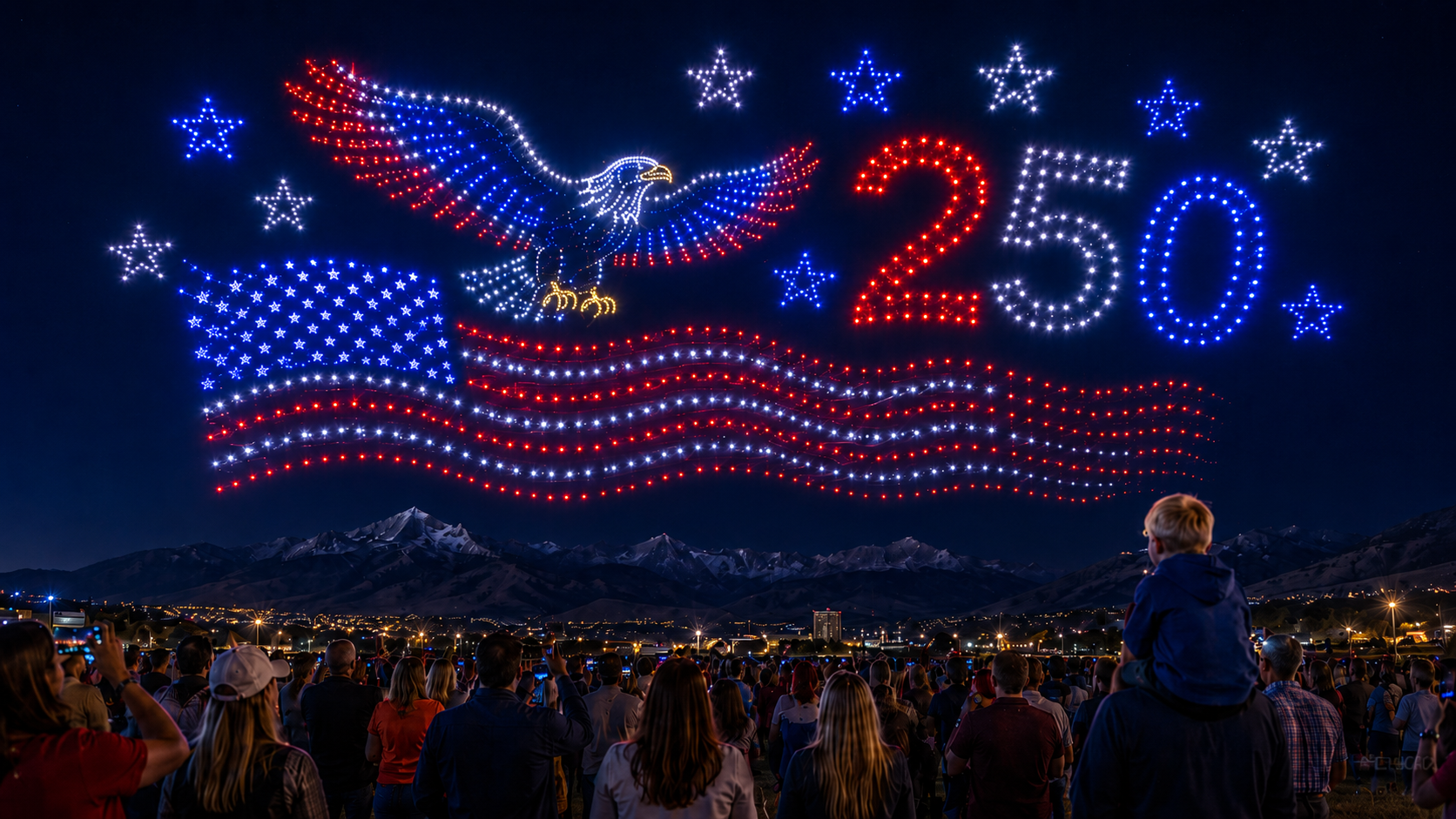
Drone light shows use fleets of small aircraft equipped with LEDs to create moving images in the night sky. They can form flags, eagles, mountains, numbers, logos, or animated scenes. They don't produce combustion smoke, they don't scatter burning material over dry ground, they don't leave behind shell debris. And unlike conventional fireworks, they can engage in visual storytelling.
Nor are drone shows just theoretical. Longmont’s Downtown Family Festival includes live music, a drone show, and fireworks on the Fourth. Denver’s Independence Eve celebration has previously featured hundreds of drones at Civic Center Park, although that does not appear to be taking place this year. However, Aspen continues its Symphony of Freedom Drone Show this year, which the city describes as a 250-drone display above Aspen Mountain that has replaced fireworks, given the high-country wildfire risk.
Nationally, drone shows have appeared in celebrations from New York City’s Macy’s Fourth of July event to Nashville’s America 250 celebration, which is reportedly pairing fireworks with 1,000 drones.
All the positives don't make drone shows a perfect substitute for fireworks, of course. Drone shows require advance planning, FAA approvals, trained operators, favorable weather, and enough money to make the spectacle worthwhile. They also lack the thunder and explosive spontaneity of fireworks, which many people love.
But they offer something important for a state like Colorado: a way to light the sky without putting at risk the ground below.
Cost remains a major obstacle. Drone light shows can avoid smoke, falling embers, and shell debris, but they are not necessarily cheaper than fireworks. Axios recently reported that traditional fireworks displays often cost roughly $1,000 to $1,500 per minute, while San Diego-based Drone Studios charges about $150 to $200 per drone, plus design fees, with July Fourth shows commanding premium rates. For a cash-strapped town, that can make drones a cleaner and safer option — but not an easy one.
The longer-term question is whether AI-assisted choreography, reusable drone fleets, and more competition among vendors can eventually bring costs down enough for smaller communities. For now, drones may be easiest to justify where the alternative is not a cheaper fireworks show, but no show at all because of wildfire danger, air-quality concerns, or permitting limits.
And this is where AI enters the story.
Drone choreography has traditionally been complicated and labor-intensive. Designers must decide what the show should look like, assign hundreds or thousands of drones to individual positions, coordinate their movements, and ensure that the aircraft do not collide.
Where AI enters the picture
Researchers are now beginning to use generative AI to automate parts of that process. A new system called SWAN can turn written prompts into large-scale drone-show choreography. It creates a reference animation, converts that animation into flight paths for individual drones, and applies a safety filter intended to prevent collisions. The researchers demonstrated simulated shows involving as many as 2,000 drones and tested the approach with a smaller real-world swarm.
That doesn't mean a city can type “patriotic eagle over Pikes Peak” into a chatbot and safely launch a show tomorrow night. Real-world drone shows still require equipment, permitting, operators, weather planning, and safety review.
But it does suggest that AI could make drone choreography faster, less labor-intensive, and eventually more accessible. Over time, the technology may help drone shows move from novelty to realistic option for communities that repeatedly face fireworks restrictions, air-quality concerns, or wildfire risk.
For Colorado, that future is easy to imagine.
A drone show over a reservoir. A mountain range forming above a city park. A bighorn sheep, a flag, or the number 250 appearing in the sky without smoke drifting across the Front Range – or embers falling into dry vegetation.
Fireworks won't disappear, and many people would miss them if they did. But traditions have always evolved. The goal does not have to be replacing joy with caution. It can be finding new ways to celebrate when old ones become harder to justify.
This Fourth of July, Washington, D.C. may show how big traditional fireworks can become. Colorado's climate is showing why they're also becoming harder to stage safely.
AI-assisted drone shows point to a third possibility: not a smaller celebration, but a cleaner and safer one that promises just as many oohs and aahs.