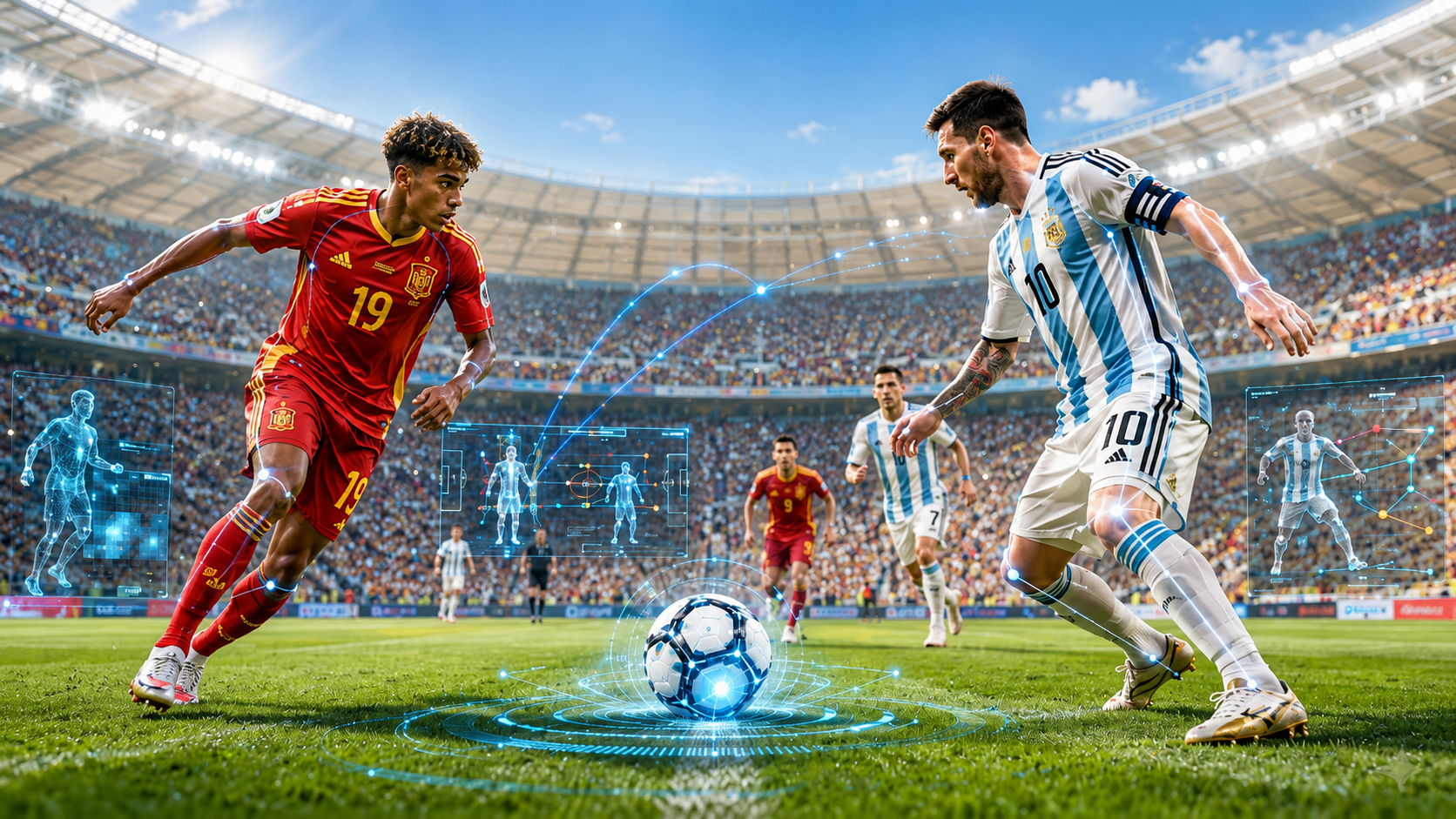
Before Spain and Argentina meet for the championship Sunday, computers will simulate the final thousands of times, betting algorithms will keep adjusting the odds, and general-purpose AI systems will confidently explain why 39-year-old Lionel Messi – or Spanish teenager Lamine Yamal – will lift the trophy.
But forecasting is only the most conspicuous piece of the technology woven throughout this World Cup.
AI has helped national teams analyze opponents and search enormous collections of match data. Cameras have tracked the movement of players’ bodies, while a sensor inside the ball has measured contacts nearly impossible for the human eye to detect. Digitally scanned versions of more than 1,200 players have assisted with offside decisions, and AI has stabilized the dizzying footage produced by cameras attached to referees.
In other words, the tournament has featured smart balls, digital doubles, AI analysts, and enough tracking data to make an NFL coaching staff jealous. That said, as Colorado AI News reported in January, Bo Nix and the Denver Broncos are already pursuing some of the same advantages.
Behind it all, a largely invisible workforce has spent hours manually labeling passes, tackles, shots, and other events so machines can learn to interpret the game.
The results have been useful, impressive, and at times controversial. England’s 6–4 victory over France on Saturday supplied one more reminder that even extraordinary amounts of data cannot tame the game completely.
The machines size up Spain and Argentina
The latest simulations from Opta, a global sports data and analytics company, give Spain a 56.05% chance of lifting the World Cup trophy, to Argentina's 43.95%. (Let's just call it 56% to 44%, shall we?)
Notably, at least one other prominent model deserves an early victory lap. More than a month ago, Goldman Sachs' forecasting system predicted that Spain and Argentina would meet in the final, weighing factors including historical performance, scoring ability, recent momentum, and geography.
But "what AI predicts" depends heavily on what is being called AI.
On the one hand, a statistical forecasting model may incorporate team ratings, recent results, scoring patterns, player performance, and thousands of simulated outcomes. Its answer normally takes the form of a probability.
At the same time, a betting market combines the judgments and financial incentives of many participants, often with algorithms supporting the pricing and trading. It may offer useful information, but it is not simply an AI system expressing an opinion.
Ultimately, a general-purpose chatbot may be doing something closer to constructing an argument. It can gather facts and explain why Spain or Argentina should win without necessarily calculating a defensible probability. In other words, while a chatbot may sound like a seasoned analyst, that does not mean it has actually run the numbers.
Consider what happened before the semifinals: Opta gave France the highest chance of winning the tournament, at roughly 34%. Spain was second, at about 23%, followed closely by England and Argentina. Spain then beat France 2–0 and advanced to the final.
However, the result did not prove the model was broken. A 34% chance of winning also meant France had roughly a two-in-three chance of failing to become champion. The model was expressing uncertainty, even if headlines declaring that a "supercomputer picked France" made it sound more certain.
Conversational AI can create the opposite problem. A chatbot may name a winner and an exact score with greater confidence while revealing far less about how the answer was reached.
The model offering Spain a 56% chance may know more – and claim less — than the chatbot predicting a 2–1 victory.
An AI analyst for all 48 teams
Predictions represent only one part of AI's role at this World Cup.
FIFA and Lenovo gave all 48 national teams access to Football AI Pro, a generative and hybrid-AI assistant developed for coaches and match analysts.
The system allows analysts to ask questions about official match data through a conversational interface, search across thousands of soccer metrics, and generate reports without manually combing through every available statistic.
FIFA presented the tool partly as an effort to broaden access to sophisticated analysis. Wealthy federations can employ large staffs of data scientists and video analysts. Smaller countries frequently cannot.
The hope was that an AI assistant could narrow that gap. But giving every team access to the same tool – and, in this case, the same underlying data – does not give every team the same expertise, staffing, or ability to act on the results. The federations with the most sophisticated analytics departments may still be the ones best equipped to ask useful questions – and recognize which answers matter.
That should sound familiar outside sports. Giving every business access to the same AI model does not erase the advantages held by organizations with better information, stronger processes, and more experienced employees.
Can we talk about England?
England offered one of the clearest examples of how a well-resourced federation could put AI to work. The English Football Association partnered with Google Cloud and Google AI on opponent analysis, travel planning, video searches, and penalty preparation. Research into an opposing team's likely penalty takers that previously required several days could reportedly be compressed into hours.
And while England's semifinal loss to Argentina ended any chance of making that work the centerpiece of a story about the final, it still illustrates AI's expanding place in elite sports.
The technology did not replace the coach or take the penalty. It reduced the preparatory labor required before a human made the decision. And sometimes, of course, the human decision is precisely where things go wrong.
England’s AI-assisted preparation could identify patterns, retrieve footage, and accelerate opponent research. It could not stop coach Thomas Tuchel from retreating into a defensive formation while protecting a 1–0 semifinal lead – a choice that came under heavy criticism after Argentina scored twice late to win the match.
For all the data available to England’s staff, the machine did not choose the substitutions, determine how cautiously the team should play, or decide when protecting a lead had become surrendering control. Those calls still belonged to the highly scrutinized head human on the sideline.
The World Cup players' digital twins
Some of the tournament's most visible technology has assisted officials rather than coaches. For example, the World Cup's semi-automated offside system combines tracking cameras, connected-ball data, artificial intelligence, and three-dimensional player models. It helps identify both the precise instant the ball was played and the positions of the players' relevant body parts at that moment.
For this tournament, players were scanned to create more individualized digital avatars. The process captured body measurements in about one second per player, according to FIFA, replacing the more generic digital figures previously used in offside reconstructions.
In practical terms, the system can evaluate whether part of a player's shoulder, head, leg, or foot was beyond the final defender when a teammate played the ball.
The technology is called semi-automated because machines do not issue the final ruling independently. The system identifies the relevant moment and body positions, after which human officials review the result and apply the rules.
That distinction can be easy to miss when television viewers see a polished three-dimensional animation appear moments later. The reconstruction may look like a machine-rendered verdict, but people remain responsible for the decision.
The connected ball adds another layer. A sensor inside it can help establish the precise instant of contact and distinguish between touches that may look nearly identical on conventional replay footage.
At times, it has detected touches that viewers – and perhaps the players involved – did not realize had occurred.
When technology sees too much
That increased precision has produced one of the tournament's central controversies.
In Croatia's Round of 32 loss to Portugal, a late equalizer was disallowed after connected-ball technology detected an extraordinarily slight touch during the buildup. The decision was described by critics as an abuse of technology, even if the equipment had accurately registered the contact.
The larger argument is not simply that the system malfunctioned. Video review and sensor technology were introduced primarily as ways to correct consequential mistakes. Critics say they are increasingly being used to discover infractions that no on-field official – and few spectators – could realistically perceive.
The World Cup has featured repeated disputes involving red cards, penalties, disallowed goals, and lengthy reviews. FIFA's refereeing leadership has defended the systems and maintained that rules must be applied consistently regardless of how small or distant an infraction appears. Players, coaches, and supporters have questioned whether technological precision has expanded video review beyond its intended role.
The connected ball has also been used in the opposite direction. After Norway claimed that an English goal should have been disallowed because the ball struck an overhead camera cable, FIFA cited the ball's sensor data to argue that no contact occurred. In one case, the sensor found a touch humans largely missed. In another, it was offered as evidence that an apparent touch never happened.
The controversy raises a question extending well beyond soccer: When technology can detect something people cannot see, should every detected violation produce a consequence?
AI systems in businesses, courts, insurance companies, schools, and government agencies are increasingly able to identify anomalies and correlations that once would have gone unnoticed. Better detection, however, does not settle the policy questions that follow.
Which signals matter? What threshold should trigger action? How much context should a human decision-maker consider? When does technical consistency conflict with the underlying purpose of a rule?
In soccer, technology may establish that contact occurred. It cannot independently decide whether the rule was designed to punish that particular contact, whether the intervention improves the game, or whether a review system has expanded beyond its proper role.
The measurement may be precise. The judgment remains human.

AI is changing what television viewers see
Some AI systems have operated with far less controversy.
Referee-mounted cameras have given viewers a new perspective on the game, momentarily placing them at field level as players sprint, collide, challenge for the ball, and protest decisions.
There is an obvious problem: Referees do not move like camera operators. They run, pivot, accelerate, and rapidly turn their heads – none of which is recommended in introductory cinematography. Raw footage from a referee's camera can be so unstable that it becomes unpleasant or nearly impossible to watch.
FIFA and Lenovo therefore developed an AI-assisted stabilization system to reduce visual jitter and make the referee's-eye footage suitable for broadcast. In fact, viewers may have watched those clips without realizing that AI was modifying the image between the field and the television screen.
That is a less dramatic but revealing example of the technology's role: AI is not deciding what happened, but it is cleaning up the visual information so people can use it.
The tournament's broader technology infrastructure has also supported 3D recreations, extensive real-time statistics, and operations spread across 16 host cities in three countries.
Not every use of AI has to be revolutionary to matter. Sometimes it simply makes useful information easier to see.
The invisible humans behind the World Cup's AI
As with most things AI, the machines depend on a great deal of human labor behind the scenes. The tech site 'Rest of World' reported that soccer's AI and data systems rely on workers who manually label the events taking place during matches. They identify passes, tackles, shots, and player movements, turning video into the structured information used by analytics companies, broadcasters, betting operations, and teams.
Many of these workers are based in countries such as the Philippines, India, Egypt, and Ukraine. Some are soccer players themselves or otherwise possess deep knowledge of the sport. One annotator may spend three or four hours processing a single match.
And while their work helps teach computers what the game's movements mean, it complicates the idea of a fully automated, AI-powered World Cup. Behind systems capable of producing nearly instantaneous analysis sits a global workforce performing slow, detailed, and typically invisible labor.
Again, this pattern is hardly unique to soccer. Many AI products that appear automated depend on people who label training data, review outputs, correct mistakes, and handle the ambiguous cases machines cannot resolve.
At the World Cup, spectators see the result as an elegant visualization or instant statistic, but they rarely see the workers who made the underlying data legible to the machine.
The model favored France. England scored six.
Before Sunday’s final, the forecasting models received one highly entertaining reality check.
A model cited here Friday favored France and identified a 2–1 French victory as its likeliest score. Instead, England won 6–4 in a match that bore very little resemblance to the forecast.
The miss does not invalidate probabilistic forecasting. Favoring one team is not the same as declaring the result certain, and exact-score predictions are shakier still. But the game demonstrated almost every complication that made it difficult to model: changed lineups, uneven motivation, emotional recovery from semifinal defeats, and the unusual freedom of a match neither team had hoped to play.
Before the game, England manager Thomas Tuchel said that none of his players – or France’s – wanted to be there. They wanted the final, not the consolation game. Once play began, however, the two teams produced ten goals.
Tuchel had spent the days after England’s semifinal defeat being criticized for retreating into a defensive shell while protecting a lead. On Saturday, his team scored six. Soccer does enjoy complicating a tidy narrative.
The result does not tell us that models are useless. It tells us that a forecast is not a promise – and that asking for an exact score is where forecasting begins to shade into theater.
The model missed third place, but its larger lesson held up rather well: Data can narrow uncertainty, but it cannot tame the peculiar human chemistry of a soccer match.
So who wins the World Cup?
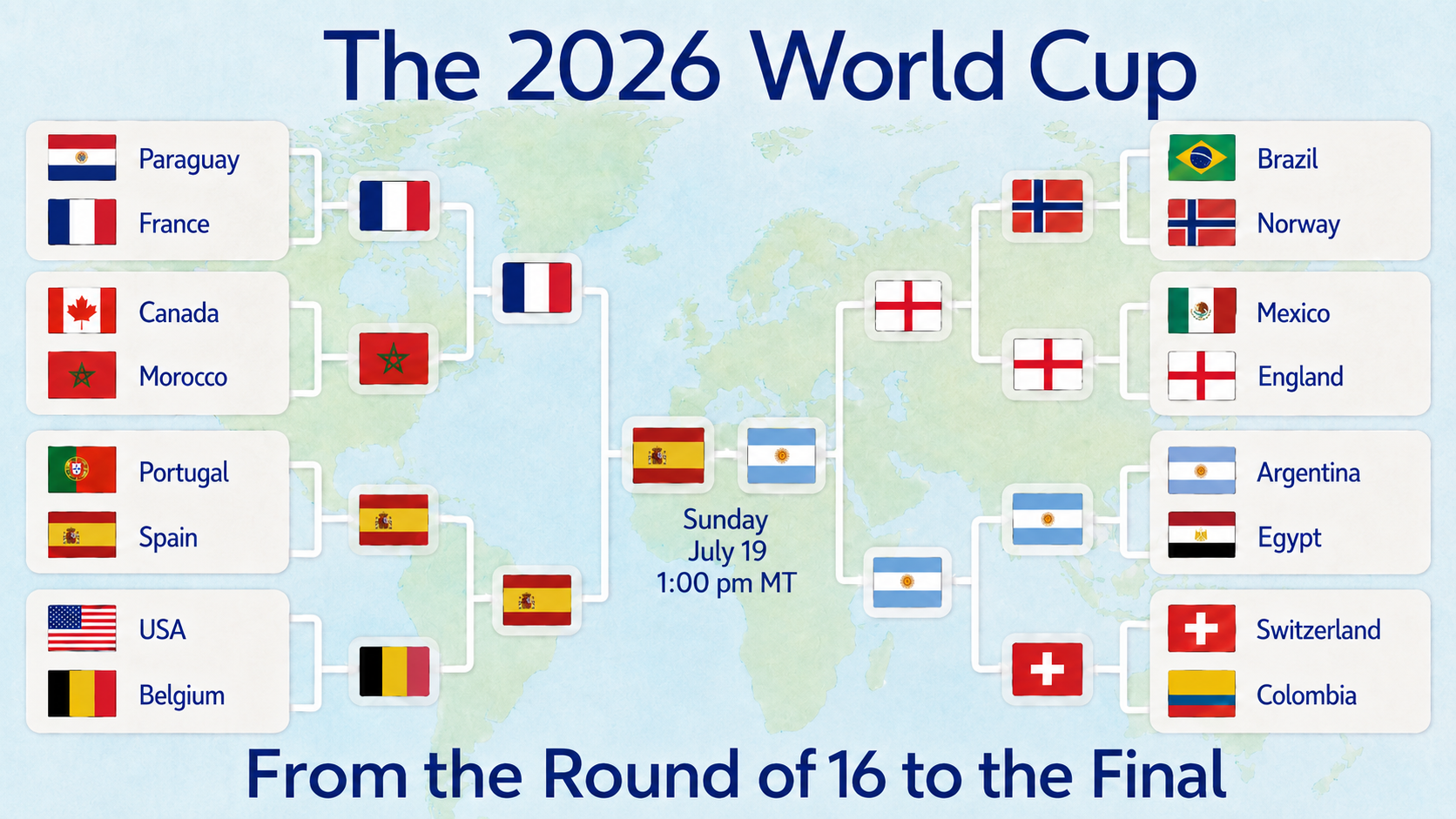
After Saturday’s 10-goal reminder of soccer’s resistance to tidy forecasting, Sunday’s final offers an unusually clear contrast: Argentina has scored more goals than any other team in the tournament, while Spain has conceded fewer than any other. Argentina has won every game it has played; Spain has gone 37 matches without losing. This feels like the classic case of the unstoppable force meeting the immovable object.
Spain does carry two minor fitness concerns. Yamal and right back Pedro Porro trained separately from the team on Thursday – bruising and soreness for Yamal, a hamstring strain for Porro – though the Spanish federation called the sessions precautionary and expects both available Sunday.
Spain's case: It controls matches through possession, positioning, and pressure, and it shut down France's attack entirely in the semifinal. Argentina's case: The tournament's most productive offense, a team that keeps finding ways to win, and Messi, whose influence at 39 extends past goals and assists – his position alone can shift where defenders stand and where space opens for his teammates.
Passing networks and expected threat go a long way toward explaining Messi's value. They stop short of the split second – the read a great defender makes under panic, or the gap Messi sees a beat before anyone else does.
Opta's 56%-44% split captures the shape of it: a narrow advantage, not a prediction of inevitability. In other words, in nearly 44 of every 100 simulations, Spain does not win.
That may be the most important World Cup lesson AI can offer. The technology can track every touch, reconstruct every player, analyze millions of data points, and simulate the final thousands of times. It can reduce uncertainty, but it cannot remove it.
The model-informed pick remains Spain to lift the trophy. For those demanding an exact score, Spain 1, Argentina 0—though Saturday’s 6–4 result offered a timely reminder of where exact-score forecasting can lead.
By Sunday evening, we will know whether the models identified the champion after missing third place.
We still will not know from one result alone whether they understood the game.