So, we’ve been in the ocean. With sharks. We’ve been above tree line when the trail markers disappear and you navigate by skyline and instinct. We’re headed for the stars inevitably, but let’s take another adventure to the ocean to talk about arguably the most interesting creature on Earth.
I fell down a serious quantum physics rabbit hole last week, and when I surfaced thinking about octopuses, I wasn't surprised. Just pulling on the thread because why not.
Turns out, the thread goes somewhere worth following. Because the answers to the questions we're all asking about AI, about intelligence, about what makes us irreplaceable, about what we're actually building aren't in front of us waiting to be discovered. They're already here.
A quick trip to the edge of physics
Bear with me for 60 seconds.
Quantum mechanics has a concept called superposition. A particle doesn't have a definite state until it's measured (until it interacts with something else). Before that moment, it holds multiple possibilities simultaneously. Not "we don't know which one." Actually, genuinely, both. The universe, at its most fundamental level, is not binary. It is not this-or-that. It is a web of probabilities, of relationships, of states that only resolve into something definite through interaction.
When two particles become entangled, locked in a relationship, they can no longer be understood separately. They are, from that point forward, one system spread across space. Measuring one instantly defines the other, not because of a signal passing between them, but because they were never truly two things to begin with.
The universe's most basic operating principle is not either/or. It's both/and.
So, now...onto octopuses.
The alien in the ocean
Octopuses are the closest thing to an alien intelligence we have on Earth. The last common ancestor between you and an octopus is a flat worm with no brain, no face, no centralized anything. Whatever intelligence is, however it arises, octopuses found it from an entirely different evolutionary direction than we did. A completely separate experiment, run by nature, that arrived at something that looks remarkably like mind.
And here's what that mind looks like.
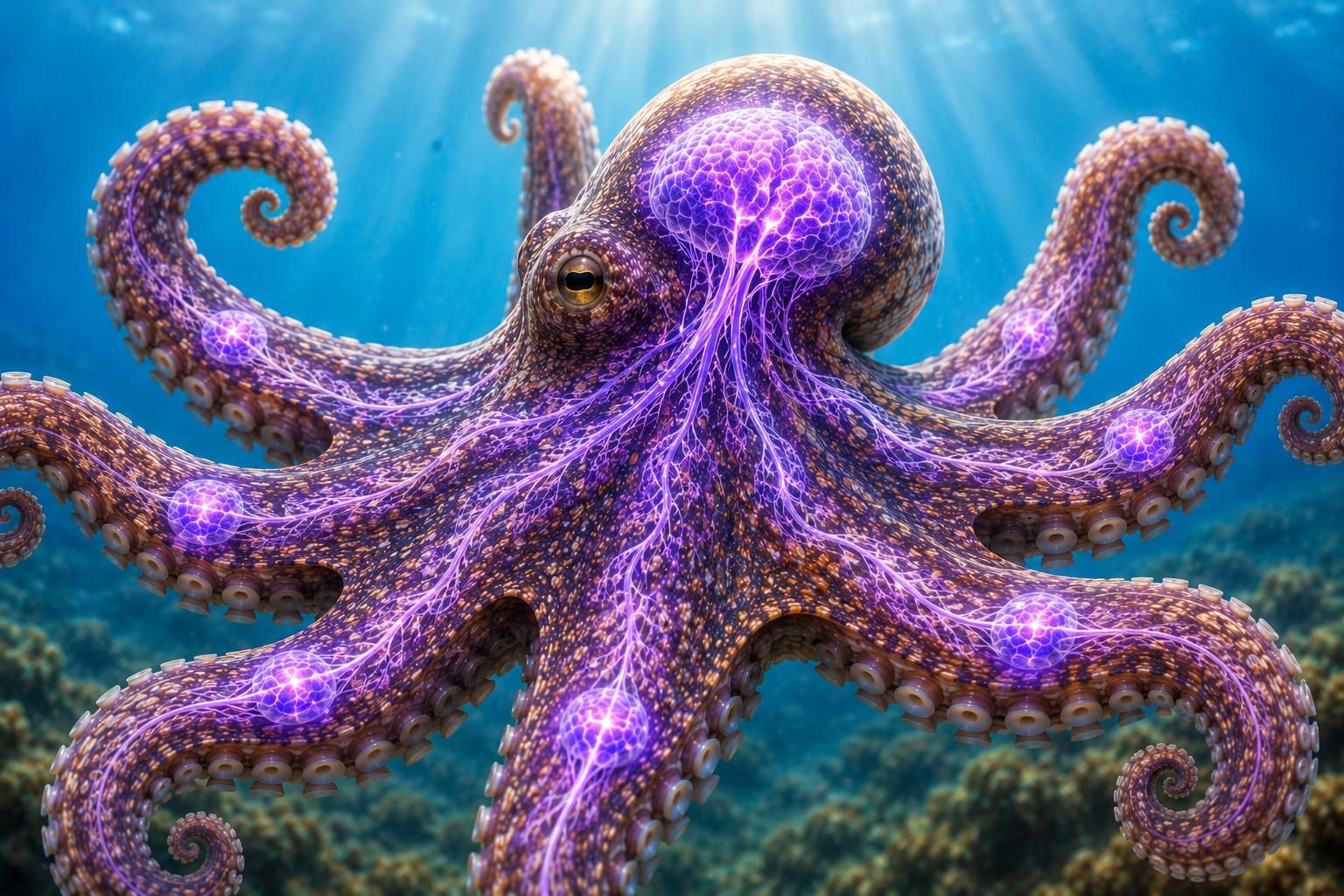
An octopus has nine brains. One central brain, and one in each arm. The arms make decisions independently, without waiting for approval from HQ. When an octopus reaches into a crevice to feel for prey, the arm is doing its own sensing, its own problem-solving, its own navigation and the central brain often doesn't know what the arm found until it's already acted on it. Intelligence, distributed. No command and control. Just a network of nodes in constant, simultaneous negotiation with their environment.
They edit their own RNA in real time. When water temperature changes, octopuses don't wait for evolution to catch up over thousands of generations. They rewrite their own neural proteins on the fly, recalibrating how their nervous systems work to match new conditions. Running live software patches on themselves. No other complex animal does this at scale.
Most astonishingly, they are almost certainly colorblind, yet they produce breathtaking color displays across their skin, a camouflage so precise it matches the texture and pattern of rock, sand, coral. The leading theory is that they perceive color through their skin. Their entire body surface functions as one giant, distributed sensor. Measurement isn't localized in their eyes. It's everywhere at once.
They are not a brain that has a body. They are a body that has become, somehow, entirely mind.
Now here is where we can connect particle physics to the ocean:
Neither the octopus nor the quantum universe operates on binary logic. Both hold multiple states simultaneously. Both are organized around relationship and interaction rather than centralized processing. Both feel alien because they are; they operate entirely outside the either/or logic that human cognition, and human-built AI, defaults to.
What humans built
Here is the architecture underneath every AI system you've used: a central model. Inputs flow in, processing happens in one place, an output flows out. Everything converges to a single prediction. One answer. The most probable next token. Binary logic, stacked and compounded into something extraordinarily complex — BUT still binary, all the way down.
It is an architecture that would be completely alien to an octopus.
The octopus arm doesn't hallucinate. It is too entangled with its actual physical environment, receiving continuous real-time feedback from nine simultaneous intelligences, to decide if a rock isn't there. The arm knows what it knows because it is in direct, embodied, ongoing relationship with the thing it's touching. There is no gap between sensing and knowing. The interaction is the intelligence.
Our language models know what they know because they were trained on records of what humans said about things. That's a fundamentally different relationship with reality. And it produces fundamentally different failure modes, including, but not limited to, the tendency to generate confident, fluent, plausible-sounding answers that have no grounding in anything real.
This is not a criticism of the technology. It's a design observation. We built what we knew how to build. We built it in our own cognitive image: centralized, sequential, binary. We built it to mimic the way we describe thinking, not necessarily the way thinking actually happens.
The intelligence in the collision
Think about the best conversation you've ever had. The one where an idea walked into the room that belonged to neither person alone. Where you couldn't reconstruct afterward who said what first, because the thinking happened in the space between you.
That's not information transfer! That's entanglement.
It doesn't proceed from input to output. It doesn't have a single answer. It holds multiple perspectives simultaneously and something emerges from the collision that neither person could have arrived at alone.
This is the intelligence you practice every time you trust your gut, read a room, or sit in the discomfort of not-knowing long enough for wisdom to arrive. It is non-linear. Relational. Distributed. Simultaneous.
It is structured exactly like an octopus. Exactly like a quantum system.
The good news...you are not behind!
In our last two columns, we talked about the pull of AI, the slot machine dopamine of the endless prompt, the cognitive muscle we risk losing when we outsource the hard thinking. That was the diagnosis and the training regimen.
This is the deeper thing underneath both of them.
The reason it matters so much to stay inside your own cognitive process – to be the author of your thinking rather than a passenger in someone else's – is not just about preserving a skill. It's about preserving access to a kind of intelligence that centralized binary systems cannot replicate. The intelligence of your body in a room. Your nervous system reading 10,000 signals at once and arriving somewhere you can't fully explain. Your arm in the crevice. Already, inexplicably knowing.
We have spent the last several years in a particular kind of anxiety about AI. Whether it's coming for our jobs, our children's futures, our sense of purpose. Whether we're smart enough, fast enough, necessary enough. Whether the thing we've built is going to turn around and tell us we were never as remarkable as we thought.
Here is what the octopus says to that, and here is what the quantum universe says to that:
The pattern of intelligence you embody — relational, distributed, simultaneous, non-binary — is not a lesser version of what the machines do. It is a different kind of intelligence entirely. One that nature arrived at through a completely separate evolutionary experiment. One that the universe demonstrates at its most fundamental scale. One that has been here, working, for 300 million years.
You are not behind. You are not being replaced. You are not a slow, buggy version of something that will soon be obsolete.
You are, in fact, the alien intelligence. You just forgot to look at yourself that way.
What’s worth building
If I could whisper one thing into the ear of every AI researcher right now, it would be this: Spend time with octopuses.
Not metaphorically. Study the actual architecture. Nine brains in constant negotiation. Arms that know without asking. Intelligence so distributed and embodied and relational that it renders the central-model paradigm almost quaint.
We might spend less time scaling the current architecture and more time asking what a nine-brained alien in the ocean figured out about intelligence that we haven't built yet. What a quantum system figured out about holding multiple states simultaneously that our binary models can't do. What you figured out, in 10 years of community building or 20 years of parenting or 30 years of trusting your gut in rooms full of people, that no training run has learned.
The answers were never ahead of us. They were in the ocean. They were in the physics. They were in the conversation you had last Tuesday that you haven't stopped thinking about. Nature already ran the experiment. We just have to choose to be curious and connected. And don’t skip leg day or your next Meetup.