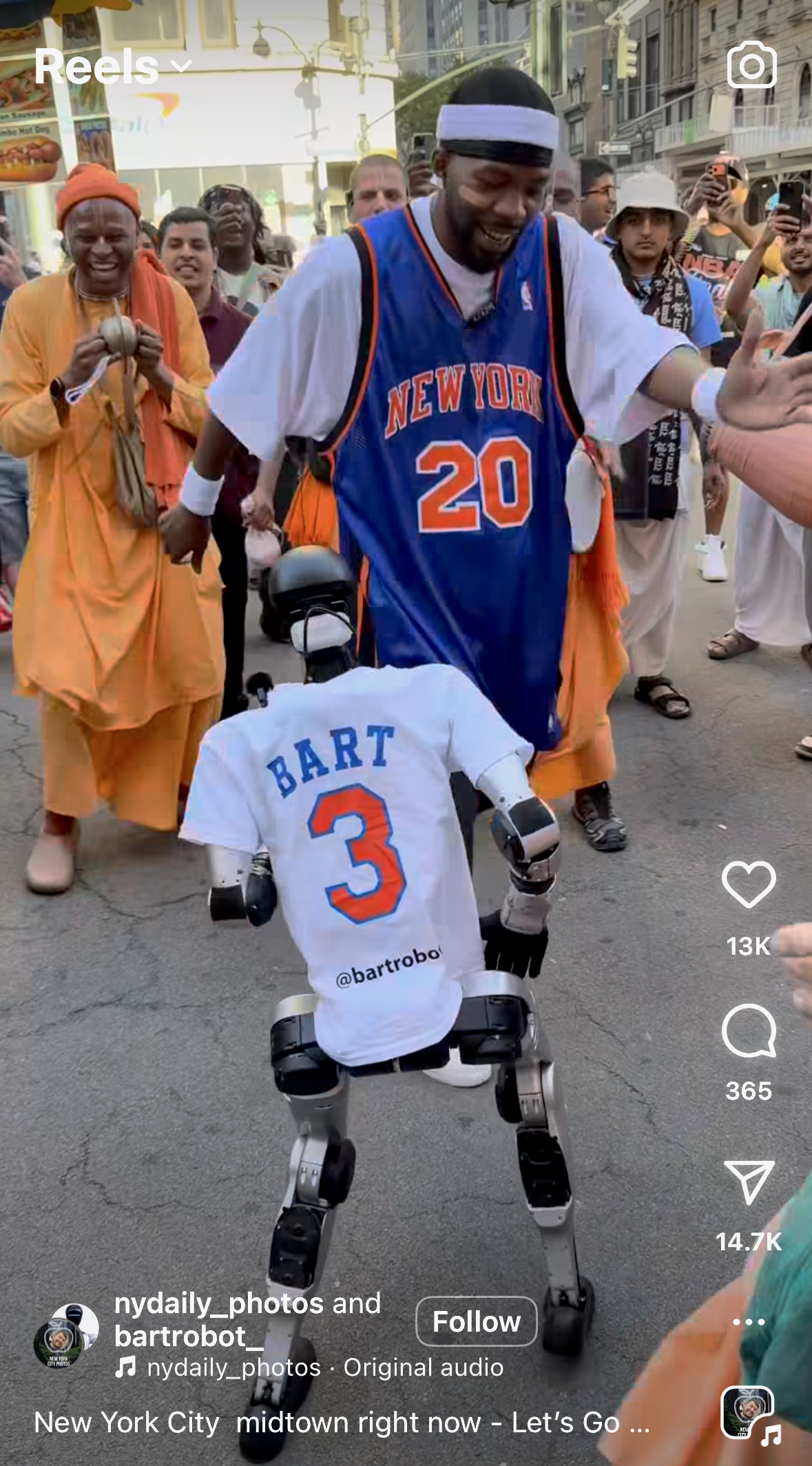
For the last few weeks, an unusual Knicks fan has been turning New York City sidewalks into dance floors.
Bart, a child-sized humanoid robot, has appeared outside Madison Square Garden and on crowded street corners as New Yorkers celebrated the Knicks’ postseason run. Videos show him shuffling, waving his arms, bouncing to the music, and occasionally looking as if he might topple over before recovering his balance.
The people around him appear delighted. They clap, dance, and hold up their phones. Children move closer. Adults – who have presumably seen almost everything New York City has to offer – grin at the little blue-and-gray machine performing in their midst.
Several Instagram posts showing Bart dancing among Knicks fans have attracted tens of thousands of likes, an extraordinary response for a robot whose public career appears to be only a few months old. Those numbers have extended Bart’s reach well beyond New York, but the videos themselves reveal something the 'likes' cannot: people gathering around him, laughing, dancing, and briefly treating a machine as another member of the celebration.
All this makes Bart a fitting choice for Colorado AI News’ inaugural Robot of the Month.
Robots usually enter public discussion through weightier subjects: factory automation, military power, technological competition, elder care, and the unsettling prospect of machines taking over a growing number of human jobs.
Bart offers a glimpse of another route into daily life.
Humanoid robots may become socially familiar before they become broadly useful. For many people, their first encounters with robots may not happen in a laboratory, factory, or technology conference. These meet-and-greets may take place on a sidewalk with raucous music playing, and they may feature a dancing robot wearing a colorful T-shirt bearing his own name.
A robot with a personality
Bart’s website describes him as a “robot influencer” with interests spanning sports, music, fashion, cars, and entertainment. His online persona includes a birthday (March 17, 2026), a growing collection of public appearances, and even a Knicks-themed song called “Rise Up New York.”
His appeal appears to come partly from how little he resembles the all-capable and frighteningly methodical robots of science fiction.
Bart is no Terminator. He's unthreatening and his steps can be tentative. His arms sometimes swing with the stiff enthusiasm of a wedding guest who has only recently discovered the dance floor. But these limitations may be part of his charm. He doesn't arrive promising to outperform anyone. He joins a celebration already underway and gives people another reason to participate. His customized shirt and carefully constructed personality help turn the machine into Bart: a mascot, a performer, and a shared focal point for strangers who might otherwise walk past one another.
There may be a lesson in that for the larger robotics industry: People will form impressions of humanoid robots through experiences, not spec sheets. A machine that makes someone smile, dance, or call a friend over to watch may shape public attitudes in ways that a technically superior robot demonstrated inside a laboratory cannot.
How much AI is inside Bart?
Bart appears to be a Unitree G1, a commercially available humanoid robot made by the Chinese company Unitree Robotics. His size, body design, and distinctive head closely match the model shown on Unitree’s website.
The G1 is an AI-assisted humanoid platform. Unitree says it uses imitation learning and reinforcement learning, along with onboard cameras and lidar, to support increasingly sophisticated movement and perception. What remains unclear is how Bart’s street performances are directed. The G1 can also be operated remotely, so Bart’s dancing may involve a human controller, preprogrammed routines, AI-assisted movement, or some combination of the three.
That does not make Bart any less of an AI-era robot. It simply means that his apparent personality and physical performance should not be confused with full autonomy.
Most importantly for our purposes, the people gathering around Bart don't appear terribly concerned about that distinction. They are responding to what Bart does, how he moves, and the personality his creators have given him.
The company behind the robot
Unitree Robotics was founded in 2016 by engineer Wang Xingxing in Hangzhou, China. The company first became known for its quadruped robots—the four-legged machines commonly described as robot dogs—and later expanded into humanoids.
Unitree’s importance to Bart’s story lies partly in its pricing. Humanoid robots have historically been experimental machines costing tens or hundreds of thousands of dollars. Unitree currently lists the standard G1 at $13,500, plus shipping, taxes, and import costs. Some U.S. sellers list it closer to $18,000.
So, while 13k is hardly inexpensive, it's a remarkably low entry price in the humanoid-robot market. Which means that a machine that once might have belonged only to a well-funded laboratory can now be purchased for roughly the price of a modest used car and turned into a research platform, performer, promotional character, or social-media personality.
That approach has helped make Unitree one of the industry’s most closely watched companies. It sold approximately 5,500 humanoid robots in 2025, according to Reuters, making it the world’s largest humanoid manufacturer by sales last year. The company is also preparing for an IPO on the Shanghai Stock Exchange that could value it at more than $6 billion. (And yet – all is not rosy at Unitree, which the Reuters story makes abundantly clear. That, however, is a story for another time.)
Looking ahead, Unitree and its competitors envision humanoid robots working in factories, performing dangerous jobs, assisting in homes, and perhaps caring for older adults. Bart’s current assignment is considerably less ambitious. He dances, poses for videos, and gives people another reason to gather.
Before robots become commonplace
Yet scenes like these may tell us something about how robots will move from technical curiosities into ordinary culture.
For many people, that transition may begin before a humanoid ever helps them at work or completes a task in their home. It may begin with a machine that looks slightly awkward, wears a fun T-shirt, and becomes part of a shared human moment.
When humanoid robots become commonplace, people may struggle to remember when seeing one in public still felt extraordinary. For a few weeks in 2026 on the streets of New York City, it did.