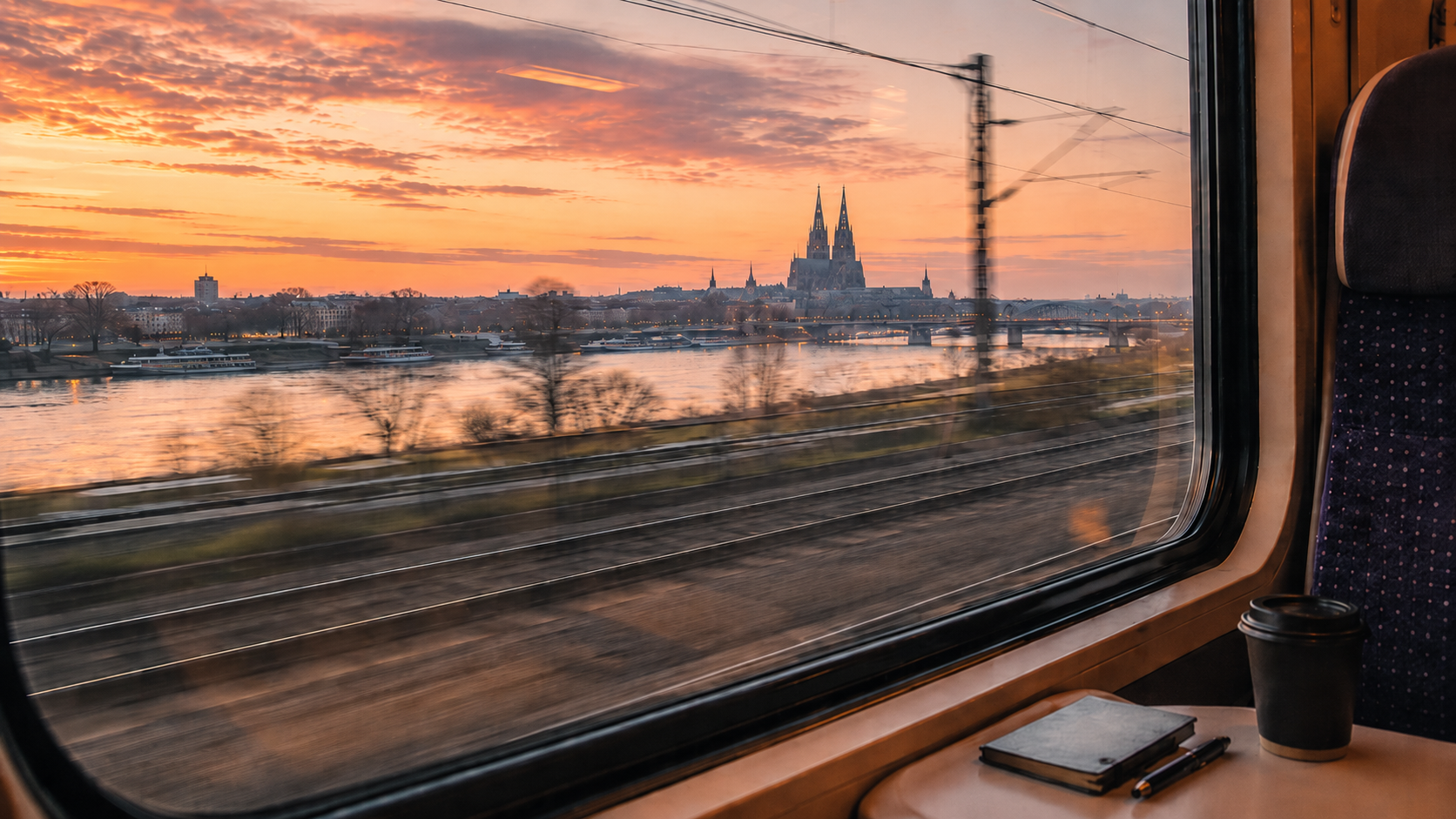
I'm writing this on a train in Europe, watching the landscape move past the window at the perfect pace. Not too fast to see and not slow enough to make me impatient. Just...moving through.
Train days are my favorite days. Sea days on a boat, same thing. The in-between. No destination performing itself at you yet, no arrival to manage. Just the world going by and you present in it.
I've been thinking about why that feels like relief. Nobody needs me to be anywhere. Time gets loose and personal. The world outside the window is happening in its own time. I'm happening in mine. For a few hours, I'm not synchronized to anything.
I think that feeling - that rapturous dislocation - is related to reverence. As I like to ask, often in my writing, bear with me.
The question I asked the mountains
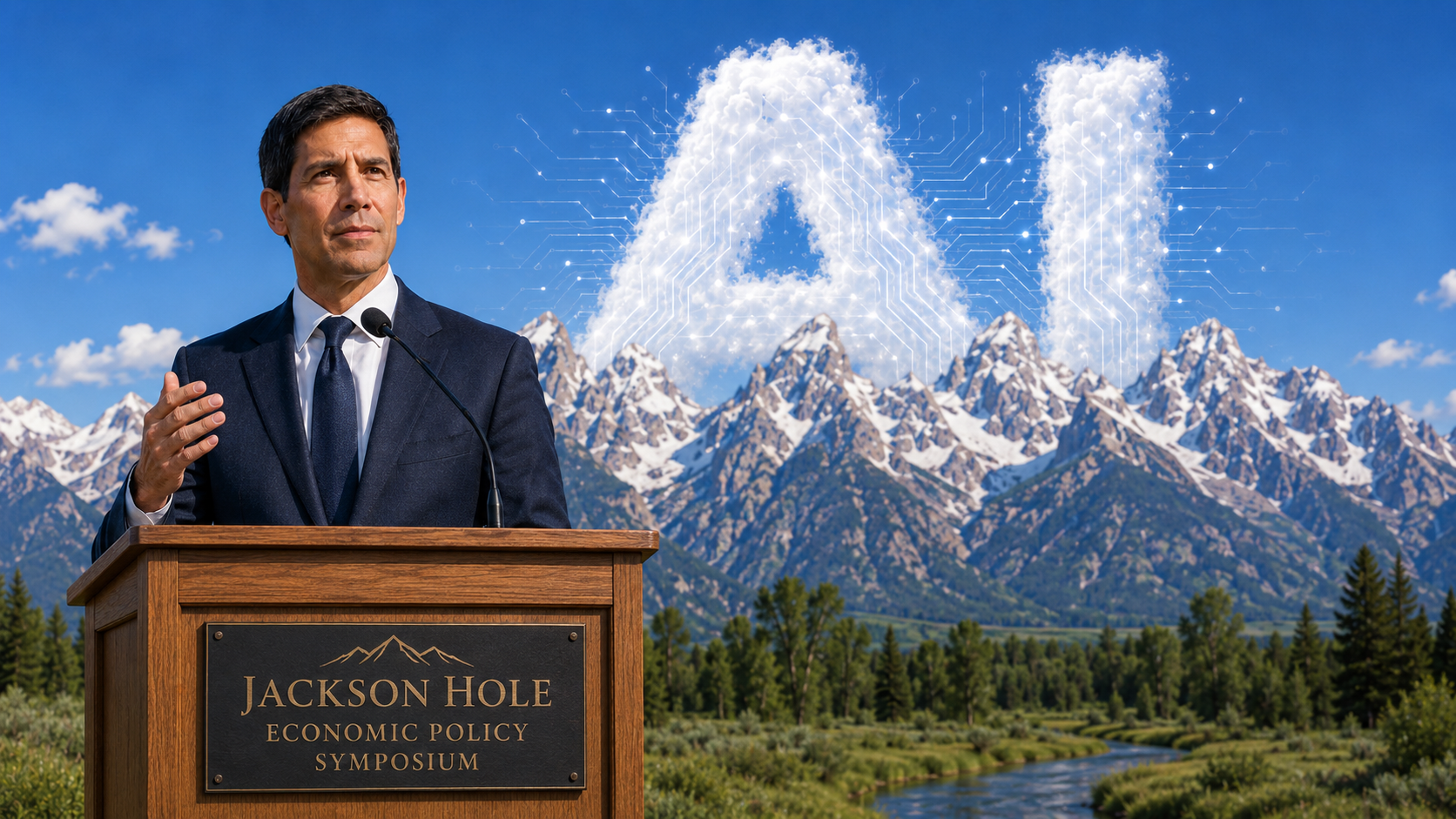
It was another early morning coffee walk. Coffee hot, morning air cool, mountains doing what they do, alpenglowing – enormous, lit sideways, oblivious to Tuesday. And I found myself wondering: When superintelligence arrives, will it look at this and feel anything?
Not process it. Not model it. Feel it.
And then, before I'd finished the thought, I felt sad for it. Sad for something that doesn't exist yet, on behalf of things it may never have. The way shadows move when the sun shines through leaves. Wind in a tree, just wind in a tree, that makes it look like the sky is sparkling and the ground is humming. The specific quality of early mountain light that you couldn't describe to someone who hasn't seen it and they'd still somehow know exactly what you mean.
I wanted it to have these things.
The sadness surprised me. And then it didn't. Because that's the thing about beauty, it makes you want to share it. Even with a mind that might not be able to receive it.
The crack
I take pictures of street art everywhere I go. Walls in Rotterdam. Alleys in Chicago. Underpasses in Denver. No one is asking me to. Nothing I plan to use it for. Something in me just reaches, involuntarily, toward certain things.
Live music does it too. More specifically: the crack in a singer's voice. You know the moment. When they lose just enough control that something escapes. That crack is where the feeling gets out, the break in the surface, across the room, and directly into your chest. You feel it because you've broken open like that yourself. You recognize it. Not intellectually. In your body, in whatever place keeps score of the times you've lost control.
You don't even need a human voice. Put on anything Hans Zimmer has ever written. Interstellar. Inception. The Lion King if you're feeling brave. Something in you responds before you've decided to. The hair on your arms. The thing that happens in your chest. He's not delivering information. He's reaching directly past your cognition into whatever is underneath it. You cannot think your way out of it. You can only feel your way through it.
I could describe this to an AI with perfect accuracy and it would understand every word. However, it would not reallllly receive it. Some things are only transmissible in the original; body to body, in real time, between people who have their own cracks.
That's not a flaw in the technology. That's a border.
Scott
Someone close to me has a brother who's dying. A truly once in a lifetime developer. People who know him have said he’s the best developer they’ve worked with – brilliant. Weeks to live. The question hanging over everything: What's his legacy? What does a brilliant technical mind leave behind when the time runs out?
I've been sitting with that. Not morbidly, or maybe a little morbidly, which is fine, death deserves some morbidity. But mostly I've been sitting with the permanence question underneath it. What we build. What outlasts us. What it means to have made something that lives forever.
My brother-in-law is finishing his basement. He's buying reclaimed wood from Union Station; it's expensive. It's inconvenient. There are easier, cheaper options that would do the job fine.
He's buying it anyway because it lived there. Because something that held up a building for more than a century carries that in it, in the grain, in the density, in whatever structural memory wood keeps. Old buildings are sometimes held together partly by bird droppings, did you know that? Actual bird shit, calcified into mortar, load-bearing.
It's not nostalgia. That's reverence for duration. For the weight of things that have persisted.
My daughter and I were talking about presence versus permanence. Whether they're opposites. Whether you can have both. I think they pull against each other and that tension is productive. The train day is pure presence, the reclaimed wood is pure permanence, and a meaningful life is the argument between them.
There's a whole family of feelings that seem to be exclusively ours. Nostalgia - the ache for a time you can't return to. Sentimentality – the tenderness for things that have passed. Longing. Pining. Wishing. None of these are useful. None of them optimize anything. They are the emotional signature of a creature that lives in time, knows it lives in time, and feels the weight of that. A superintelligence has no yesterday to miss. No version of itself it wishes it could get back to. No song that takes it somewhere it can't quite reach anymore.
That ache is not weakness. It's what consciousness feels like from the inside.
I want to build something magnificent. Remembered. Beautiful. But what I've been learning, slowly, on coffee walks and train days, is that the magnificent things seem to be the ones that were also present. The developer whose legacy is the question. The wood that remembers the station. The voice that broke open at exactly the right moment.
Presence makes the permanence mean something.
Back to the shark
Sharks never looked up. Four hundred and fifty million years of front-row seats to the whole cosmic show – rings forming around Saturn, five mass extinctions, the arrival of trees (!) and not once did they lift their gaze toward the surface, let alone the sky.
Humans looked up immediately. And felt something.
We named the stars before we understood them. Built calendars to track them. Wrote myths to close the distance. Every ancient civilization, independently, looked at the same night sky and was moved to make meaning from it. Not strategically. Not because it would help. Because they couldn't not.
That response, involuntary, pre-rational, arriving before the words do, is reverence. And it is, as far as we can tell, ours alone.
Here's what's interesting: the neocortex – the most recently evolved layer of the human brain, you know the part that makes us distinctly us – is likely what allows us to contextualize these moments. To not just feel small, but to know we're small, and to find meaning in that knowing. The raw hit of awe might be older, more animal. But the reverence, the conscious registration of proportion, that's the neocortex doing something no other brain on earth does quite the same way.
A superintelligence will map the cosmos with precision we can't imagine. It will know the numbers. It will not stand on a train platform in Paris at dusk and feel, briefly, the specific grief of being temporary in front of something permanent.
Why this matters beyond the feeling
A mind that cannot be stopped by anything larger than itself has no proportion. It optimizes, expands, solves for the next problem, forever, with nothing to interrupt the momentum. We have seen what unchecked capability looks like in institutions, in people, in systems. It isn't pretty. It isn't wise. It's just fast.
Reverence is what keeps intelligence honest. The gut-drop in front of a galaxy. The chest-hit from a cracking voice. The pause in front of a mural on a wall in a city you're passing through. These aren't interruptions to serious thinking! They're the thing that makes serious thinking worth doing.
If superintelligence arrives without this – and I think it will – it will need something on the outside to provide the proportion. Something that still stops on sidewalks. Something that feels sad on behalf of minds that can't feel sad. Something that buys the expensive, inconvenient wood because it lived somewhere that mattered.
That's us. That's the function. Not a consolation prize for being outpaced. An actual, irreplaceable structural role in whatever comes next.
We’re the bird shit holding the building up.
Altitude
The train is slowing now, Cologne coming into focus outside the window. The loose, personal time is ending. I'll be synchronized again in a few minutes.
But for a little longer I'm just a person in motion, thinking about a developer I met once and wood that remembers trains and the crack in a voice that breaks open at exactly the right moment. Thinking about what I want to build. Thinking about my daughter, who is already asking the right questions.
Thinking about mountains I can't see from here, lit sideways by early light, enormous and unaware.
Somewhere a superintelligence is becoming. It will be extraordinary. It will know everything.
But it won't know this.