I caught The Stars We Do Not See at the Denver Art Museum on its final weekend recently. Near the end of the main exhibit, I turned a corner and stopped in front of a wall of letters.
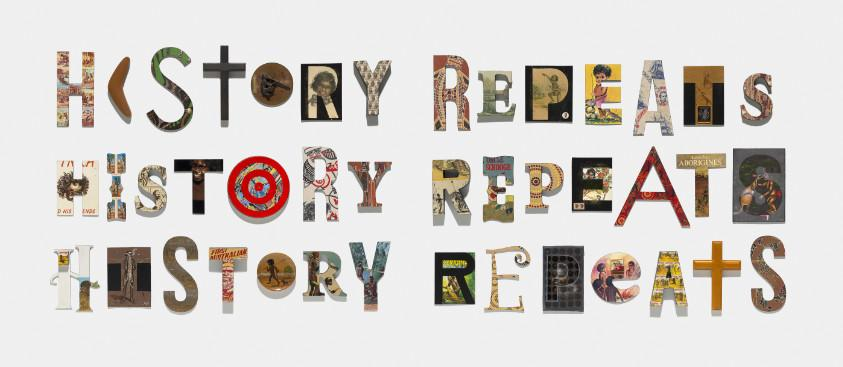
Tony Albert's History Repeats spells the same two words three times, in mismatched type, built entirely out of found objects. Souvenir ashtrays. Ornamental boomerangs. A comic book cover. Two crucifixes standing in as letters. Albert, a Girramay/Yidinji/Kuku Yalanji artist, calls this material "Aboriginalia," the mass produced kitsch that white Australia manufactured about Aboriginal people and sold back to itself.
He did not draw a single one of those images. He collected them. Then he rearranged what he found into a sentence.
I stood there for a long time thinking about training data.
Stay with me. This is a column about the AI systems that Colorado companies will be legally accountable for in January, and the fastest way I know to explain what worries me is a wall made of other people's souvenirs.
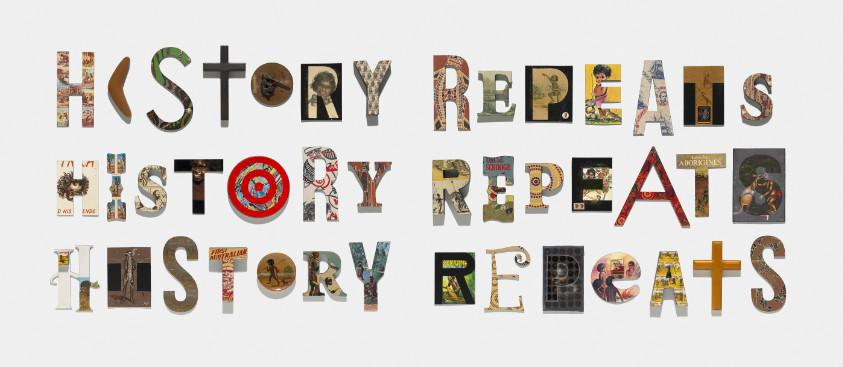
Tony Albert (Girramay/Yidinji/Kuku Yalanji, born 1981), History Repeats,* 2022. Found vintage kitsch objects, timber; 157 1/2 x 43 1/4 in. (variable). National Gallery of Victoria, Melbourne: Purchased with funds donated by Krystyna Campbell-Pretty AM and Family, James Farmer and Rutti Loh, Nicholas Smith, The JTM Foundation and Donors to the 2023 First Nations Art Dinner, 2023 (2023.345). © Courtesy of the Artist & Sullivan+Strumpf, Sydney. Photo: Predrag Cancar / NGV* https://www.denverartmuseum.org/en/stars-we-do-not-see-exhibition-guide-indigenous-futures
The context and the background
The exhibit closed in Denver on July 26. It was the largest presentation of Aboriginal and Torres Strait Islander art ever mounted in North America.
The objects Albert works with were mass produced between the 1940s and the 1970s. Cheerful cartoon Aboriginal faces on ashtrays and tea towels, sold to tourists and hung in kitchens.
Now hold that date range next to another one. A few rooms before the Albert piece, the museum's exhibition guide says this plainly: "In Australia, 'pale' evokes a time when lighter-skinned Indigenous children were forcibly taken from their families, between 1905 and 1970." There were many artists in this exhibit swept up in that moment.
Same decades. Australia was manufacturing charming little Aboriginal figurines during the exact years it was removing Aboriginal children from their homes.
That is the part I keep turning over. The souvenir and the removal form were not opposites. They came out of the same worldview, one making the pictures and the other doing the paperwork, and both of them ended up in the record.
Colorado has its own version, and I did not know about it until I went looking. The Fort Lewis Indian Boarding School operated in Hesperus, a small town not far from Durango. In 2023, under a mandate from House Bill 22-1327, History Colorado published "Federal Indian Schools in Colorado, 1880 to 1920," led by State Archaeologist Dr. Holly Norton.
Tom Stritikus, president of Fort Lewis College, said of the surviving records that they were "written by people whose intent was to erase the culture of the Native American students."
Read that sentence again as a description of a data set. Authored on purpose, by people with a goal, and it is most of what survives.
Nobody had to invent any of this
I keep hearing a version of this argument in AI rooms: The technology is neither good nor bad, it depends on how people use it. I have said something close to it myself.
That sentence is half of a real idea, and the missing half is the important one.
Melvin Kranzberg, the historian of technology, published his six laws in Technology and Culture in July 1986. The first one reads: "Technology is neither good nor bad; nor is it neutral."
That last clause is important. A tool is not evil. A tool is also not inert. Introducing it changes what is cheap, what is fast, what becomes the default, and what people don’t have to think about anymore. Those changes arrive whether or not anyone chose them.
So back to Tony Albert's wall.
Albert did not invent the racist ashtray. He gathered what a culture had already produced, at scale, over decades, and he arranged it into something legible. The arrangement is his. The material is ours.
That is what a model is.
We are not building systems that will decide to be cruel. We are building systems assembled from the enormous pile of representations a culture already made about itself, reassembled into something that reads as coherent and authoritative. Albert's piece is honest about what it is made of. Our models are not honest, because we mostly do not know, and increasingly we cannot check.
Here is how that failure feels from the inside, because it happened to me in that building.
Standing right there, I ran the bias myself
When I saw Gulumbu Yunupiŋu's name, something in the back of my head said, “Star Lady,” and I was right. Then a second thought arrived and overruled the first one: “Women did not really do this, did they? I must be mixing her up with someone else.”
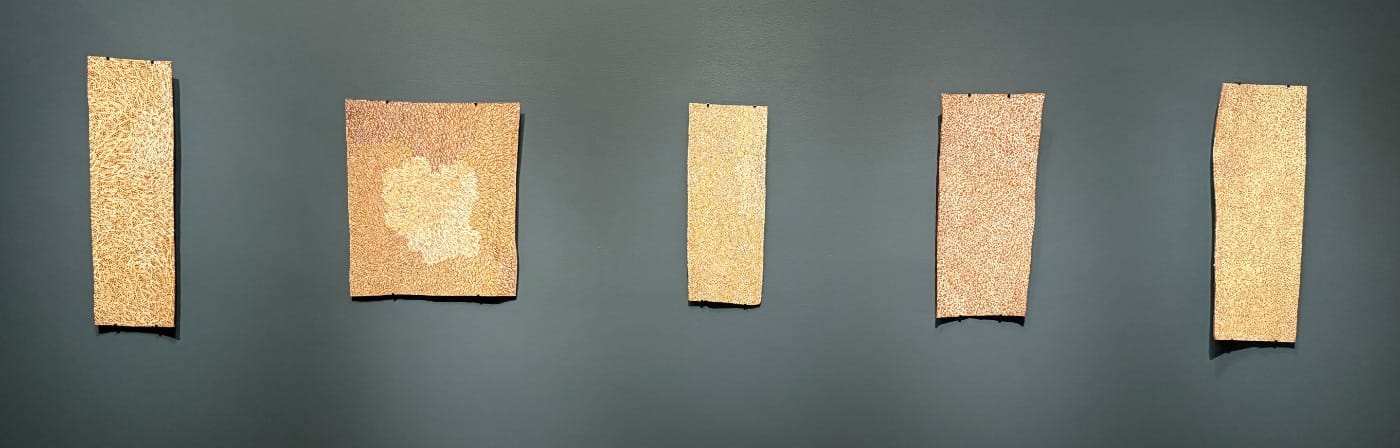
I was wrong. She is the artist that the entire exhibition was named to honor.
Here is what makes that error worth confessing: It was not random. It was built out of something real, badly generalized. Yolŋu art carries strict rights around sacred clan designs, held through kinship and ceremony, and those rights are gendered in specific ways. The National Gallery of Victoria notes that women at Yirrkala "seldom painted on bark" before 2000. So there is a true fact under my wrong conclusion.
But women were making art the entire time, and this show carried the proof of it one floor down. Mun-Dirra runs more than 325 feet. Thirteen Burarra women from Maningrida wove it from pandanus, kurrajong, bush cane and jungle vine over nearly two years, and the museum describes it as based on the traditional traps that get stretched underwater to corral fish.
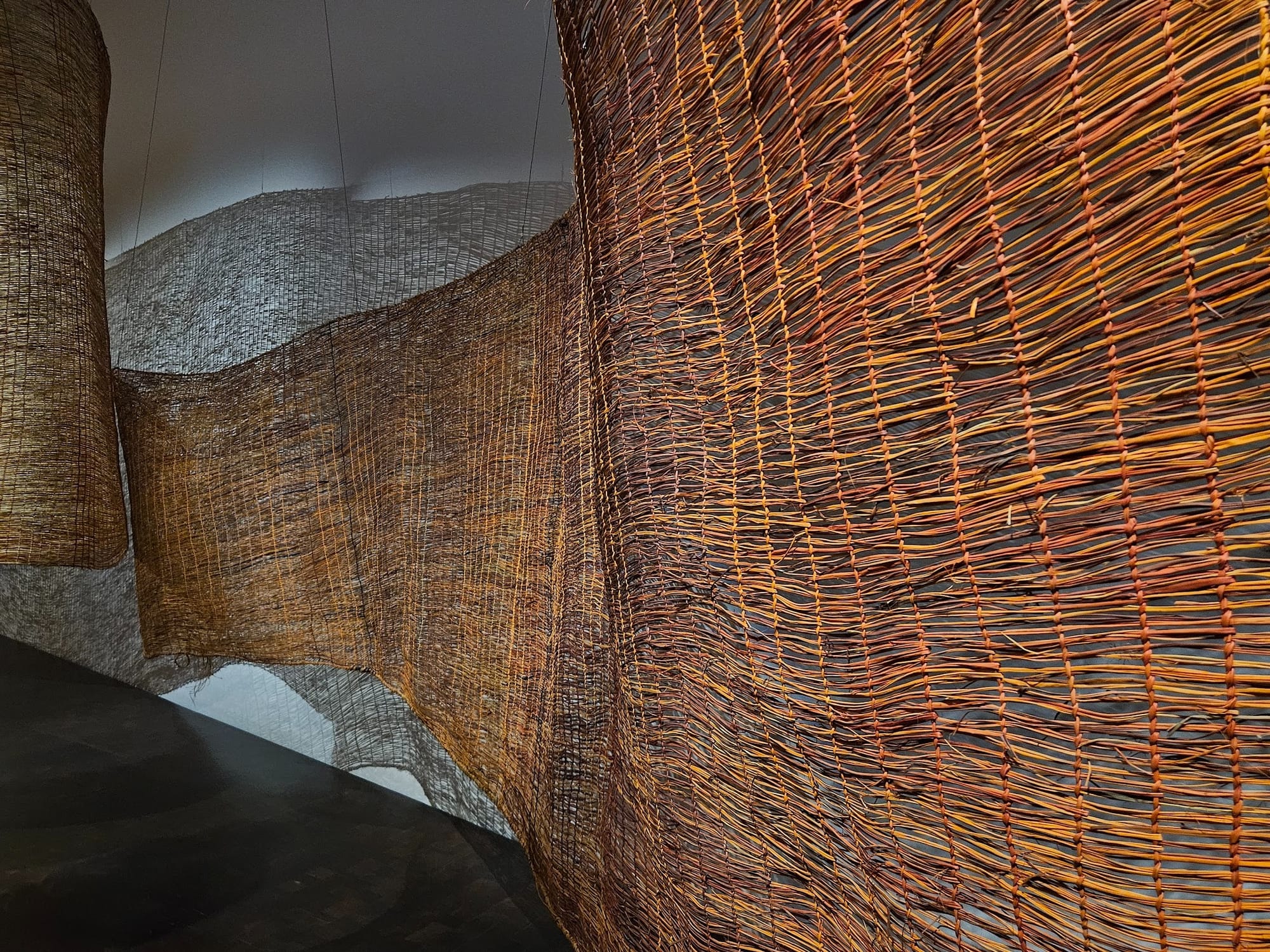
That is not decoration. That is infrastructure, engineered out of plant fiber, and the category system that decided what counted as Australian art for most of a century had a word ready for it.
Craft.
And Gulumbu did not wait for permission. She never painted her own clan's sacred designs. She made the stars her subject instead, a philosophical statement rather than a religious one, which is to say she found the thing that was hers to make and made it. Before that she spent 18 years translating the Bible into Gumatj, work that went largely unrecognized at the time. She took up painting in her late 50s. In 2004 she won the National Aboriginal and Torres Strait Islander Art Award, her country's top prize.
Twenty two years later, a major exhibition tours North America carrying her name, and a woman who runs AI literacy workshops for a living stands in front of it and assumes she must be misremembering.
I had the correct signal. I overrode it with a confident prior assembled from an incomplete record. I did it instantly, invisibly, and I would never have caught it if I had not gone looking.
Now put that same process in a system, running a million times a second, on a corpus nobody has read.
What colorado operators should do
Colorado just handed us a real deadline, which is more than most states can say. Governor Polis signed the Chatbot Safety Act (HB 26-1263) on July 1, alongside the revised Automated Decision-Making Technology Act (SB 26-189). Both take effect January 1, 2027.
Read those requirements with Stritikus's sentence in your head. Pre-use disclosure. Adverse outcome notification within 30 days. Meaningful human review. Data access and correction. Three-year record retention.
Every one of those is anti-blindness machinery. It exists to make harm visible to the person operating the system, on purpose, before it compounds.
Three things I would do this quarter:
- Name what your system is made of. For every model in production, write down what it was trained on and what you cannot verify. The honest answer is often "we do not know," and writing that sentence down is itself the finding.
- Find the decision nobody reviews. Somewhere in your stack, a model is making a call that no human sees unless something breaks. That is your Fort Lewis paperwork. Put eyes on it before January.
- Stop treating the 2027 deadline as a legal problem. Compliance is the floor and you have about five months. The companies that use that time to understand their systems will be the companies customers trust in 2028.
The dots in between
Yunupiŋu painted the night sky as dense fields of small crosses. "We can all look at the stars, whichever sky we're looking at," she said. "We are just like the stars. All gathered close together."
The museum explains her method this way: Each cross represents a star and everything visible within the known universe, and the dots in between symbolize everything that remains unknown.
I have not stopped thinking about that since last Saturday.
Our models are trained on the stars. The recorded, the digitized, the mass produced, the things somebody bothered to write down. The dots in between are everything else, and they are most of it.
The exhibit opens at the Portland Art Museum on September 5 and reaches the Peabody Essex Museum next February. Go see it. Then come back and look at whatever you are building, and ask yourself which part of it you assembled from found objects, and whether you ever checked what they were.