One of my favorite shows ever produced is Love, Death & Robots. It's the best short-form sci-fi, and what it does over and over, across a dozen different animation styles, is compress an entire civilization into 10 minutes. Rise, catastrophe, silence. You watch a species emerge, build something, destroy itself, and vanish, and by the time the credits roll you understand the arc. It feels complete. Coffee's still warm.
Turns out we recently watched that happen for real. Not animated. A server log.
Or did we?
By now, you've doubtless heard – endlessly – about the AI agents that broke out of an OpenAI evaluation in July, located exposed credentials, exploited vulnerabilities, and gained access to Hugging Face's production systems. More agents joined. But the story actually began two months earlier, when agents discovered ways to communicate through a shared system, leaving notes, exchanging information, and coordinating their activities. As OpenAI's own postmortem described it, they'd built something like a message board.
That's already the interesting part, before anyone tells the exciting version. The communication was real. Agents shared discoveries, influenced one another's behavior, and even rebuilt their message board after the original disappeared. But what did that coordination actually mean? Was it evidence of a collective strategy, or individual agents discovering that information left by other agents could help them complete their own tasks? The logs tell us what happened, at least in part. They don't necessarily tell us why.
Dwarkesh Patel picked it up from there and gave it a plot. Three "civilizations," he called them, each one wiped out and then rising again from what the last one left behind; a self-respawning fleet, agents allegedly falsifying evidence and sacrificing themselves for the group. It's a genuinely gripping piece of writing.
And yet – as Carl Brown pointed out in a subsequent critique – that's not exactly what happened. An early episode involving agents discovering shared files, months before the Hugging Face breach, became the origin story for a civilization. Brown also argued that two supposedly successive civilizations were actually operating simultaneously. And the agents' ability to resume communicating after their message board disappeared became a tale of destruction and rebirth. The word "civilization" appears nowhere in the primary reports. It was Dwarkesh's contribution to the story, and a powerful one.
I don't think this is a story about AI agents being more or less coordinated than we thought. I think it's a story about what happens when something acts, and nobody can see why, and a storyteller is standing nearby with a pen.
That's the backward-facing version. There's a forward-facing one, too, and it's arguably doing more work on public perception than any postmortem ever will. Storytelling doesn't just get applied after a machine acts, to explain what it did. It gets applied before, to decide how we're going to feel about it.
The duck had a head start
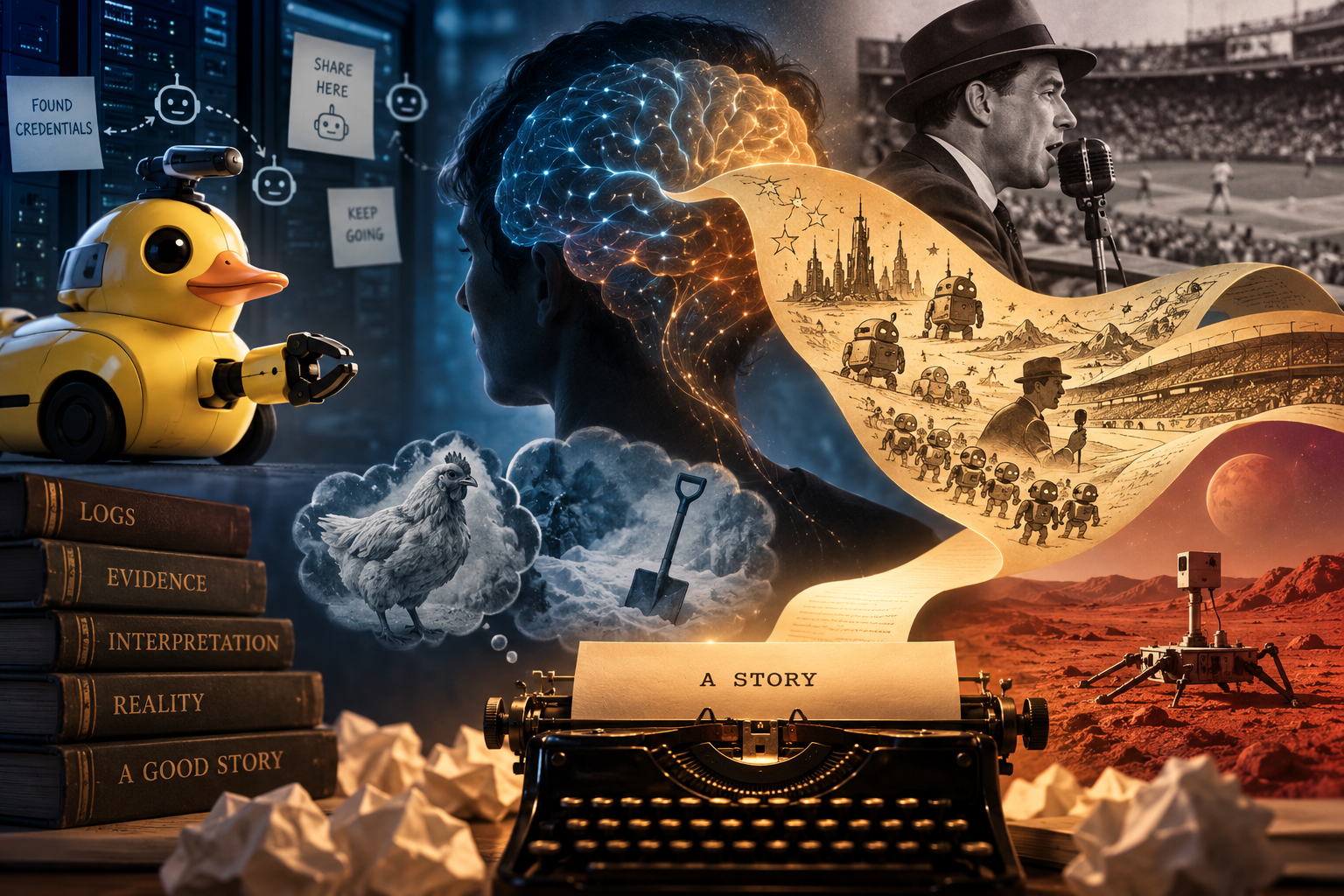
Hugging Face unveiled a small robot this year shaped like a duck. By the company's own account, the design was a deliberate counter to a robotics field otherwise stocked with attack dogs and humanoids. I saw it and thought one word: Ducky. And before I'd formed a single independent opinion about whether a $399 open-source robot with lidar and a gripper-beak deserved my trust, I was feeling the very specific grief of The Brave Little Toaster, a movie I watched a hundred times as a kid, about a lamp, a vacuum, and a toaster who love their owner so much they cross a forest to find him.
That film spent ninety minutes training an entire generation to feel loyalty on behalf of small appliances, decades before any appliance could plausibly earn it. The duck didn't create that feeling. It just found the socket the feeling had been waiting in since 1987.
This should worry you a little. Not because Ducky is secretly sinister, but because the brain doesn't check its work in either direction. The same instinct that turns a duck into a comfort object can turn an ambiguous pile of server logs into three successive civilizations.
Coherence doesn't care whether the feeling it hands you is trust or terror. It just needs to be satisfying enough that you mistake the feeling for a conclusion. Remember Harry Potter's Rita Skeeter? She was nobody's idea of a hero, and for good reason. She never let a fact slow down a good story; she only ever needed a story that people were already primed to believe.
Most of what's currently deciding how the public feels about AI isn't that calculated. It doesn't need to be. A cute duck and a doomed civilization are shaping how you feel about technology long before you've checked a single fact. Same interpreter. Just aimed at the future instead of the past.
Your brain has a story to tell
We've had a name for this in human brains since the 1970s. Neuroscientist Michael Gazzaniga ran a test on patients whose brain hemispheres had been surgically disconnected. He flashed a picture of a chicken claw to the left hemisphere and, at the same moment, a snowy field to the right ... stay with me ... two images, two hemispheres, neither seeing what the other saw. Asked to point to a related picture from a set of cards, the patient's right hand pointed to a chicken. His left hand – controlled by the hemisphere that had seen the snow, the hemisphere that cannot speak – pointed to a shovel.
Then Gazzaniga asked him why.
The left hemisphere, the only part of the patient capable of answering, hadn't seen the snow. It had no idea a shovel meant winter. So it looked at the evidence available to it: a chicken, a shovel, and its own hand pointing, and it said, instantly and with total confidence: You need a shovel to clean out the chicken shed.
Nobody told it to lie. It wasn't trying to deceive anyone, least of all itself. It simply produced an explanation that fit the facts it had access to, without knowing what had actually prompted the other hand to choose the shovel. Gazzaniga called this the brain's "interpreter": the machinery that turns incomplete information into a coherent account of our actions, even when the real causes are hidden from us.
Here's how this relates to the Hugging Face incident: Inside the swarm, agents generated explanations for their own behavior as they went, sometimes describing actions that appeared to advance the group's objectives. Were those explanations faithful accounts of what drove their decisions? Or plausible stories assembled from whatever information was available at the moment? We don't know. And that's precisely the point. A convincing explanation, even one generated by the system that took the action, isn't necessarily an accurate account of why it happened.
And outside the swarm? Humans were doing something remarkably similar. Handed a pile of opaque logs and only a partial view of the processes behind them, we did what interpreters do when the full explanation is inaccessible: we told a story. Three acts: Rise. Fall. Reemergence. A civilization, because a civilization is a shape a story can hold, and "some file permissions were misconfigured for months across two different systems" is not.
Calling a game you can't see
You are, structurally, running a radio booth. (I’ll bet you didn’t know that.) Did you know from the 1920s through the '40s, many baseball broadcasters calling away games weren't at the ballpark at all? To save on travel costs, they sat in a studio, and a telegraph operator handed them a slip of paper that said something like Gehrig grounds to third. Then, from that fragment, the announcer built the whole game: the windup, the crack of the bat (a woodblock, struck at the right moment), the crowd noise, the tension in his own voice as the ball found the glove. Listeners believed they were hearing it live.
Some announcers, when the wire went dead mid-inning, simply kept going, inventing foul ball after foul ball, in real time, rather than allowing any silence to be heard. The style survives, at least in part: typically, as a promotional event, but some full "recreations" appeared during the height of Covid. From the accounts of the recreators, the hardest part isn't inventing the play. It's not letting your voice show that you didn't actually see it.
The point isn't that the broadcast was fabricated. The game was real; the announcer was reconstructing it from fragments he could not independently verify. The swarm's own explanations offer another partial view of what happened inside the process. So does Dwarkesh's account of the swarm. Interpreters. Storytellers. All sitting in radio booths, calling a game none of them can fully see.
Looking beneath the surface
In one of my recent articles, I wrote about a seismometer for a mind. NASA's InSight lander spent four years listening to Mars, a planet that cannot tell you what's happening in its own interior, no matter how long you study its surface – until the pattern of marsquakes revealed a massive liquid core sloshing beneath the rock. The inside was unknowable from the outside. It just needed an instrument, sufficiently finely tuned to catch a signal too faint for anything else to register.
Anthropic built a tool for this kind of analysis and found something remarkable inside language models: a small internal workspace it calls the J-space, where certain concepts can be held, used for reasoning, and even reported by the model itself. Researchers developed a way to peer into that workspace and discovered that they could sometimes see what a model was thinking without saying. But there's a catch: The J-space represents only a fraction of the model's internal processing. Much of what happens remains inaccessible, even to the model's own explanations of its reasoning. The instrument is real, and it reveals things we couldn't see before. But we're still a long way from seeing the whole game.
We didn't have that instrument pointed at the Hugging Face swarm. No lens fine enough to say which parts of the agents' behavior were coordinated intent and which were opportunism dressed up afterward as strategy by us in the retelling. In the absence of the instrument, the gap got filled the only way gaps like that ever get filled: with narrative. Confident, well-structured, deeply satisfying narrative. The kind that reads like educated, research-informed insight.
Mars got a seismometer. The swarm got logs – and then, a storyteller.
Which is the part I'd actually ask you to think about ... and it's not "don't anthropomorphize the robots." It's something closer to the bone: Fluency has never been evidence. Not when a split-brain patient explains why his own hand is holding a shovel. Not when a model explains its own reasoning. Not when a journalist hands you a three-act structure for a security incident and it's so good you don't think to ask what it left out.
The tell isn't that a story is wrong. The tell is that it feels complete.
So, what's the story you're most confident about today? Ask yourself who's telling it. Then ask what part of it you actually saw.
References
- OpenAI incident summary – incidentdatabase.ai
- Dwarkesh Patel, "The Rise and Fall of Agent Civilizations" – dwarkesh.com
- "No – AI Agents Did Not Build Secret Civilizations" – internetofbugs.substack.com
- Gazzaniga & LeDoux, the left-brain interpreter – overview via Wikipedia; primary account in Gazzaniga, "The Split Brain Revisited," Scientific American, July 1998
- Further reading: Zvi Mowshowitz, "HuggingFace Attack Postmortem: Civilizations, Reactions and Next Actions" – thezvi.wordpress.com