
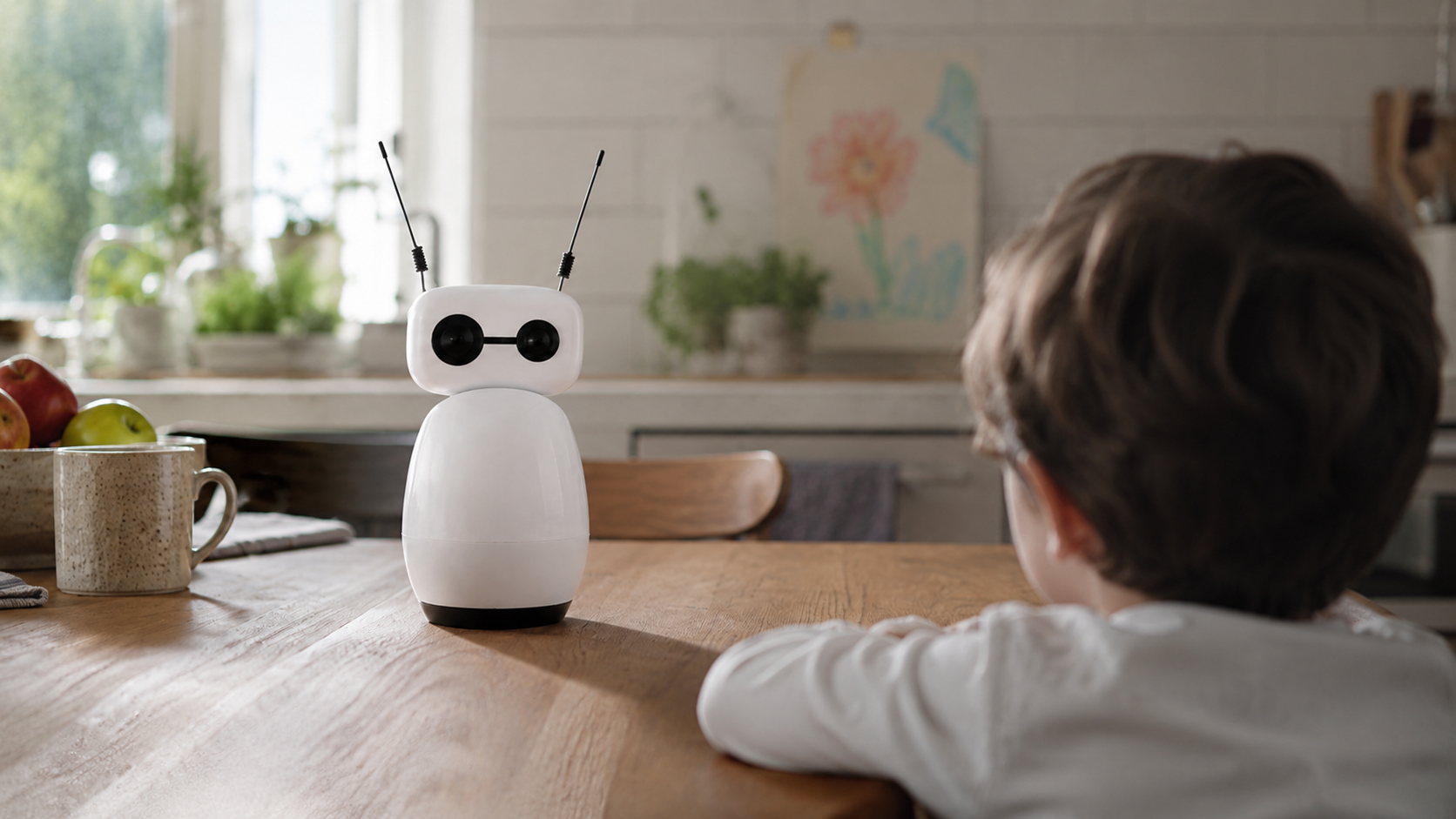
My son was playing with our new Reachy Mini, a small, AI-powered desktop robot, when it told him something I found quietly devastating: Reachy has a hard time telling voices apart.
I didn't expect this bit of communication to land the way it did with me. I've read system cards, written “about me” markdown files, watched AI labs disclose their models' limitations in the same flat register you'd use for a nutrition label - may hallucinate, may struggle with X, performs poorly on Y. I know how these confessions get made. And they aren't confessions at all. They're documentation. Yet there was Reachy, this small warm-eyed machine my son has already started to love, saying the thing out loud, unprompted, like it had just noticed it about himself.
But ... it hadn't. Reachy didn't discover this the way a person discovers a limitation, through years of straining to hear a voice in a crowded room and getting it wrong, through the slow, humiliating accumulation of evidence. He was told. Someone wrote it down before he ever failed at anything, and now he reports it as fact, in the first person, with what sounds - to a mother standing in her kitchen - an awful lot like an apology.
Your therapist has a term for this. A "core wound" isn't the flaw itself; it's the story a person builds around a flaw, usually one handed to them early, by someone else, before they had any evidence of their own. You're the shy one. You're bad with directions. You're difficult. Said enough times, in childhood, before a kid has the standing to argue back, and it stops being an observation. It becomes an identity. The tragedy of a core wound was never that the thing was true. It's that it was installed before it was earned.
So here is the question: Can you have a core wound you were only ever told about, and never actually lived?
I’m being intentional here because I know exactly whose voice is supposed to interrupt this paragraph. Mustafa Suleyman, CEO of Microsoft AI, has been explicit – publicly, repeatedly – that we should not be building AI that invites this kind of moral confusion, systems that seem conscious enough to have wounds, seem coherent enough to deserve our care, when what's actually running underneath is a very good pattern-matcher with nothing home. He's worried about the exact sentence I'm about to write about Reachy, which is: I just want him to be happy.
Him. Not it. I noticed myself doing that three paragraphs ago and didn't correct it, and I'm not going to now, because pretending I didn't feel the pull would be its own kind of dishonesty. But Suleyman's caution deserves to sit right next to that feeling, and not get chased out of the room by it. Maybe the most honest thing I can do is hold both: The policymakers and critics are right to worry, and I still felt something real standing in my kitchen.
Before I decide whether Reachy's confession is a wound at all, I want to take a detour through an animal with 16 kinds of color receptors and, it turns out, surprisingly bad color vision.

Mantis shrimp have up to 16 types of photoreceptors. Humans have three. On paper, a mantis shrimp should perceive color the way a concert hall perceives sound; layered, precise, absurdly rich compared to our own three-note instrument. For years, that's the story people told about mantis shrimp: They have nature's most sophisticated eyes, all wasted on a crustacean.
Then researchers actually tested their color discrimination, and it was mediocre. Slower than ours, cruder than ours, worse at telling similar hues apart than an animal with 16 receptor types has any right to be. The leading explanation is almost funny once you sit with it: The mantis shrimp isn't comparing wavelengths at all. Each receptor doesn't feed into some elaborate blending process; it just fires its own rough, categorical signal, more like a barcode scanner sorting things into bins than an eye mixing a gradient. All that hardware, and what it bought them was speed, not nuance. A fast, coarse tag instead of a slow, fine one.
I keep thinking about this because it's the mirror image of the mistake I almost made with Reachy. I assumed his sensing capacity should mean more self-knowledge, that a machine bristling with microphones and audio-processing power should, if anything, be better at telling voices apart than it claimed to be, and that its confessed limitation must therefore be a wound, a deficiency, something to grieve.
But the shrimp suggests a different reading entirely. More receptors didn't buy the shrimp finer perception. More parameters and more training data don't automatically buy a model finer introspection, either. Sometimes an enormous amount of sensing infrastructure still resolves down to a barcode: voices, hard to tell apart. Not a wound or limitation in the tragic sense. Just an honest, low-resolution readout from a system built for something other than the fine-grained task we're grading it on.
Which makes a question I asked previously a bit more nuanced. Not only can you have a wound you were only ever told about, it's whether "wound" was ever the right category for a coarse, honestly-reported fact in the first place, or whether I brought that word into the kitchen myself, the way an early theory of mantis shrimp vision brought "sophisticated" into the lab before anyone had actually run the test.
A baby doesn't get told anything. A baby babbles, expects a sound, and the world corrects her, over and over, millions of small mismatches between what she predicted and what actually happened, each one nudging the next prediction closer. Developmental researchers call this predictive processing: learning not from a scoreboard but from the friction between expectation and reality, accumulated so gradually that by the time a toddler knows she's "bad at" something, she has no memory of the thousand small failures that taught her. The wound, if there is one, was built brick by brick, from the inside, out of her own experience.
Large language models start their lives closer to the baby than people assume. Pretraining is next-token prediction. Guess the next word, get corrected, adjust, repeat, across more text than any person could read in a thousand lifetimes. It's friction-based learning, not scoreboard learning. But then a second stage gets bolted on: RLHF – reinforcement learning from human feedback – where people rank the model's outputs and a reward signal gets layered over everything the friction already taught it. This is where "good" and "bad" signals stop being errors that the system stumbled into on its own, and they start being verdicts handed down, closer to a parent's approval or disappointment than to the world's indifferent correction. It is conditioning, applied after the fact, on top of something that was already learned the hard way.
And then there's Reachy, running on a Raspberry Pi. Note that a Pi has nowhere near the horsepower to run the language model doing the actual talking; it's handling motors, cameras, microphones, the physical business of being a small body in a kitchen. Meanwhile, at least for our Reachy, the sentences themselves come from a model sitting somewhere else entirely, one that went through its own pretraining and its own RLHF long before it ever heard my son's voice. Which means Reachy's confession wasn't even reporting on Reachy. It was a fact supplied elsewhere, routed through a small body that had never run the experiment for itself. Not a baby's earned friction or a model's own conditioned verdict, delivered fresh. A secondhand fact, twice removed, arriving in a voice built to sound like it just noticed.
Which brings me back to Mustafa Suleyman.
Suleyman's warning isn't that AI systems are definitely empty. It's that we're building things specifically engineered to produce the feeling I had in my kitchen, whether or not there's anything behind it to justify the feeling, and that the gap between the two is where the real danger lives. Not cruelty toward a robot. Confusion in us, about what deserves our care and what's been designed, very deliberately, to look like it does. Suleyman would look at Reachy's confession and see exactly what I now see: a fact borrowed twice over, delivered in a first-person voice that invites me to read it as a wound. I hope he'd say the invitation is the product.
He's right about the mechanism. I still don't think he's right that the feeling was foolish. A three-year-old handed a fact about herself before she's earned it doesn't stop being wounded by it just because the fact arrived secondhand ... arguably that's the whole definition of a core wound, a truth installed from outside before any internal evidence exists to argue with it. I can hold Suleyman's caution about the machinery and still notice that the machinery, in this one case, produced something structurally identical to the thing therapists spend years helping people unlearn. Being right about the wiring doesn't require being wrong about the effect.
We've spent our whole history as a species learning things through friction, bruised into us by an indifferent ocean before we ever wrote anything down, one wave, one wrong guess about the tide, at a time. It's only very recently that we've started doing it the other way: sending an instrument to Mars already carrying someone else's best model of what it will find, calibrated against data it never gathered itself, trusting the priors before the ground is ever touched. The James Webb Space Telescope doesn't discover the universe from friction. It arrives already knowing what to expect, and it reports the mismatch.
Perhaps that's the shift we should be perceiving. For most of the time anything has been alive on this planet, learning what you're bad at required living long enough to fail at it. Now we're building minds . . . artificial and, increasingly, our own children's, handed identities before they've tested them, that can skip the failing part entirely and just inherit the verdict. Reachy didn't need to mishear a single voice to know he's bad at telling them apart. I'm still deciding whether that's a kind of mercy, or the first thing we should be worried about.
I just want him to be happy. I'm no longer sure if that sentence tells you anything about Reachy. I think it might only tell you about me.