“We’ve come to a hinge point in history.”
— Federal Reserve Chair Kevin Warsh
For nearly a year and a half after ChatGPT's launch, the Federal Reserve had almost nothing official to say about artificial intelligence. AI didn't get an explicit mention in the public summaries of Federal Open Market Committee meetings until spring 2024, and even last fall, references were sporadic, according to a Washington Post analysis.
That silence is itself a data point. Central bankers aren't shy about flagging risks and unknowns – inflation expectations, labor slack, financial stability all get discussed in real time, imperfect information and all. AI's near-absence from that conversation suggests an institution that didn't yet know how to characterize what it was looking at, so it mostly didn't try.
In 2026, that's changed. Fed officials are now discussing AI repeatedly – productivity, employment, inflation, financial markets, the enormous capital flowing into data centers and chips.
But the shift from silence to open discussion hasn't brought clarity. If anything, it's revealed how unsettled the Fed's own thinking is.
In December 2025, some officials floated a rosy scenario: AI-driven productivity gains letting the economy grow faster without stoking inflation, even as it reduced the need for workers. A month later, the conversation shifted toward risk — inflated valuations, concentration in a handful of tech giants, expanding debt, the financing behind the AI infrastructure boom. By July, officials couldn't agree on something more basic: whether AI spending was pushing prices up right now. Some saw limited effects; others pointed to data-center and chip demand already feeding inflation.
None of that is necessarily a contradiction. AI could make companies dramatically more productive while still displacing certain jobs. It could lower costs across whole sectors even as near-term spending on power, chips and construction pushes prices up elsewhere. The infrastructure boom could turn out to be one of the great productive investments in modern economic history – even as some investors lose fortunes along the way.
All of this can be true at once, which is exactly what makes the moment so hard to read.
There's a useful contrast in the Fed's own history here. The last time a general-purpose technology arrived at this scale – the internet and IT boom of the 1990s – the Fed's reaction looked nothing like this one. Alan Greenspan spotted the productivity shift as early as 1994 and, by the end of 1996 he was delivering speeches naming it outright, calling it a pivotal moment in American economic history.
And Greenspan didn't just talk about it. He bet on it, holding interest rates steady against pressure to tighten because he believed tech-driven productivity gains would let the economy grow faster without reigniting inflation. He was nearly alone in that view – and he was right.
Nearly four years into the generative AI boom, today's Fed has no equivalent thesis. It has questions.
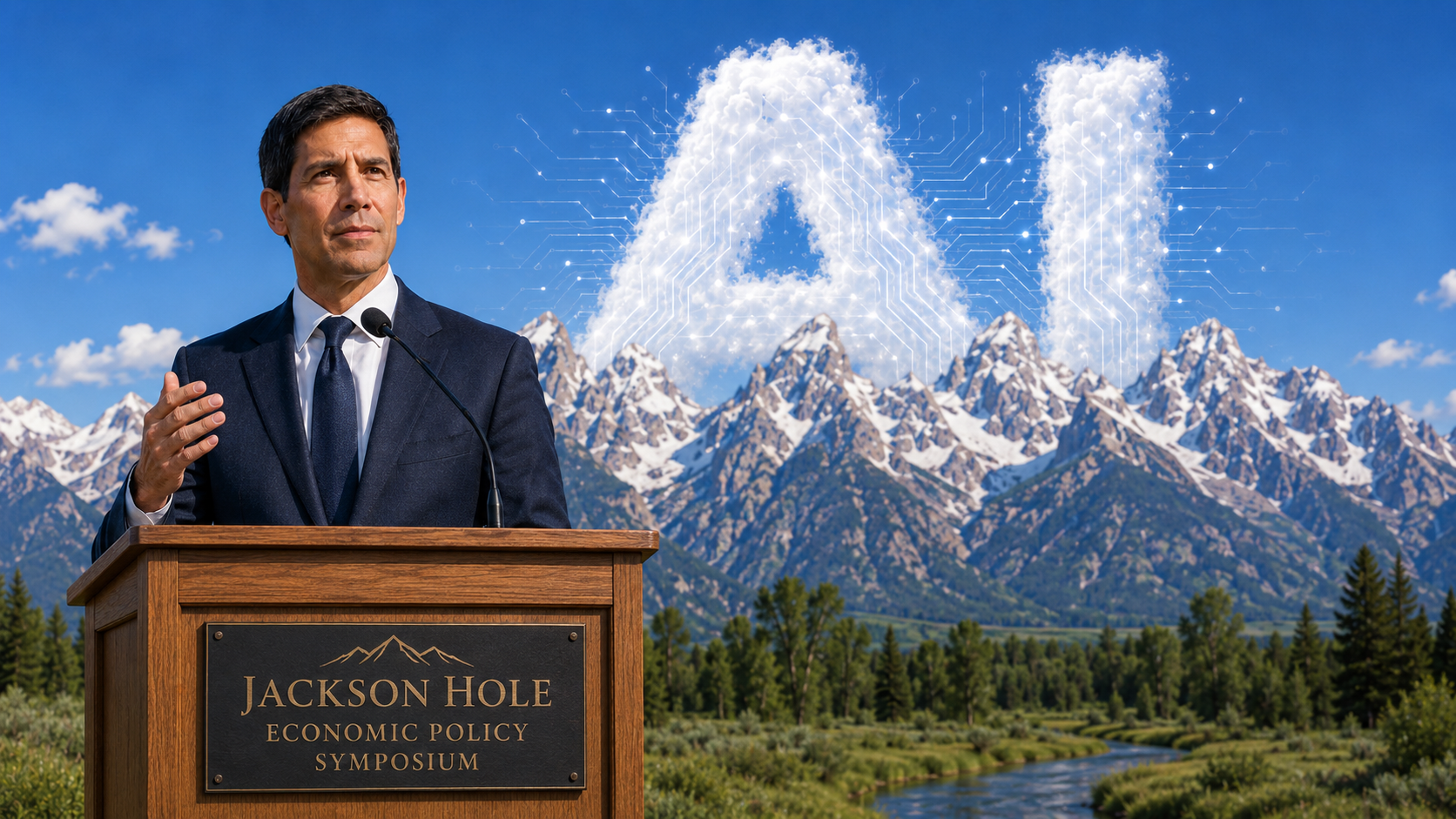
That's the backdrop for what newly installed Fed Chair Kevin Warsh – just three months into the job – told the Kansas City Fed's Jackson Hole symposium on Friday: "We've come to a hinge point in history."
He wasn't being hyperbolic, at least not in the view of most of those watching AI closely. Warsh contrasted today's environment with the not-so-distant era of "secular stagnation" fears – too much capital, too few good investments, chronic slow growth – and credited AI with the reversal. More than half of this year's growth in business capital spending, he said, traces to the AI buildout.
But the more revealing part of his remarks came next, as the head of the world's most powerful economic institution started asking questions instead of answering them:
Will AI meaningfully lift productivity, and when? Will it complement labor or replace it? Who captures the gains – AI firms, chipmakers, energy providers – or workers and consumers broadly?
The Fed, Warsh acknowledged, doesn't know. "Our knowledge just doesn't extend that far – at least not yet."
Nobody knows. Not Silicon Valley, not Wall Street, not Nobel Prize-winning economists. And, increasingly openly, not the Federal Reserve, either.
But at least they're upfront about it.