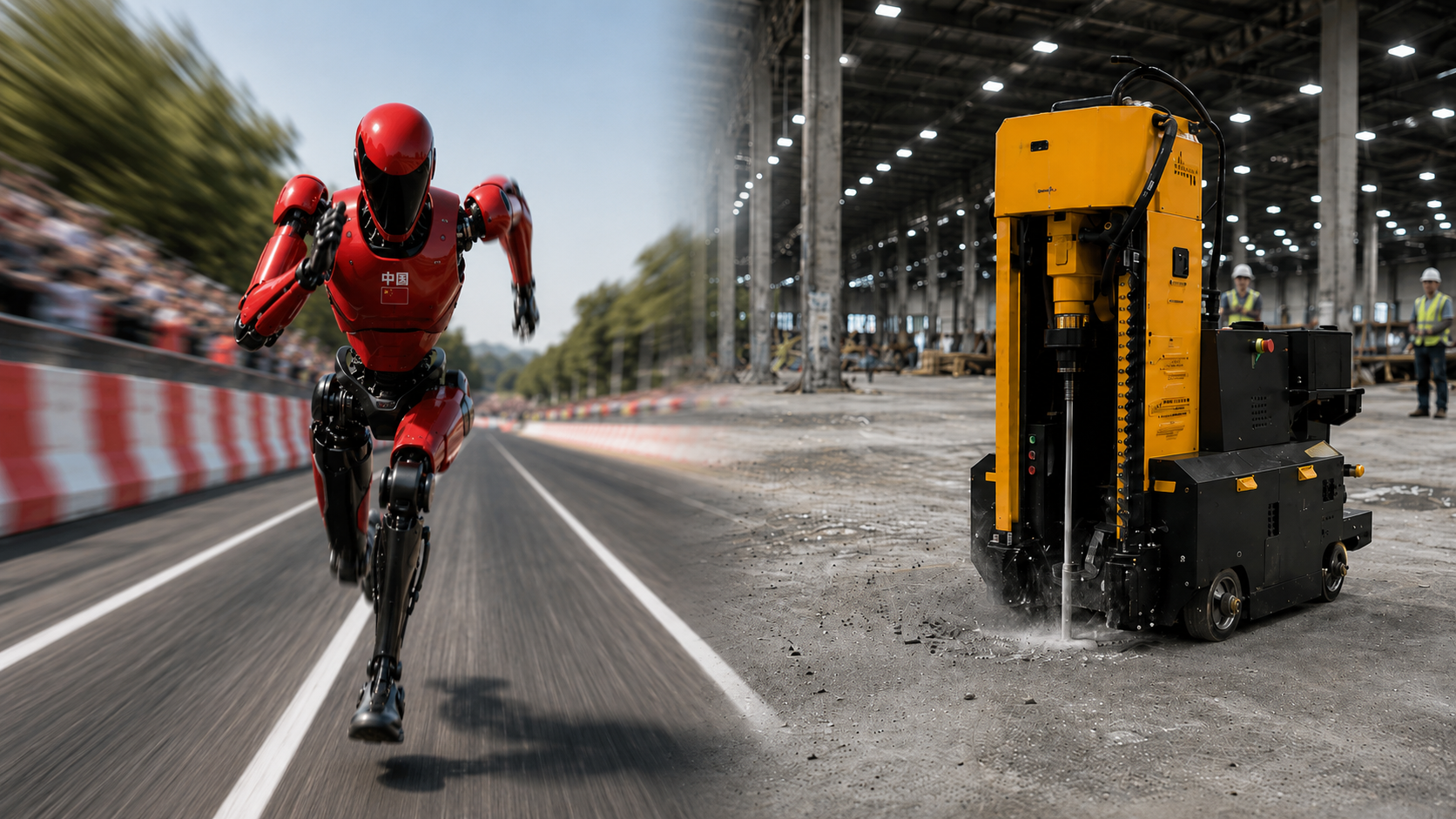
Our Robot of the Month feature went missing in July. Fortunately, the robots did not – not at all. With that in mind, August gets two Robots of the Month, and as different as they are, together they perfectly tell the story of robotics right now.
So, if you’ve spent any time on social media in the last few days, you’ve likely seen the first of our featured robots, Tiangong Ultra.
More than 2,000 robots from nearly 700 teams descended on Beijing this week for the second World Humanoid Robot Games, competing in everything from running and soccer to dancing, table tennis and industrial tasks. It's an Olympics-like spectacle designed to demonstrate just how quickly humanoid robotics is advancing.
On Tuesday, Tiangong Ultra, developed by the Beijing Humanoid Robot Innovation Center, covered 100 meters in 8.86 seconds (and later, 8.64). Those times were dramatically faster than its 9.39 seconds just a few days earlier – and well below Usain Bolt's 9.58-second human world record. To put the pace of this improvement in perspective, Tiangong won the same event last year, but at a relative snail's pace of 21.50 seconds.
While this doesn't mean that Bolt needs to surrender his title, cutting more than 12 seconds (over 50%!) from its winning time just a year ago is hard to ignore.
The robot Olympics are about more than play
The videos inevitably make the World Humanoid Robot Games look like an elaborate amusement park from the future. Robots race, box and kick soccer balls. Of course, robots also run into walls and fall over. And humans rush onto the field and pick them up.
But behind the spectacle is a much more serious effort. The Games also include contests meant to approximate work in factories, restaurants, offices and emergency situations, with robots asked to recognize objects, connect cables, handle packages and perform other tasks considerably less likely to go viral than a 100-meter sprint.
That matters because one of the unanswered questions surrounding today's humanoid boom is whether robots that can walk, run and perform choreographed demonstrations can become dependable enough to do economically useful work.
China is betting heavily that they can. Robotics has become a national industrial priority, supported through government policy, investment and an increasingly formidable domestic industry.
Still, the robots drawing the most attention are almost invariably the ones that look like us. That can distort our view of what is happening, because many of the robots most likely to change how work gets done may never have arms, legs, faces – or any desire to run the 100-meter dash.
Which brings us to August's second Robot of the Month.
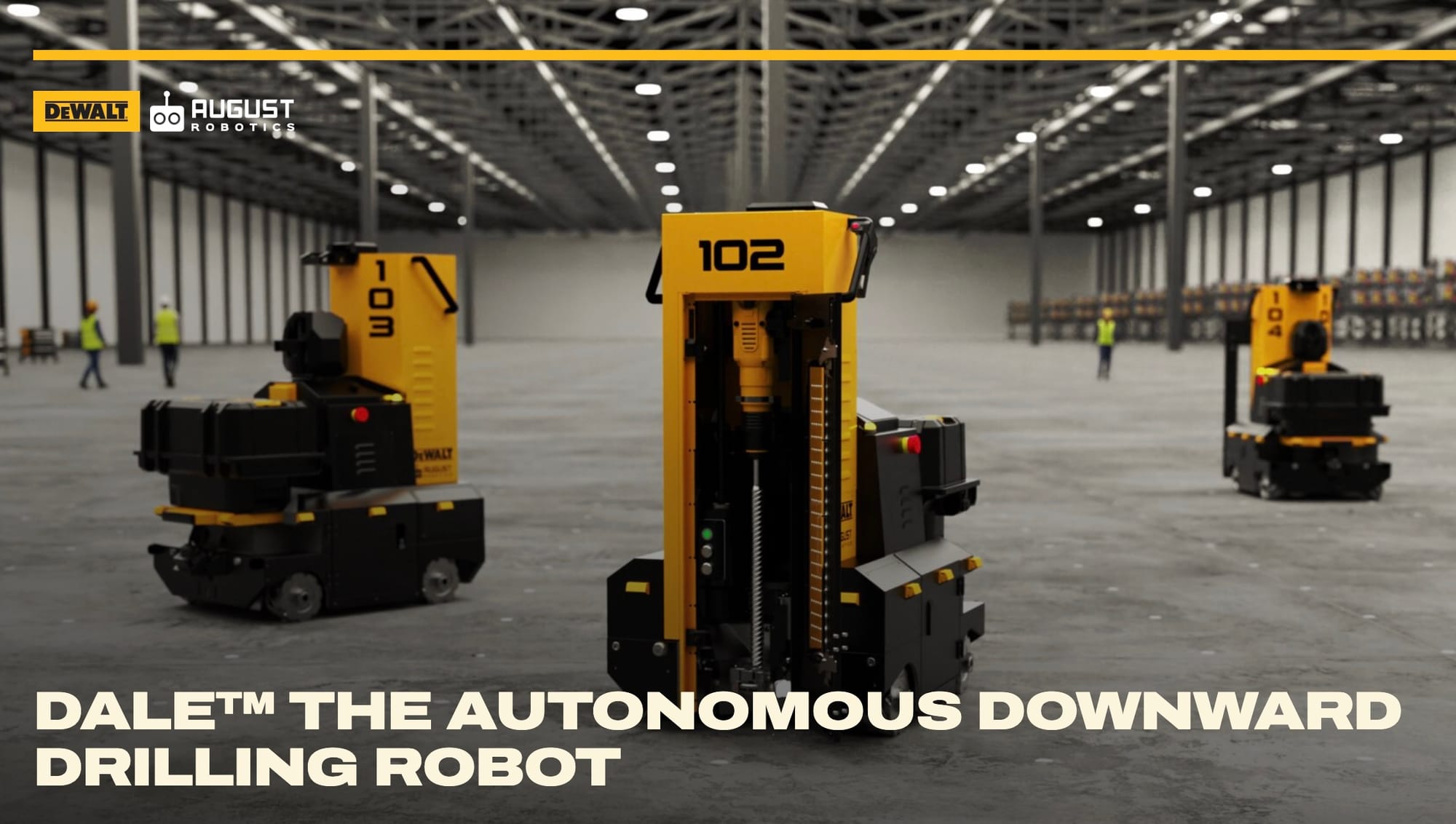
Meet DALE. He drills holes.
DALE is considerably less glamorous than Tiangong Ultra. He's a squat yellow machine built to roll around construction sites and drill holes into concrete floors.
That is pretty much the job. And yet, DALE may prove considerably more consequential than many of the humanoid robots attracting worldwide attention.
DeWalt, the Stanley Black & Decker tool brand, commercially launched DALE in July in partnership with August Robotics, calling it the world's first fleet-capable, autonomous, downward-drilling robot. One of its primary markets, perhaps somewhat ironically, is data-center construction.
AI needs data centers – and it needs them ASAP. And data centers can be built more quickly with the help of AI-driven robots. It's a striking loop, but of course, it's only part of the larger story. The growth of data centers brings investment and computing capacity, but also difficult questions about electricity demand, water use, grid capacity and effects on surrounding communities. DALE answers none of those important questions. It simply makes it possible to build some of those facilities faster.
Getting back to DALE, today's data centers require thousands of precisely located holes in concrete floors for server racks and mechanical, electrical and plumbing systems. Rather than having workers locate and drill every hole manually, crews feed DALE a digital drilling plan. The AI-assisted robot navigates the floor, positions itself and drills, while detecting and cutting through rebar and extracting concrete dust as it works. It then uses AI for QA, verifying work quality and ensuring the site is properly prepped after the drilling. To maximize the impact, multiple DALE robots can operate at the same time.
According to DeWalt and August Robotics, DALE's pilot deployments have already drilled more than 230,000 holes with 99.97% accuracy across 26 data-center construction phases. The companies say the robot does its drilling up to 10 times faster than traditional, manual, human-centric methods.
Those are company-reported figures, not independently audited results, and they deserve to be treated accordingly. But there is an important distinction nonetheless: DALE is not a prototype waiting for someone to figure out what it might someday be useful for. DALE has already gone to work.

A robot isn't synonymous with a humanoid
Daniel Ritchie, a Denver-based robotics expert and an adviser and contributor to Colorado AI News, says there is a perfectly reasonable explanation for the industry's fascination with humanoids: We live in a world designed around human bodies, so machines that resemble us may be particularly well suited to navigating our stairs, doorways, tools and workplaces.
But that doesn't mean the human body represents some ideal robotic design.
“We live in a human world, so if we have human-like creatures that can navigate our human-like world, that's a nice analogy,” Ritchie said. “But nobody ever said that the human form was the best form.”
If the goal is simply to move efficiently, Ritchie noted, wheels and other forms of transportation already outperform bipedal movement. And once engineers know the specific job a machine needs to perform, the ideal robot may look nothing like a person.
“At the end of the day, we're just talking about manufacturing machines to do jobs,” Ritchie said. “I think we're going to see a lot of non-humanoid forms.”
DALE illustrates the point unusually well. Nobody appears to have worried about giving it legs, a face or hands because there would be little reason to do so. Its body is dictated by the job.
A humanoid machine could be enormously valuable in environments designed for humans. But when engineers know exactly what problem they want to solve, a specialized robot may be cheaper, more reliable and easier to deploy.
DALE does not need to fold laundry, play soccer or shake your hand. It just needs to find the next hole.
Then comes the uncomfortable question: What about the people?
Concrete drilling is repetitive, physically demanding work that exposes workers to noise, vibration and potentially dangerous silica dust. Automating some of it could reduce injuries and allow skilled tradespeople to spend more time on tasks requiring judgment and expertise.
There is another way to describe what DALE does, however: It reduces the number of human hours required to drill holes.
That does not mean DALE is about to replace “the construction worker.” It performs one narrow task, while construction sites depend on people constantly adapting to changing conditions. This is a data point, and only a data point, but it's worth highlighting: Automation does not necessarily arrive by eliminating entire occupations in one dramatic stroke. It can arrive task by task.
Measuring, positioning and drilling. Moving and drilling again. Thousands of times. That's why machines like DALE are worth watching.
From the track to the jobsite
Tiangong Ultra and DALE could hardly look more different. One resembles a human athlete and has become a symbol of the race to improve humanoid performance. The other looks a little like a DeWalt tool chest that learned to drive.
One is the star of videos that humans send to their friends. The other drills holes. But together they provide a useful snapshot of robotics in August 2026.
The most visible robots are getting faster, more coordinated and increasingly autonomous. Meanwhile, less photogenic machines are quietly moving into workplaces, where their significance will be measured not in likes or race times but in productivity, safety, cost – and perhaps jobs changed or eliminated.
That is what we want Robot of the Month to capture. The robot doesn't have to be cute or humanoid, and its arrival doesn't have to be something everyone celebrates. It just has to tell us something important about where robotics is going.
This much is clear: Robotics is moving faster – and in more directions – than most people realize.