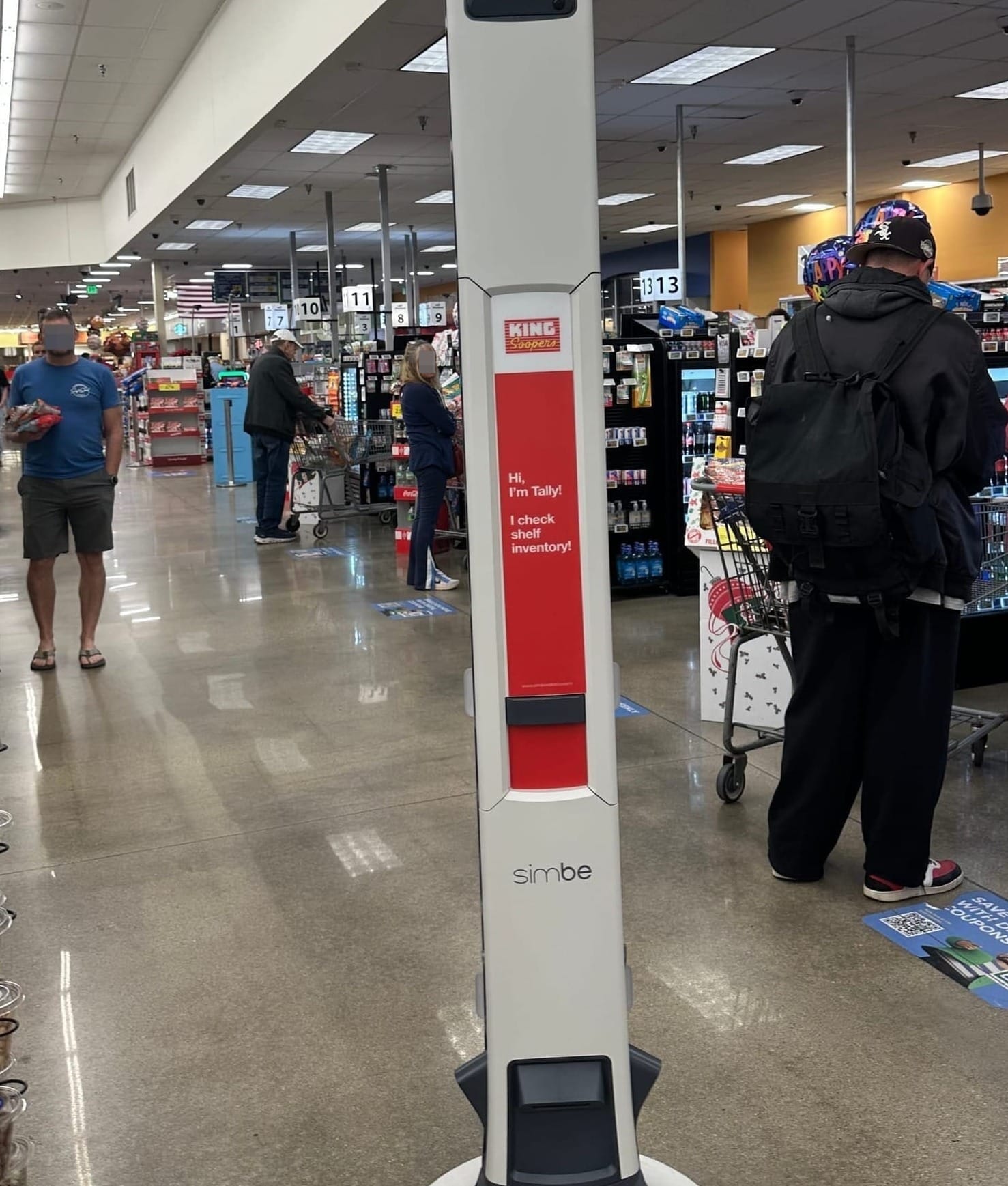
If you were among the millions of Americans making a last-minute trip to the supermarket this Thanksgiving week, you might have found yourself sharing an aisle with a rather unusual presence. Standing about six feet tall, moving slowly, and paying remarkably close attention to what's on the shelves, Tally has been making frequent appearances at King Soopers stores across Colorado.
Of course, Tally isn't shopping. Tally is working.
For all the attention lavished on humanoid robots that can dance, box, and do backflips, Tally – as unassuming as it appears – may turn out to be even more significant, at least as an everyday symbol of the robot revolution. Tally is among the first autonomous robots millions of Americans are regularly encountering outside their homes in the course of their everyday lives. And unlike many of its more glamorous and acrobatic robotic cousins, Tally already has a steady job.
Keeping tabs on thousands of products
Developed by California-based Simbe Robotics, Tally has been around since 2015. The company introduced its fourth-generation robot, Tally 4.0, in January of this year.
Using cameras, sensors, and AI-powered computer vision, Tally can scan between 15,000 and 30,000 products an hour, identifying gaps on shelves, misplaced products, and pricing discrepancies. That information is relayed to store employees, who can address the problems.
For shoppers, the benefit is straightforward: There's a better chance that the products they came to buy will actually be on the shelves.
For supermarket operators, the benefits are potentially substantial. According to Jari Safi, Simbe's vice president of AI, Tally can save store teams as many as 50 hours of work each week, freeing employees to spend more time on customer service and other responsibilities.
Note that this is not a test. Kroger, the parent company of King Soopers and City Market, reportedly deployed its 500th Tally robot in August. Simbe says its robots are now working across 75 retail brands in nearly every U.S. state and close to a dozen countries.
Not everyone is welcoming Tally
Among those less than enthusiastic about the new arrival is Steve Staeger, consumer investigative reporter for Denver's 9NEWS. In a recent Instagram video, Staeger described an encounter with Tally while shopping at a Highlands Ranch King Soopers. The robot, he said, was blocking shoppers in the aisle, and its presence frightened his child.
"I nominate the King Soopers robots for the next tech outage," Staeger wrote in the caption accompanying his video. "Is that too harsh? Anybody else wondering about their usefulness?"
His post struck a nerve, attracting approximately 2,200 likes and 300 comments by Thanksgiving. Some of the responses were surprisingly vehement, with commenters threatening violence against the robot and expressing concerns about corporate spending priorities, the future of grocery store employment, and the possibility of unwanted surveillance.
One commenter described the robot as "creepy." But a commenter identifying themselves as a King Soopers employee offered a more nuanced perspective, describing Tally as genuinely helpful in understaffed stores while expressing concern that more advanced robots could eventually take jobs at the supermarket chain.
Even Tally got in on the conversation, responding through its official Instagram account with a friendly explanation of its duties.
For its part, Simbe says that Tally monitors shelves rather than shoppers. The company also reports that 96% of shoppers across the retailers it serves worldwide have either a positive or neutral attitude toward Tally, and that 90% of store managers say the robot makes their jobs easier.
While Staeger's Instagram thread hardly constitutes a representative survey, the intensity and variety of the responses offer a glimpse of the challenges retailers may face as robots become an increasingly visible presence in Americans' everyday lives.
In July, a grocery workers union in the Pacific Northwest voiced its opposition to the introduction of Tally at Kroger-owned Fred Meyer stores, expressing concern about the potential loss of working hours and the impact on employee benefits.
That's no surprise, given that the apparent savings for each store of up to 50 hours of work each week exceeds the weekly hours of a typical full-time employee. What remains an open question is whether those savings allow existing employees to spend more time on other responsibilities – or if fewer employees will be needed.
Telexistence's TX GHOST robot. (Video credit: Telexistence)
Beyond counting groceries
For now, Tally can identify what's missing from supermarket shelves, but it still takes a human being to put the products there. However, elsewhere in the world, even that task is being automated.
Just last week, Japanese robotics company Telexistence announced that its TX GHOST robot will begin a phased nationwide rollout at Japan's FamilyMart convenience stores in January.
Operating inside walk-in beverage coolers, TX GHOST can restock as many as 1,800 drinks a day. According to the company, early deployments of the robot and its accompanying digital inventory system have reduced the daily workload associated with beverage replenishment by approximately 70%. Humans still load the inventory and provide remote assistance when the robot encounters problems.
Telexistence also uses the data generated by those human interventions to train its AI models, enabling its robots to become increasingly autonomous. And in Japan, where a shrinking working-age population presents significant challenges for retailers, such robots could help address persistent labor shortages.
As impressive as Tally's capabilities are, they offer only a glimpse of what the next several years are likely to bring to the retail industry.
In the meantime, if you encounter Tally on your next trip to King Soopers, the polite – and arguably humanist – response is simple: Give the machine room to do its job.
Also recommended: Spare a moment this Thanksgiving to thank the human beings who helped put all that food on your dining room table.