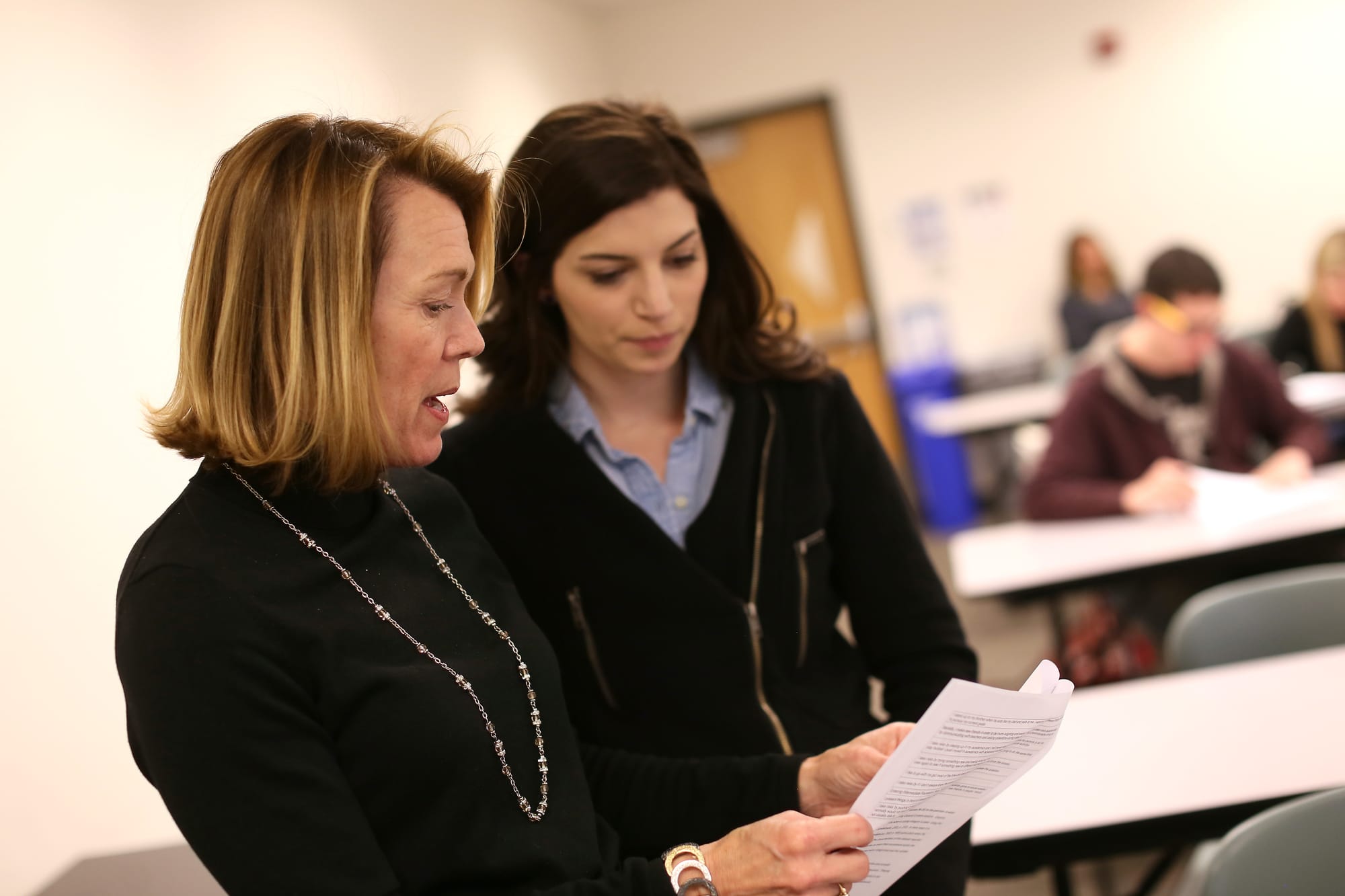
In March 2022, Janice Thorpe was named the first faculty program chair of the Colorado Learning and Teaching with Technology conference, better known as COLTT. Just eight months later, OpenAI released ChatGPT. The timing is hard to miss.
Thorpe had already spent years thinking about technology and education. A teaching professor in the Department of Communication at the University of Colorado Colorado Springs (UCCS), where her academic interests include online education, instructional communication, and assessment of student learning, she had been attending COLTT for about 15 years before taking on its faculty leadership role.
Over that time, she had watched the conversation evolve from online learning and open educational resources to video, accessibility, virtual reality, and other technologies that might improve teaching.
Then came COVID.
Technology suddenly went from something faculty members might choose to incorporate into their courses to what Thorpe calls “essential infrastructure.” Colleges discovered, almost overnight, how unprepared faculty, students, administrators, and their systems were for the shift.
As campuses emerged from the pandemic, the question was no longer how to return to the way things had been. Educators were trying to figure out what they had learned, what they should keep, and what students now expected from their education.
And yet, before they could finish answering those questions, generative AI arrived on November 30, 2022, in the form of ChatGPT.
“We’ve been sprinting, I think, since 2022, trying to keep up,” Thorpe said.
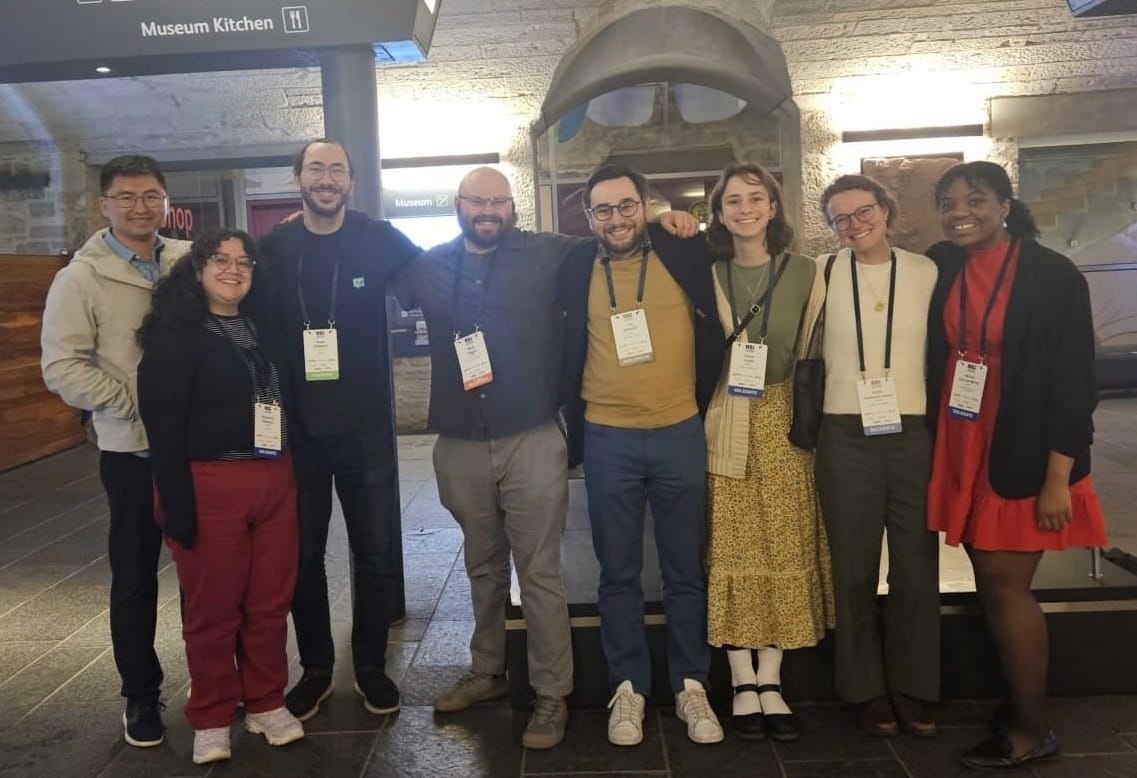
That sprint was on display last week when educators, instructional designers, administrators, and others gathered Aug. 5-6 at CU Boulder’s Wolf Law Building for COLTT 2026.
AI dominated the conference from the outset. Seven of the eight sessions on Day One dealt directly with AI, ranging from AI-native assignments and course bots to AI literacy, assessment design, and a hands-on NotebookLM/Gemini Notebook workshop. AI remained woven throughout much of the second day’s agenda as well.
For Thorpe, that reflects something bigger than enthusiasm for a new technology.
“AI isn’t just giving us another way to teach,” she said. “It’s really forcing us to re-examine what learning looks like and how we’re measuring learning.”
When the technology can do the assignment
That examination of learning itself may be the most consequential change AI has brought to higher education. A professor could once assign a paper, presentation, summary, or problem set and look at the finished work as evidence – however imperfect – of what a student knew and could do.
Generative AI complicates that assumption.
“If AI can write the paper and develop the presentation and summarize and solve your problem,” Thorpe said, “then we have to ask ourselves, okay, so what were we actually intending them to learn by making them do those things in the first place?”
That pushes instructors backward into the process behind the assignment. What thinking had to occur before a student produced a good paper? Which parts of that thinking matter? Which can appropriately be assisted by AI? And how can an instructor tell whether the student learned anything?
Thorpe believes educators now have to make that thinking more visible, both to students and to themselves. “What thinking do the students need to do themselves?” she said. “How will we know that they learned something?”
Those questions surfaced repeatedly at COLTT.
Sessions on the agenda included Designing for Judgment: Building Assignments That Measure Thinking & Process, Who Does the Thinking? Course Design Principles for the AI Classroom, AI for Research, Save the Human: Building Student Skills, and Cheating Required – Faculty as Students in the Age of Generative AI.
The titles alone suggest how far the conversation has moved from the early days of “here’s a new technology, and here’s what it can do.”
Grief, resistance, a standing-room-only crowd - and more
Not everyone at COLTT was eager to race toward an AI-enabled classroom.
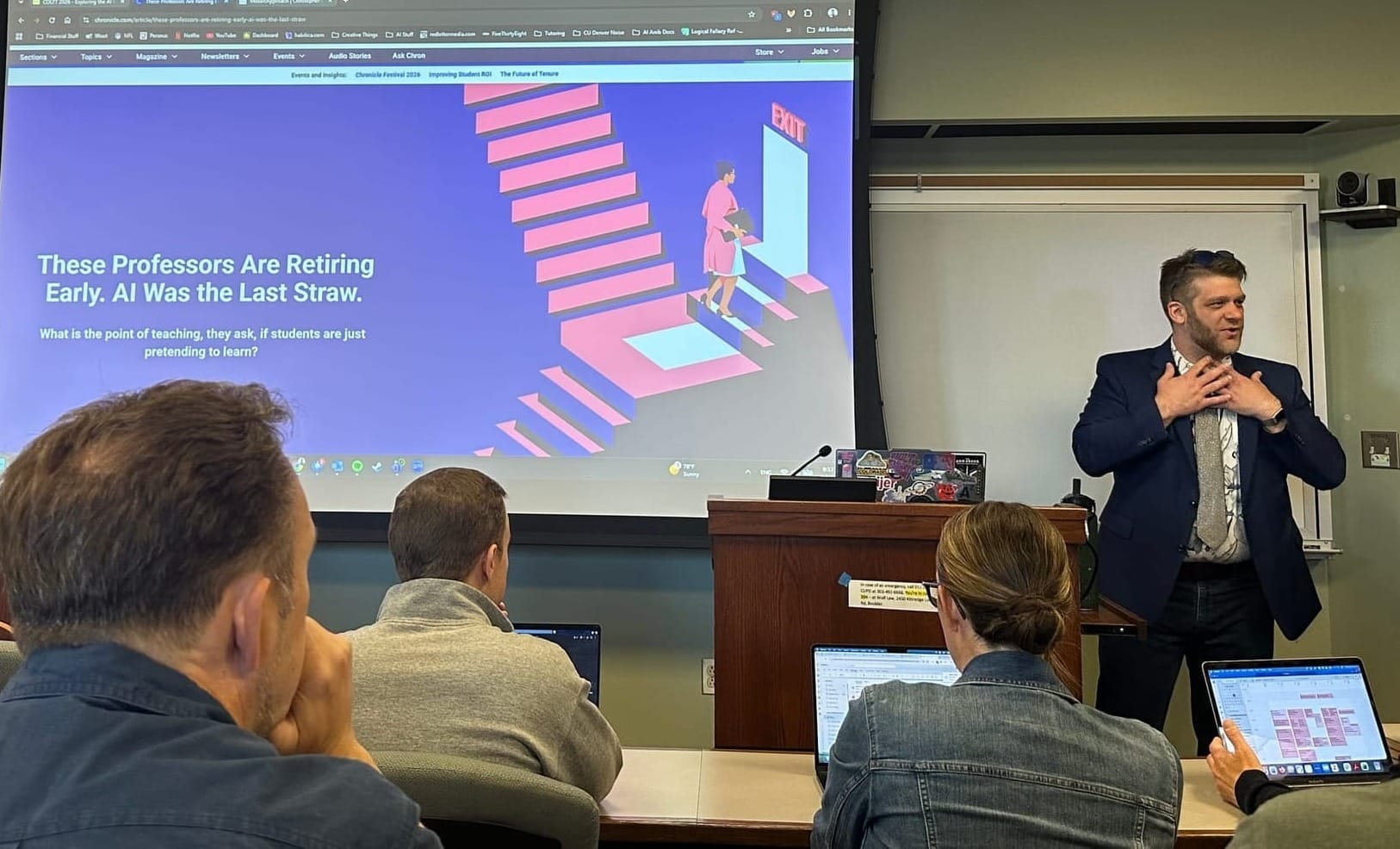
Christopher Ostro of CU Boulder led a session titled Exploring the AI Grief Cycle: Finding a Path Forward for Faculty. The session, which examined the uncertainty, frustration, and professional disruption educators are experiencing as AI changes their work, drew a standing-room-only crowd.
CU Boulder's Rori Romero addressed another concern in The AI Equity Gap: Student Access, Confidence, and Institutional Action, focusing on differences in students’ access to AI, their confidence in using it, and the institutional support available to them.
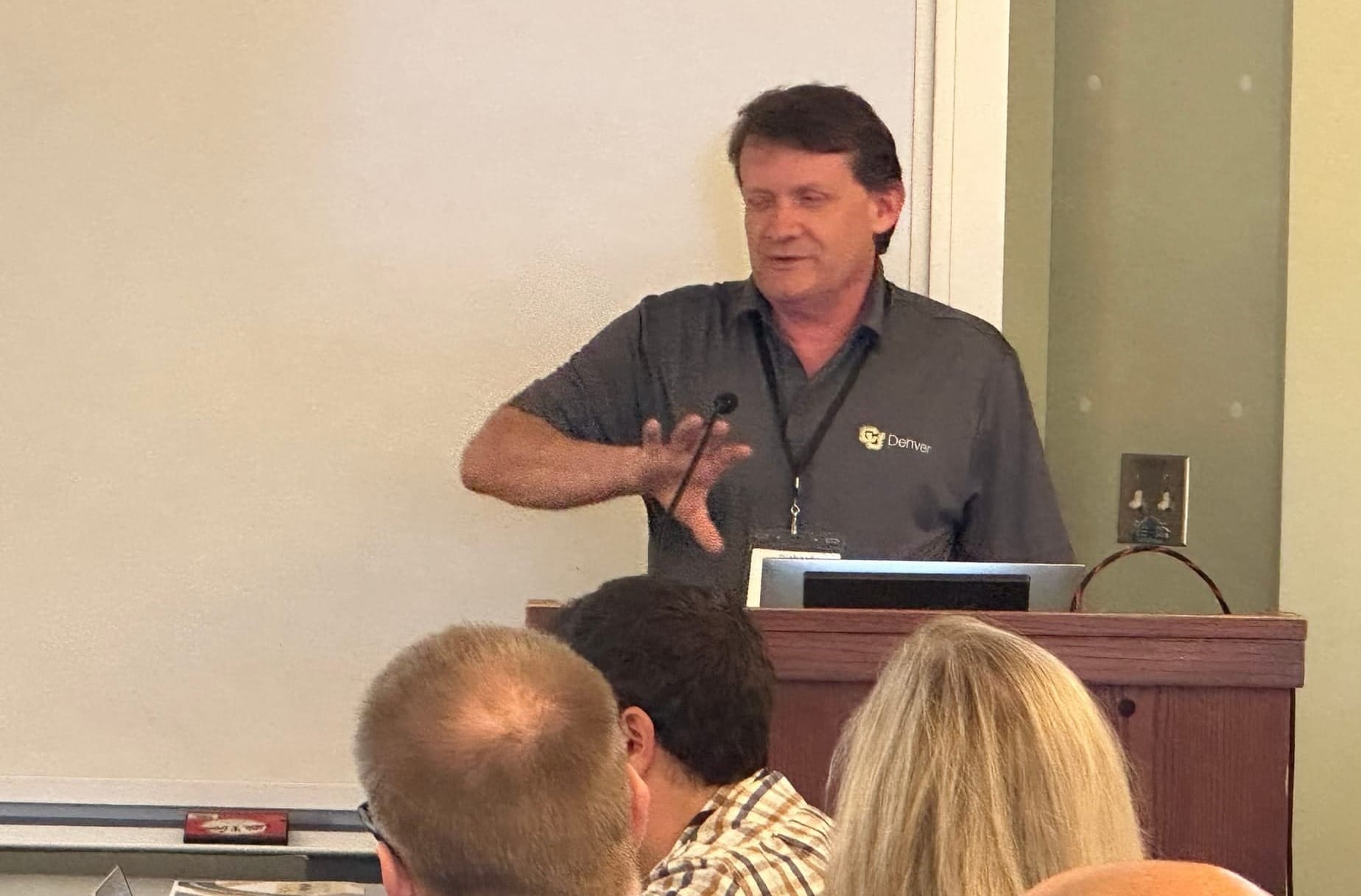
Richard Ashmore, who teaches at CU Denver's Department of Geography and Environmental Science, presented Building AI-Native Assignments, which explored how assignment design must evolve as AI becomes a routine part of student work. The overriding takeaway: Methods for assessing student thinking need to be re-thought when AI is part of the workflow.
In a similar vein, CU Boulder's Diane Sieber presented Who Does the Thinking? Course Design Principles for the AI Classroom, in which she discussed assignment strategies that make student learning visible.
Susan Adams moderated a panel of instructors – including Nicole Jobin, Rebecca Lee, Teresa Nugent, and Chris Ostro – who discussed CU Boulder's AI Literacy Ambassadors' program. This highly successful, faculty-focused initiative, designed to support AI teaching through peer "ambassadors," is now starting its third year.
Taken together, the sessions suggested a higher-education community that's moved well past the question of whether AI matters, but which is still wrestling intensely with where it belongs.
Thorpe thinks that range of responses matters. Some faculty members want to experiment at the leading edge. Others want practical strategies they can take back to class immediately. Some remain unsure what AI means for their disciplines, while others have decided that certain uses do not belong in their courses at all.
“In the end, it isn’t about technology adoption,” Thorpe said. “It’s still about – as it always has been – student learning.”
Students are divided, too
Thorpe sees much the same range of attitudes among her students at UCCS. In one digital communication technology course, students work with AI as part of the curriculum. Thorpe makes room for concerns about privacy, sustainability, water consumption, employment, and the companies developing the tools.
Some students embrace AI, while others are deeply skeptical. One told Thorpe she was ethically opposed to using it at all. Thorpe allowed her to complete the assignment without AI.
But Thorpe also teaches communication students preparing for careers in areas such as public relations, social media, content creation, and digital video production. In those fields, she believes students need to understand what employers are increasingly going to expect.
“You will not get through the interview if you can’t articulate how you’re using AI to create content,” she tells these students.
That does not mean they have to embrace every company or every product. Thorpe hears students make distinctions that sometimes get lost in broader debates about Gen Z and AI: They may object strongly to a particular company's tool while remaining willing to use AI somewhere else.
The harder skill, in her view, is judgment: Students need to decide what work they should hand to an AI system, what work they should do themselves, and why. Faculty members are confronting essentially the same question.
So how do you know they learned?
Assessment may be where that problem becomes most visible. Some educators have returned to handwritten blue books. Others use timed assessments, randomized questions, oral responses, or assignments that require students to document how they arrived at an answer.
Of course, each solution comes with its own limitations. Thorpe uses a form of timed assessment in which students receive questions and record their responses within a set period. It works, she said, until class sizes grow and the approach becomes difficult to scale.
Meanwhile, technology keeps moving. Smart glasses and other AI-enabled devices make even some old-fashioned solutions less reassuring than they once were.
“I think we’re going to be behind the curve here for a couple more years, and maybe even longer,” Thorpe said, noting that higher education is known for moving slowly while AI is doing anything but.

Building an AI coach - and reconsidering her own job
Thorpe’s own experiments with AI have forced her to confront the same questions she is asking other faculty members to consider. In fact, she has been building a custom GPT to serve as a research coach for students in her graduate research-methods courses.
Thorpe knows from years of teaching where those students tend to stumble. Some enter the course with little confidence in themselves as researchers; others are intimidated by statistics. And in a fully online course, students may also be working in different time zones and need help at times when Thorpe is unavailable.
An AI research coach could be there around the clock.
Thorpe started by putting something deeply human into it: the teaching philosophy she wrote roughly 15 years ago. She added examples, identified common trouble spots, broke the research process into milestones, and designed guardrails intended to keep the bot from simply doing students’ work for them.
But as she developed the coach, another question occurred to her: Would students begin to feel as if they were being taught by a bot? And if the bot could handle some of the individual help Thorpe had traditionally provided, where did that leave her?
“What’s my role?” she remembers asking herself. Her answer gets to the heart of the debate over AI and education. “AI is not invested in my student’s success,” Thorpe said. “It may act like it is, but it doesn’t care whether they get a C or B or whatever.”
That realization caused her to redesign parts of the course around the places where she believes the human instructor adds the most value. She thinks the course is better as a result.
At the same time, Thorpe sees advantages in precisely the fact that a bot is not human.
Students sometimes hesitate to ask a professor a question because they are embarrassed that they do not understand something. Asking in front of classmates can be even harder. With an AI tutor, they can ask the same question repeatedly, practice, make mistakes, and expose what they do not know without worrying that another person is judging them.
“They can look stupid, and nobody will care,” Thorpe said. “It’s just a bot.”
That possibility – individualized help without embarrassment – could become one of AI’s more useful roles in education. It also reinforces the distinction Thorpe keeps returning to: Where can AI genuinely help someone learn, and where does a human teacher matter most?
From what can we do to what should we do
Thorpe is reluctant to predict what COLTT will look like even three years from now. AI is changing too quickly for confident forecasts.
But she does see the conversation evolving. The discussions around AI in higher education, she said, have become “far more philosophical than technological.”
Faculty still need to understand the tools. Students still need to learn how to use them. Institutions still have to make decisions about access, policies, privacy, assessment, and training.
Increasingly, though, the hardest questions involve critical thinking and judgment: What should be outsourced to a machine? What should remain the student’s work? Where can AI improve learning? Where might it undermine the learning an assignment was designed to produce?
Thorpe sees risks in moving too quickly. Faculty can spend enormous amounts of time redesigning courses around systems that change again months later, and instructors cannot be expected to teach students to use AI thoughtfully if they have not been given the opportunity to understand it themselves.
Moving too slowly carries risks as well, particularly as students enter workplaces where AI skills are increasingly expected. Thorpe does not claim to know exactly where the right speed lies. However, she does have a test for the decisions educators make along the way.
“How can I use AI to advance learning?” she said. “If that’s the north star, I think we’ll be okay, fast or slow.”
For a conference that has spent nearly three decades examining the relationship between teaching and technology, that represents a significant evolution. While the conversation once centered largely on what new technologies made possible, Thorpe believes the more important question now is which of those possibilities are worth pursuing.
The tools may change before next year’s COLTT convenes. That question probably won’t.
This is the first in a series of Colorado AI News articles examining ideas and conversations that emerged from COLTT 2026. As a new school year begins and we approach the four-year anniversary of the launch of OpenAI's ChatGPT, we’ll talk with conference presenters about how AI is changing teaching, learning, and the choices educators and students are making about both.