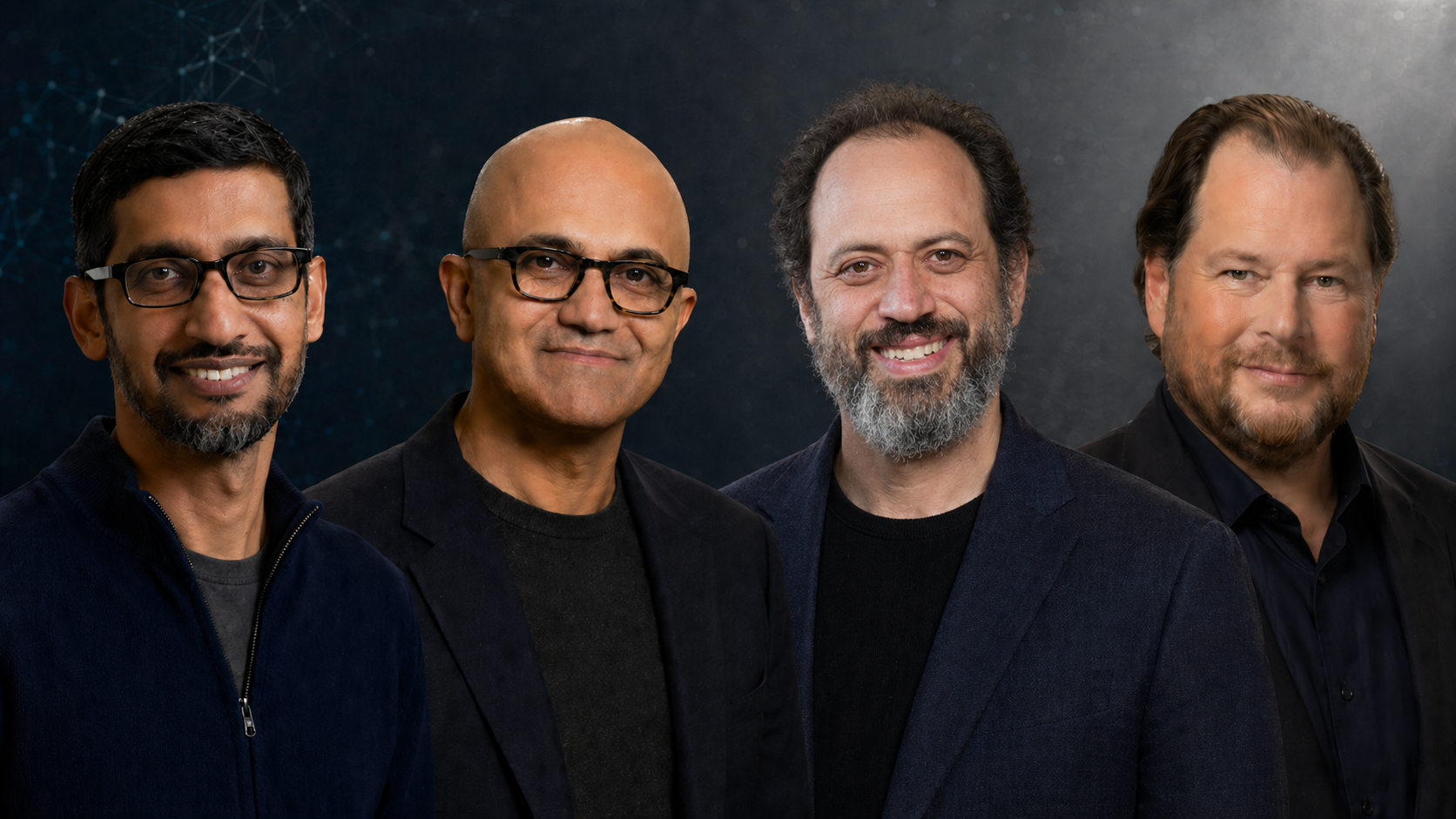
This week, Google CEO Sundar Pichai captured an important change underway in AI when he wrote, “The conversation has gone from ‘Can we build an agent?’ to ‘How do we manage thousands of them?’”
In the context of the just-ended "Google Cloud Next 2026" event in Las Vegas, Pichai wasn't talking about a clever new demo or just another chatbot feature. Instead, he was describing a broader shift toward systems that take actions, use tools, and operate at scale inside organizations. He wrote that Google is “firmly in the agentic Gemini era,” and said the company’s focus now is building the connective and governance layer needed to “build, scale, govern and optimize” agents with confidence.
Of course, this isn't a new thing. Nearly a year ago, Microsoft CEO Satya Nadella framed the moment in similarly broad terms: “We’ve entered the era of AI agents.” Nadella tied that shift to improvements in reasoning and memory, arguing that models are becoming capable enough to do more than generate plausible text.
He pointed to agents moving into coding, workflows, and healthcare preparation, and described a world in which they operate across individual, team, organizational, and end-to-end business settings. His point was not simply that agents exist. It was that they are becoming a new layer of computing and work.
A similar point has come from Wharton professor Ethan Mollick, whose writings on AI are widely read by those who value his just-over-the-horizon gaze. Two months ago, he wrote: “The shift from chatbot to agent is the most important change in how people use AI since ChatGPT launched.” Mollick added some useful caution: It's still early, the tools can be hard to figure out, and they still do baffling things.
Even so, Mollick argued that “an AI that does things is fundamentally more useful than an AI that says things.” That distinction gets at what is changing. The story is no longer just about better answers. It is about delegation, supervision, and what happens when software starts taking on multi-step work that once belonged to people.
The implications become more concrete in the hands of Salesforce CEO Marc Benioff, who recently pushed the argument to a more consequential conclusion. In a news release titled, "How Digital Labor Will Reshape the Enterprise," he was quoted as saying, “Agentic AI is a new labor model, new productivity model, and a new economic model.”
In Salesforce’s broader framing, agents are a form of digital labor that can work alongside humans to streamline operations, raise productivity, reduce costs, and expand output without increasing headcount. Benioff also said that digital labor is “a new horizon for business” and that how companies architect, staff, and run themselves “will never be the same.” Granted, Benioff has been accused of hype from time to time, but this point is worth hearing clearly.
Even allowing for all the corporate promotion, this is where the agent story starts to feel less like a technology narrative and more like a work narrative. Once software can take on multi-step tasks, use tools, hand work off to other systems, and report back, the issue stops being just capability. It becomes a question of workflow, management, accountability, and leverage. Who oversees that work? Who gets augmented, who gets replaced, and who captures the productivity gains?
That doesn’t mean every claim will prove true, that there are not real risks involved, or that every company will use agents well. It does mean that the center of gravity in AI is shifting again, and this time the change is not about what these systems can say, but about what they can do. The real question is no longer whether agentic systems can do useful work, but how much work, under whose control, and to whose benefit?