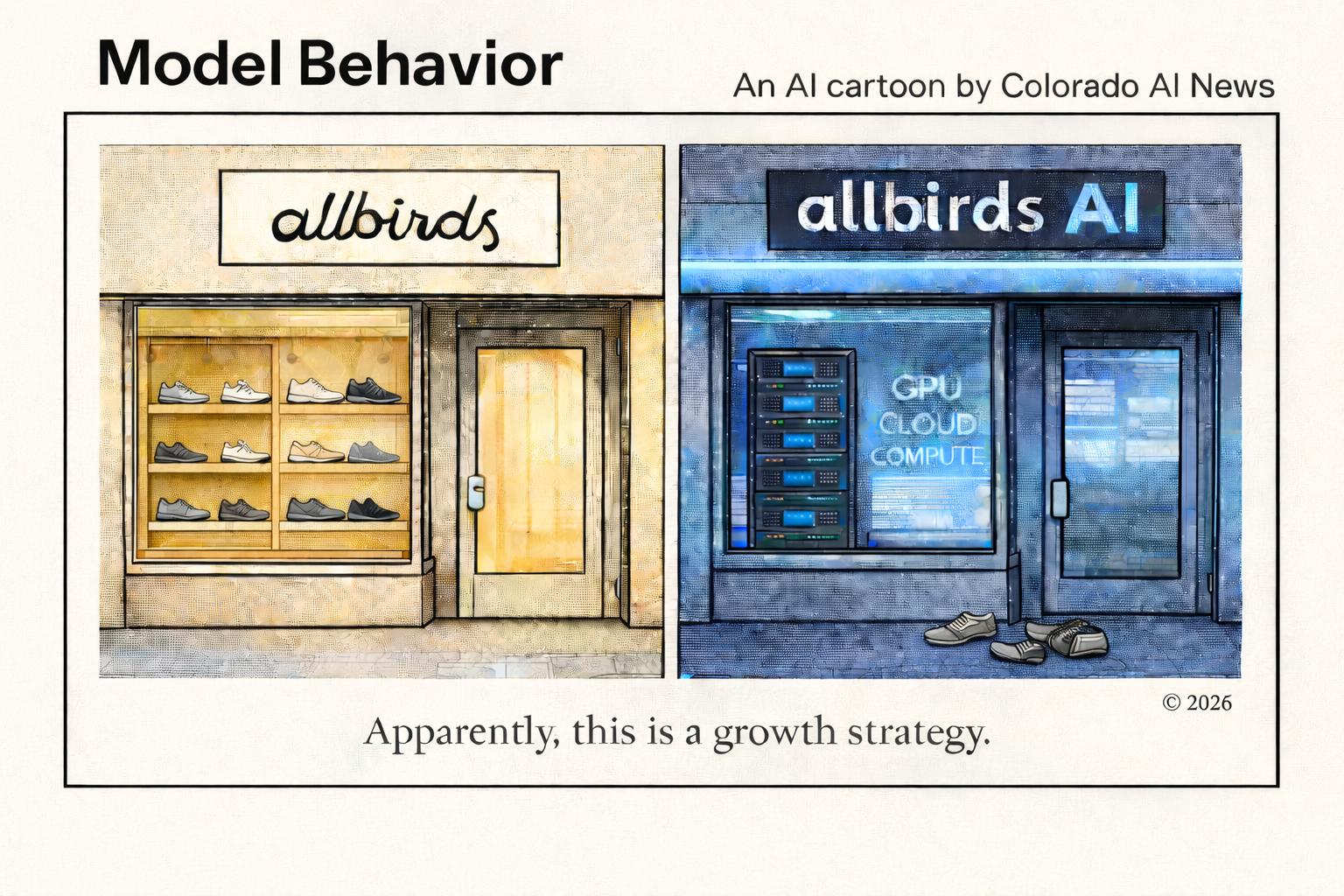

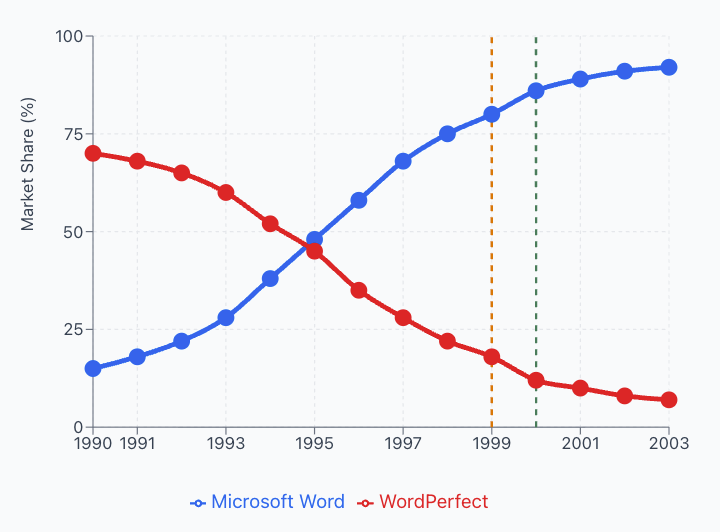
The summer between my second and third year of law school, I clerked at Jones Day in Dallas. This was 1999, and the entire firm, one of the most prestigious corporate practices in the country, ran on WordPerfect. Not Word. WordPerfect. The blue screen. The reveal codes. The keyboard shortcuts were automatic to the partners who'd been using the software since the Reagan administration.
I learned WordPerfect that summer because that's what the firm used, and what the firm used was what mattered. The clients didn't care. They got polished PDFs or hard copies, formatted immaculately by a word processing team that worked in the basement and processed documents overnight. The tool was invisible to clients.
By the time I started my first real job the following summer, everything had changed. Jones Day, along with most of Big Law, was in the middle of a forced migration to Microsoft Word. Not because the partners wanted it. Not because Word was better. (Ask any WordPerfect loyalist and they'll tell you it wasn't.) But because the clients demanded it. Clients were sending Word documents for review. Clients expected track changes in Word. The entire transactional workflow had shifted, and law firms had no choice but to follow. The transition was ugly, but none of it mattered. The clients had moved, and the law firms had to catch up or lose the work.
I've been thinking about that WordPerfect moment a lot lately, because I think we're in another one. But this time, what's changing isn't the software we use to draft documents. It's the economic model we use to price our work. And this one will hurt more than the WordPerfect-to-Word migration.
The efficiency paradox
According to the 2026 Thomson Reuters and Georgetown Law Center report on the state of the legal market, roughly 90% of legal revenue still flows through hourly billing arrangements. This hasn't changed in decades. The billable hour is more entrenched today than WordPerfect was in 1999. By then, WordPerfect was already in decline. I just happened to be at one of the last big strongholds.
At the same time, artificial intelligence tools are cutting the time lawyers spend on routine tasks by at least 25%, with some tasks seeing efficiency gains of 70% or more. Contract review that once demanded teams of junior associates working through the night can now be handled by a single midlevel lawyer with the right AI tools running in the background. Here's the problem: if you bill by the hour, and the work takes a quarter of the time, your revenue collapses even though you delivered the same result. Maybe even a better one.
This is what Rita Gunther McGrath called 'the economic absurdity' in a Wall Street Journal essay. The billable hour made sense when legal work was labor-intensive and time-bound. It absorbs uncertainty. It shifts risk from the firm to the client. But when a machine can do in ten minutes what used to take ten hours, billing for time spent stops making sense for anyone.
Clients know this. A general counsel with a ChatGPT subscription understands how long a first draft should take with modern tools. And they're starting to ask the obvious question: Why am I paying for 25 hours if AI can make it faster?
Big Law's billion-dollar contradiction
Harvey AI, a legal AI platform valued at $11 billion, costs over $1,000 per lawyer per month with enterprise minimums and annual commitments. It's built for Am Law 100 firms (the largest and most profitable U.S. law firms), and it's very good at what it does: legal research, contract analysis, due diligence, memo drafting. More than 100,000 lawyers are using it.
Firms are buying Harvey (and tools like it) because they have to. If your competitors are using AI to deliver faster, higher-quality work, you can't afford not to. The technology is legitimately transformative.
But here's the contradiction: those same firms are also raising associate salaries to record levels. In December 2025, Cravath (a premier white-shoe New York firm) bumped first-year associate pay to $225,000. Eighth-year associates now pull in over $430,000. These are not firms worried about cutting costs.
And yet, at the same time, two Am Law 100 firms reportedly launched 'AI Summer Associate' pilot programs. These aren't real summer associates. They're bots. Trained on the firms' internal knowledge bases, they assist with research, drafting, and diligence, the exact work that first- and second-year associates have historically done.
So we're paying humans more than ever, while simultaneously piloting their replacement, all to feed a billing model that punishes us for getting more efficient. It's like we're on the Titanic heading straight for the iceberg, but we don't want to turn around because we're billing by the nautical mile.

The ethics trap
In July 2024, the American Bar Association issued Formal Opinion 512, its first official ethics guidance on the use of generative AI in legal practice. On billing, the guidance was unambiguous: If you bill by the hour, you must bill only for the actual time you spent. You cannot bill for the time the AI saved you. If a contract review that used to take 25 hours now takes you 10 hours with AI assistance, you bill for 10 hours. Not 25. The efficiency gain belongs to the client.
This makes perfect sense if you think billing should be tied to effort. It makes zero sense if you think billing should be tied to value.
Virginia's State Bar went the other direction. In Legal Ethics Opinion 1901, they argued that reasonableness should reflect the lawyer's investment in technology, the skill required, and the results obtained, not just the hours logged. So which is it? Is a flat fee of $5,000 for a contract that took you 45 minutes reasonable because you invested in the tools and expertise to deliver it quickly? Or is it unreasonable because you barely worked on it? Right now, the answer depends on which state you're in.
I presented a three-part CLE series for the Colorado State Bar in December 2025 called 'AI for Transactional Lawyers: Ethics and Efficiency in Your Legal Practice.' One of the biggest questions I got was about flat fees. The answer I gave, based on Colorado's rules: Yes, you can charge a flat fee for AI-assisted work, as long as the fee is for specified legal services and the overall fee is reasonable. Colorado defines a flat fee as a fixed amount for specified services, regardless of time or effort. The key is defining the scope clearly in writing.
But flat fees have to be a two-way street. When I charge a flat fee, I'm giving up upside to make the work efficient and predictable for the client. In exchange, I define and narrow the scope. The problem comes when clients treat it like buying a ticket to a buffet: unlimited changes, unlimited calls, incomplete information, and dragging the assignment out over weeks. That doesn't work, whether you're using AI or not. A flat fee isn't a blank check. It's a contract for a defined deliverable.
Why this time Is different
So here's my thesis: The billable hour is going to die (or at least shrink dramatically). Not because lawyers want it to. Not because bar associations mandate it. But because clients are going to demand it. When law firms moved from WordPerfect to Word, it didn't affect the client's bill. The clients didn't care what software we used because it had nothing to do with what they were paying for.
But AI is different. Clients have access to the same tools we do. General counsels are using ChatGPT to draft policies. In-house teams are experimenting with contract automation. Corporate legal departments are piloting AI for research and diligence and realizing, sometimes for the first time, just how much of what they've been paying for is mechanical work that doesn't require a $600-an-hour partner.
David Cohen, the Chief Transformation Officer at Dentons (one of the world's largest law firms), said it plainly in a recent interview: 'There's a strong correlation between the clients that are asking us about our use of AI and those that are asking us about alternative fee arrangements.'
According to Clio's 2025 Legal Trends Report, 71% of legal clients now say they prefer flat fees to hourly billing. Flat-fee matters close 2.6 times faster than hourly matters and get paid almost twice as quickly. For clients, the case for flat fees has always been obvious: predictability, transparency, alignment of incentives. What's changed is that AI has made flat fees operationally viable for firms in a way they never were before.
A decade ago, flat fees were risky because scope creep was constant and unpredictable. AI doesn't fix bad clients. But it does let you model the work more precisely. You can test drafts. You can simulate scenarios. You can scope the likely paths before you quote the price. And once you've committed to a flat fee, AI gives you the efficiency cushion to absorb the surprises without going underwater.
Some industry analysts are now projecting that alternative fee arrangements could rise from roughly 20% of law firm revenue in 2023 to over 70% by the end of the decade. I don't know if that's right. But I know the direction of travel. And it's not toward more hourly billing.
What this means for lawyers right now
There's a scene in the documentary "BlackBerry" where the phone maker's Jim Balsillie is desperately trying to convince AT&T's Stan Sigman to keep supporting the device. Jim pleads, "Stan, come on. You owe me. You've sold a lot of minutes because of us." Stan's response cuts to the bone: "Yeah, but you know what the problem with selling minutes is? There's only one minute in a minute."
That's the billable hour in a single exchange. There's a hard ceiling on what you can sell when the product is time. You can raise your rate. You can work more hours. But you can't manufacture more minutes. And when a technology comes along that cuts the required minutes by half or three-quarters, the whole model is in big trouble. The short-term disruption will be painful. Firms that have spent decades optimizing for hourly billing will have to rebuild their entire pricing infrastructure or be absorbed by those that do.
But in the long term, this might be better. A profession built on selling time has perverse incentives. Efficiency becomes a liability. Automation becomes a threat. The faster you work, the less you earn. That's not sustainable, and it's certainly not a model that attracts the best talent or serves clients well.
Here's what I'm doing: I'm learning to scope work more precisely, investing time up front with clients to define exactly what they need so I can price it as a fixed deliverable. I'm using AI to model the likely effort and build in a margin for surprises. And I'm being ruthlessly honest with clients about what's routine (and therefore cheap) versus what's genuinely complex (and therefore worth paying for).
I'm also watching the clients. Because the clients are going to tell us where this goes. They always do. When the clients moved from WordPerfect to Word, we followed. When the clients start demanding flat fees and value-based pricing, not because it's trendy, but because they can now see exactly how much of our work is automatable, we'll follow again.
The only question is whether we'll be leading the transition or scrambling to catch up.