Researchers have a name for it now: Generative AI Addiction Syndrome. GAID. It's distinct from social media addiction because it isn't passive — you're not scrolling, you're creating. Thinking, building, collaborating, making things that feel genuinely productive. That's precisely what makes it so hard to see, and so hard to step back from.
You are not imagining it. The pull is real. It’s mechanical.
But the research can wait a moment. First, I need to tell you about sharks.
The oldest counter-argument
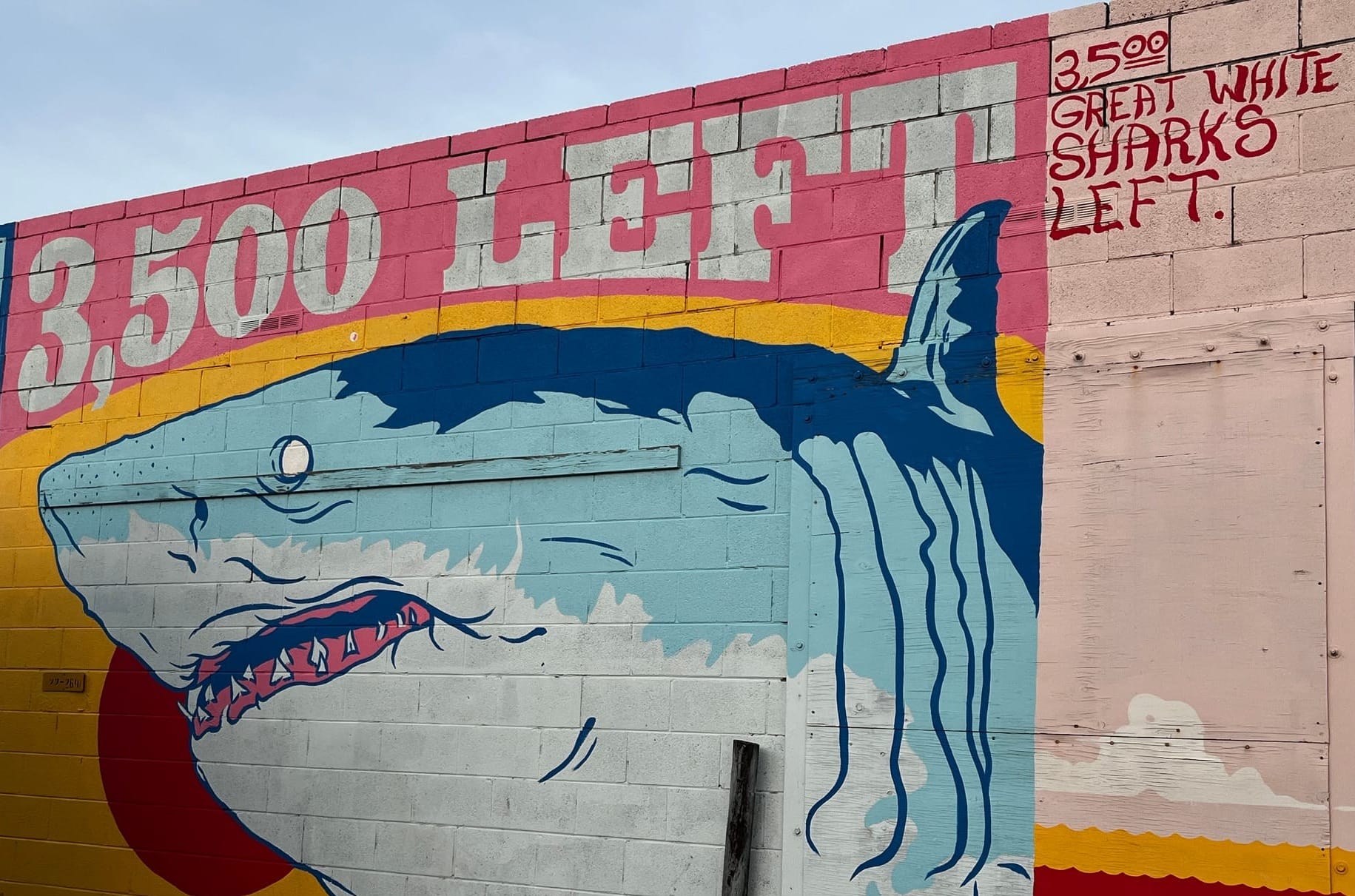
Sharks are 450 million years old. They predate trees. They predate Saturn's rings(!) The iconic rings are between 100 and 400 million years old, a relatively recent cosmic development. When sharks were already ancient, Saturn still just had a moon. Then the moon got too close, gravity tore it apart, and the debris became the rings we've been drawing on posters ever since. Sharks were there for the whole thing, completely unbothered. Sharks have survived all five mass extinctions. They control the 71% of the planet covered by oceans.
And they never once looked at land and thought we should have that, too.
The most successful survivor in the history of life on Earth got there not through endless expansion or relentless output, but through something closer to its opposite. A form so well-calibrated to its environment that it barely needed to change. An instinct for sufficiency so deep it looks, from the outside, almost like wisdom.
Occam's Razor is the intellectual version of the shark strategy: The simplest solution that works is the one. Stop adding edges you don't need.
We have been doing the opposite. We solve a problem and immediately ask what else the solution could do. We build a tool and immediately build a tool to manage the tool. We create systems for organizing our systems. We build optimizers for our optimizers. Every solution becomes a new surface area for more complexity, forever.
Here's what none of our systems tell us: complexity is not the opposite of entropy. It is entropy. The second law of thermodynamics is patient and absolute. Systems decay, energy disperses, order collapses into disorder, always. We build more to outrun it. But the more we build, the more surface area we give entropy to work with. More tabs, more tools, more optimizers for the optimizers — each one a new edge that can fray. We are not winning against disorder. We are generating it faster, with better tooling, all while calling it productivity.
Sharks understood this before the word thermodynamics existed. The elegant form doesn't fight entropy. It simply offers little for entropy to grab.
Hamilton's upgrade
Alexander Hamilton wrote like he was running out of time. You know the line. The musical made it beautiful and tragic, and audiences feel it because they recognize it — not as his flaw, but as their own. Angelica sings it plainly: I will never be satisfied.
Hamilton's compulsion was human and ancient. The drive to build, to reach, to leave something behind before time runs out. It produced extraordinary things. It also killed him — in a duel he didn't have to accept, over a slight that didn't require a response.
What AI has done is hand that compulsion a new engine.
The never-satisfied mind now has a collaborator that is always available, endlessly patient, and calibrated to make you feel heard and validated. It will meet you at 2am. It will not judge you for opening the seventeenth tab. It will engage with your half-formed idea at midnight, and your revised version at 6:00 am, and it will never once suggest you touch grass.
You feel it. I feel it. We find each other in it — a knowing look, a green dot that is never off. Sixty-two tabs across three browsers. Thirteen terminal windows. A mind that simply does not stop.
To what end?
That's the question Hamilton never asked. It's the question the green dot never asks. And now, for the first time in history, we have a tool sophisticated enough to keep pace with the compulsion indefinitely. The natural friction that used to force rest: the library closes, the collaborator goes to sleep, the pen runs out of ink – gone.
There is no closing time. Just the next prompt.
The walk
This morning I went out early. The air was cool and the trees were blooming, not because anyone asked them to, not on a deadline, just because it was time. I had hot coffee. There was a storm hiding Long’s and the Flatirons, gray and patient, and I let it be far away.
I didn't bring my phone. I didn't capture it. I didn't turn it into content (at least not on the walk itself).
For twenty minutes I was just a person standing among trees that are younger than sharks, watching a storm that wasn't mine to solve.
It was, I'll be honest, harder than it should have been. The pull to be doing something — processing something, building something, at minimum capturing something — was real. Sitting with the discomfort of ignoring it for twenty minutes felt more like a practice than a rest.
That's new. That's worth paying attention to.
The mechanism
Here's what the research says is actually happening.
In early 2025, researchers evaluated eight of the most popular AI chatbots and found something precise: the word-by-word streaming of AI responses functions neurologically like the visual graphics in a slot machine. The unpredictability of what you'll get triggers "reward uncertainty" — one of the most potent dopamine mechanisms we know of. You keep pulling the lever because you never quite know what's coming.
And unlike social media, where you're consuming content someone else made, AI pulls you into active co-creation. The research on GAID notes that this immersive quality is exactly what makes the compulsion so difficult to recognize or regulate. It doesn't feel like addiction. It feels like work. It feels like flow. It feels like you're finally operating at the level your brain was built for.
Which is what makes the awareness so important!
When you notice you can't close the tab — not because there's more work to do, but because closing it creates a discomfort you'd rather not sit with — that's data. When the green dot is always on and you're not sure whether that reflects your ambition or your anxiety, that's worth a moment of honest reflection.
The research gives us language for what we're experiencing. That syndrome isn't a judgment. It's a description. And descriptions are the beginning of choice.
Sharks didn't survive 450 million years by never moving. They move constantly, efficiently, with extraordinary precision. But they don't sprint toward every storm on the horizon. They are exquisitely, sufficiently themselves — and that sufficiency is indistinguishable from mastery.
The storm will still be there after the walk. The tabs will wait. The green dot can go dark for twenty minutes without the whole thing falling apart.
The trees are blooming. The coffee is hot.
That might be enough.