If you have even a little orange and blue in your blood – or at least in your wardrobe – this Saturday is a day you've long been waiting for.
The Broncos just wrapped a 14–3 regular season, nabbed the top seed in the AFC, and this weekend they host Josh Allen and the Buffalo Bills in Denver’s first home playoff game since the 2015 AFC Championship run that ended with a Lombardi Trophy.
Bo Nix has seven game-winning drives. Sean Payton’s defense leads the league in sacks. The stadium is loud again in a way that feels familiar to anyone who still reflexively flinches when someone says “Elway to Rod.” (Does anyone else remember partying like it was 1999 – in 1999?)
And hanging over all of it is the ghost of Buffalo. The long-suffering Bills still managed to dramatically bounce Denver from the playoffs in Buffalo last year, 31–7, and they ran for 210 yards doing it. On Saturday, they walk into Empower Field at Mile High to try to do it again, this time against the AFC’s top seed.
So, yes – this is absolutely a Broncos fanboy week for me. But because I also run something called Colorado AI News, I am contractually obligated to point out that artificial intelligence has quietly become a very real character in this story.
Not in the “Bo Nix is secretly a robot” sense, but in the “every big decision and every improbable comeback is happening inside an AI-soaked environment” sense.
Let’s start with the moment the math said the Broncos were done.
When the numbers said “no chance,” and Nix said “hold my Gatorade”
You know a game has entered Broncos lore when it gets its own name and Wikipedia entry. This one already has both: the Mile High Meltdown.
Playing at home on October 19, Denver had not scored a point through three quarters. The Broncos then scored 33 in the fourth quarter and won 33–32 on a Wil Lutz field goal as time expired.
It was the largest fourth-quarter comeback in NFL history by a team that had been shut out through three quarters. It also snapped an NFL-record streak of 1,602 straight wins by teams leading by 18 or more in the final six minutes.
Here’s where AI walks into the frame.
On the broadcast and all over social media, we started seeing graphics from Next Gen Stats, the NFL’s chip-in-the-pads tracking system that turns player movement into machine-learning-driven metrics. NGS had the Broncos’ win probability as low as 0.7 percent in that spot. ESPN’s model had it at 0.2 percent one snap earlier.
That’s not a guy with a calculator in the truck. It's a full data pipeline:
- RFID chips in every player’s shoulder pads – and in the ball
- 20 to 30 ultra-wideband receivers throughout every stadium, tracking location, speed and acceleration ten times a second
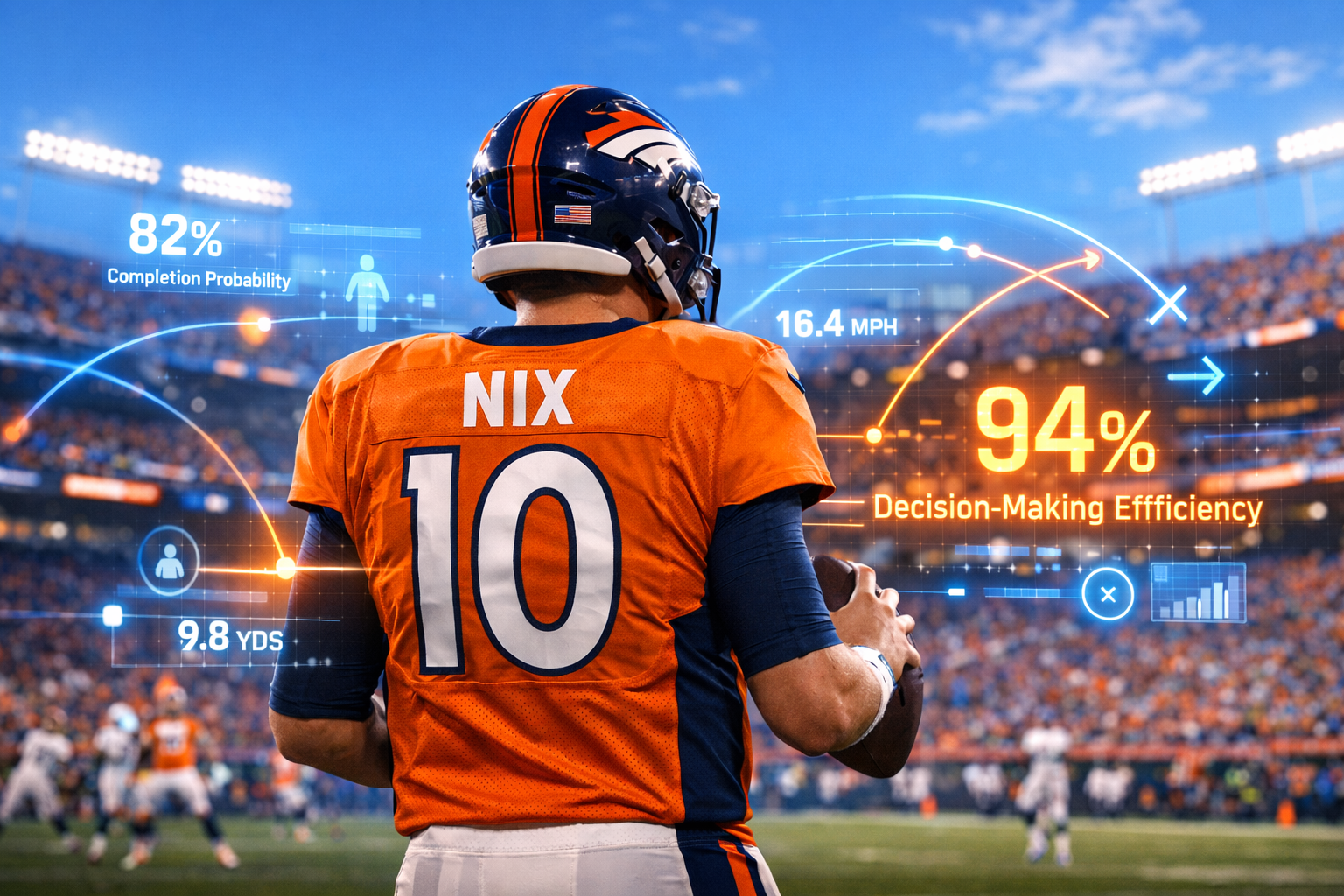
- Machine-learning models running on Amazon Web Services to turn all that into crazy stats, such as win probability, completion probability and expected rushing yards
When Next Gen Stats put that “0.7 percent” on the screen, it was the AI-driven version of a grizzled old defensive coordinator muttering, “Yeah, this is over.”
Then Bo Nix and the Broncos spent six and a half minutes showing why we still play the game.
The nerds love Bo Nix, even if the highlight shows are late to the party
If you watched every snap this season, it's not shocking that the math people are starting to fall for Nix.
Sports Info Solutions, one of the more serious analytics outfits, just dropped a piece ranking quarterbacks by an “all-encompassing” value metric called Total Points. As the Mile High Report spells out, SIS's models say Bo Nix was the most valuable player in the entire NFL in 2025, with 142 Total Points – ahead of names like Matthew Stafford, Patrick Mahomes, and Jared Goff. Josh Allen is back at 107.
The kicker: SIS admits that Nix does not look great in a lot of traditional “skills” metrics. Their own write-up says he is being propped up by two big things:
- He avoids sacks.
- He leans into a high volume of short, low-risk passes.
If you've watched the Broncos this season, that checks out. The deep ball has been a rare adventure. SIS notes that Nix was sixth in deep attempts but just twenty-ninth in “catchable” deep throws. (Ouch!)
But the underlying value models like the way Nix keeps the offense on schedule, avoids the negative plays that killed Denver for years, and lets the defense and special teams do their work. That's how you quietly end up 14–3, with every loss by one score, and with seven game-winning drives on your résumé as a second-year QB.
If you're a Broncos fan, this is the rare moment when the eye test and the spreadsheets tell the same story: This is not a video-game offense, but it is ruthlessly competent and weirdly unshakable. (Cross your fingers!)
Where the AI actually lives on Sundays
So, what exactly counts as “AI” in all of this? Fair question: Let’s be specific.
1. Next Gen Stats: the chips in the pads
The league’s own Football Operations site lays it out: The aforementioned NFL's Next Gen Stats uses an estimated 250 devices for each game, all of which are managed by a team of three human operators. The system records positions and speeds ten times a second, and it then uses machine-learning models running on AWS to generate hundreds of data points on every play – route charts, coverage shells, “completion probability,” “expected rushing yards,” and yes, “win probability.”
That same tracking feed powers advanced work like Coverage Responsibility, a new AI framework the league and AWS built that uses a spatial-temporal transformer (a cousin of what powers self-driving cars) to figure out which defender was responsible for which receiver, frame by frame, on every passing play.
If you've seen graphics this year showing how often Patrick Surtain II follows a No. 1 receiver, or how well the Broncos disguise their coverages compared to Kansas City, that is exactly the kind of thing those models make possible.
2. The Digital Athlete: AI as the invisible athletic trainer
Then there is the Digital Athlete, which the NFL just put front and center again this month. It is an injury-prediction and workload tool that takes video and tracking data from games, practices and training, and uses AI to simulate millions of seasons and scenarios.
Clubs get daily views of training volume and injury risk for each player. Coaches and trainers use it to shape individual practice loads, recovery plans and even rules changes. The league used it, for example, to simulate 10,000 seasons under the new “dynamic kickoff” rule to see how it would affect concussion risk and return rates before rolling it out.
You and I never see this on the broadcast, but in a year when Denver’s defense has stayed mostly intact and the pass rush is fueled by four different players with at least seven sacks, it is worth noting that the health and safety side is AI-heavy, too.
3. TruPlay AI and the “all-22 for nerds” broadcast
If that still sounds a little abstract, consider ESPN’s new MNF Playbook with Next Gen Stats altcast, which launched in December.
It is essentially an AI-powered “coach’s tape” broadcast: all-22 camera angle, real-time probabilities on run versus pass, blitz likelihoods, target distributions and more, all generated by Adrenaline's TruPlay AI models, which have been trained on more than one million NFL and college plays and the full Next Gen Stats tracking feed.
The idea is simple: Pair AI-generated probabilities with smart ex-players providing the play-by-play, and you get a telecast that talks to the fans who want to know not just what happened but what should have happened.
It is not hard to imagine a future version of that format sitting on your tablet while you watch the Broncos–Bills game, constantly updating things like:
- “Chance of Nix keeping on zone-read here”
- “Coverage disguise rate on this drive”
- “Probability Josh Allen is blitzed if it's third and long.”
In other words, AI is no longer sitting on the sideline waiting for its chance, but in 2026 it's fully baked into how the league tracks, protects, analyzes, and now televises the sport.
Bills vs. Broncos: a playoff game the models love
None of this wins you a playoff game, of course. But it does shape how that game is understood.
From the traditional scouting view, Saturday is strength on strength. Buffalo brings the league’s No. 1 pass defense, a bruised but still dangerous Josh Allen, and a run game that punished Denver's defense for 210 yards in last year’s Wild Card matchup.
Denver counters with:
- The NFL’s sack leaders, with 68 on the season and four different pass rushers at seven sacks or more.
- A secondary led by Patrick Surtain II that shows up near the top of every advanced coverage metric.
- An offense that leans into efficiency, led by a second-year quarterback who just happened to grade out as the league’s most valuable player in one of the more sophisticated value models we have.
If you dropped all that into an AI model – and, to be clear, several companies already have – you would likely get something close to what the betting markets foresee: a close game between two well-rounded teams where one big mistake or one weird bounce swings the entire afternoon.
The comforting part – at least for Broncos fans still living off the history-making Week 7 comeback over the Giants – is that we've already seen what happens when all the models agree something is over, and yet Bo Nix refuses to agree.
So is there “there there,” or is this just an excuse to talk Broncos?
Let me be blunt: Yes, this story is absolutely an excuse to talk about Nix, the Broncos' pass rush, and the reality of the Broncos playing at home as the top seed in the AFC. Because if you can't wear your fan hat in a week like this, when can you?
But it's not just that. A decade ago, you could write about the Broncos, or you could write about AI, and those were two entirely separate beats. Today, an ordinary NFL weekend – especially in a season like this one – is saturated with AI:
- Tracking every step and route we see on the broadcast
- Powering injury-risk models that influence how often players are on the practice field
- Driving advanced coverage and matchup metrics that front offices use to decide who to sign, draft and extend
- Feeding altcasts that promise a deeper, data-heavy view of the game for fans who want that
And now we have teams like the Broncos, who seem to break the models just enough to keep things interesting.
So yes, this is written by someone who will be pacing back and forth on Saturday every time Nix breaks the pocket. But it's also a very real snapshot of how quickly AI has moved from “maybe it will show up in sports someday” to “it is literally under the hood of every stat and storyline we care about.”
If the Broncos knock off the Bills and keep this run going through Super Bowl Sunday on February 8, the victory parade will be about players and coaches, not algorithms. (As it should be, of course.)
But tucked behind every viral highlight and every breathless win-probability chart, there will be a quiet supporting cast of AI models and chips and systems that help tell the story of how it happened.
And for a Broncos fan who also likes to talk about AI, that's about as fun a crossover episode as you could ever ask for.
Broncos by 3.