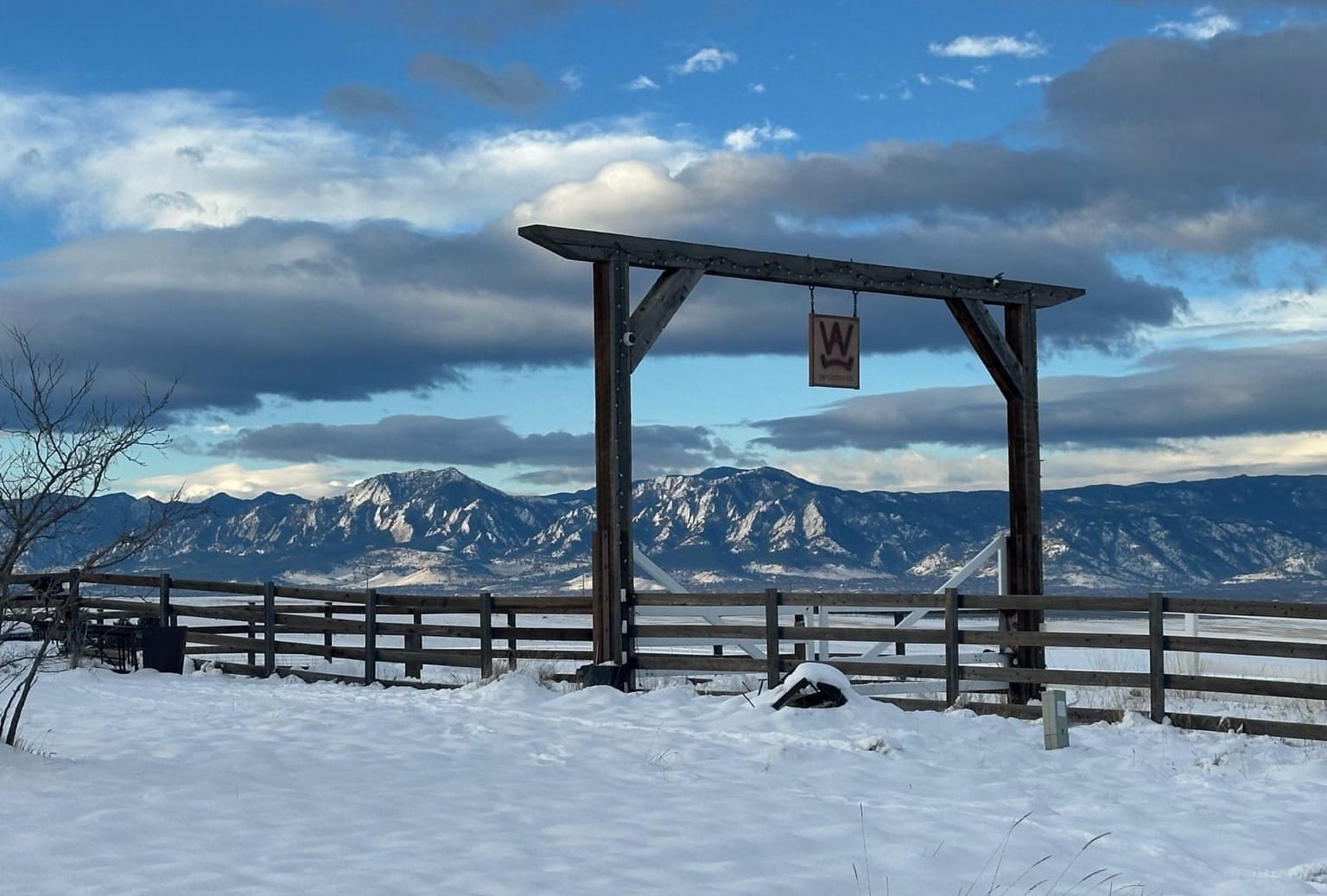
The first real snow of the season pulled me off a trail north of Boulder the other morning. The fields were white, the sky was clearing, and the Flatirons were showing off, as they always do after a storm.
But what made me pause was the weathered ranch gate framing the Flatirons in the distance.
Two heavy posts, a classic crossbeam, a hanging “W” brand, fence lines fading into the distance. Through that frame: the striking Flatirons, and below them, just out of view, Boulder’s AI startups, entrepreneurs, labs, and researchers.
The scene felt like more than just another pretty Colorado postcard. It looked like a doorway between two eras: the Colorado of cattle, horses, and fences and the Colorado of prompts, models, and algorithms.
That’s why this very human, non-AI photograph is this week’s AI Pic of the Week: It raises the question so many of us are facing as AI races ahead: What should we make sure to carry with us through the gate, and what do we risk leaving behind?
What's beyond that old ranch gate?
Most of us do not live purely on one side of the gate or the other.
We still shovel driveways, go to the store, walk the dog, and show up for in-person meetings. But we also use AI to brainstorm ideas, understand concepts, research competitors, and summarize reports. Our lives are a mix of old habits and new tools.
That old ranch gate captures that mix: The wood is worn and the mountains are unchanged. But the work done in the shadow of the foothills has shifted from mending fences and running feed stores to building AI tools and shipping code. And yet, the place is the same. The question is not “old or new?” It is how we layer the new on top of the old without losing what matters.
One of the things we risk losing is simple trust in what we see.
When seeing is no longer believing
For more than a century, a photograph carried a built-in claim: Someone stood here and saw this. Yes, images could always be faked, but it took real effort.
Now, anyone with a browser can generate a convincing “photo” of almost anything. Snow that never fell. Protests that never happened. Politicians in places they never were. The line between a photograph and an illustration is blurring fast.
That does not mean synthetic images are bad by default. They can be powerful tools for education, art, and accessibility. But when they're presented as documentary evidence, the stakes change. Elections, public safety, personal reputations, and local news all depend on people being able to trust at least some of what they see.
So, as we walk through this gate into an AI-saturated future, a few older ideas are worth keeping:
- Skepticism: A century ago, you didn't believe every story you heard at the general store; you sized up who was talking and what they stood to gain. Online, that same habit means asking yourself who made an image or video, what they want you to think, and whether it matches what you already know.
- Local knowledge: Ranchers and neighbors used to know which creek flooded first, which fields the wind stripped bare every winter, and which pasture could carry cattle through a dry summer. That grounded sense of place still matters when a “photo” or video clip shows people or places you know looking not-quite-right in ways that only locals or keen observers can spot.
- Old-fashioned honesty: In a small town, your word is supposed to mean something. On the internet, the least we can do is be clear about what we are showing and why — including when an image is synthetic.
At Colorado AI News, that last one means something concrete. When we use AI-generated images, we will label them. When we run human-taken photographs like this one, we will say so, too. It will not solve everything, but it is one way to plant a post in the ground.
Walking through the AI gate together
For now, I like that this week’s image is stubbornly real. It required getting off the trail, tromping through the snow, hanging onto a fence, and having a bit of luck with the morning light. You can feel the cold and imagine the wear in the wood.
Mostly, I like what the photo asks of us:
Which parts of “old Colorado” do we want to carry forward as AI becomes part of daily life? How about our humanity? Our connection to place? Real conversations? Pride in one’s craft? Passing our values down to the next generation? All of these feel incredibly important.
And which parts of the AI future do we welcome? How about scientific discovery, medical advances, smarter transportation, tools to help the disadvantaged, critical assistance for bootstrappers, and new ways to express our creativity?
The Flatirons will outlast all of us. The real question is what kind of community we choose to build in their shadow as AI becomes an equally inescapable part of the landscape.