
Other Voices is a new Colorado AI News feature that highlights insights and ideas from well known experts writing and speaking about AI. Each installment will link to an original source and offer a quick, plain-language synopsis of a few key points, plus brief context on why they matter.
For our first entry, we’re drawing from longtime technology writer Tomasz Tunguz. He's a San Francisco-based VC who heads the firm Theory Ventures and can boast of 403,000 followers on LinkedIn and over 150,000 subscribers to his blog. Tunguz's annual predictions post for 2026 can be found here. In the interest of focus, we’re highlighting just seven of his 12 predictions.
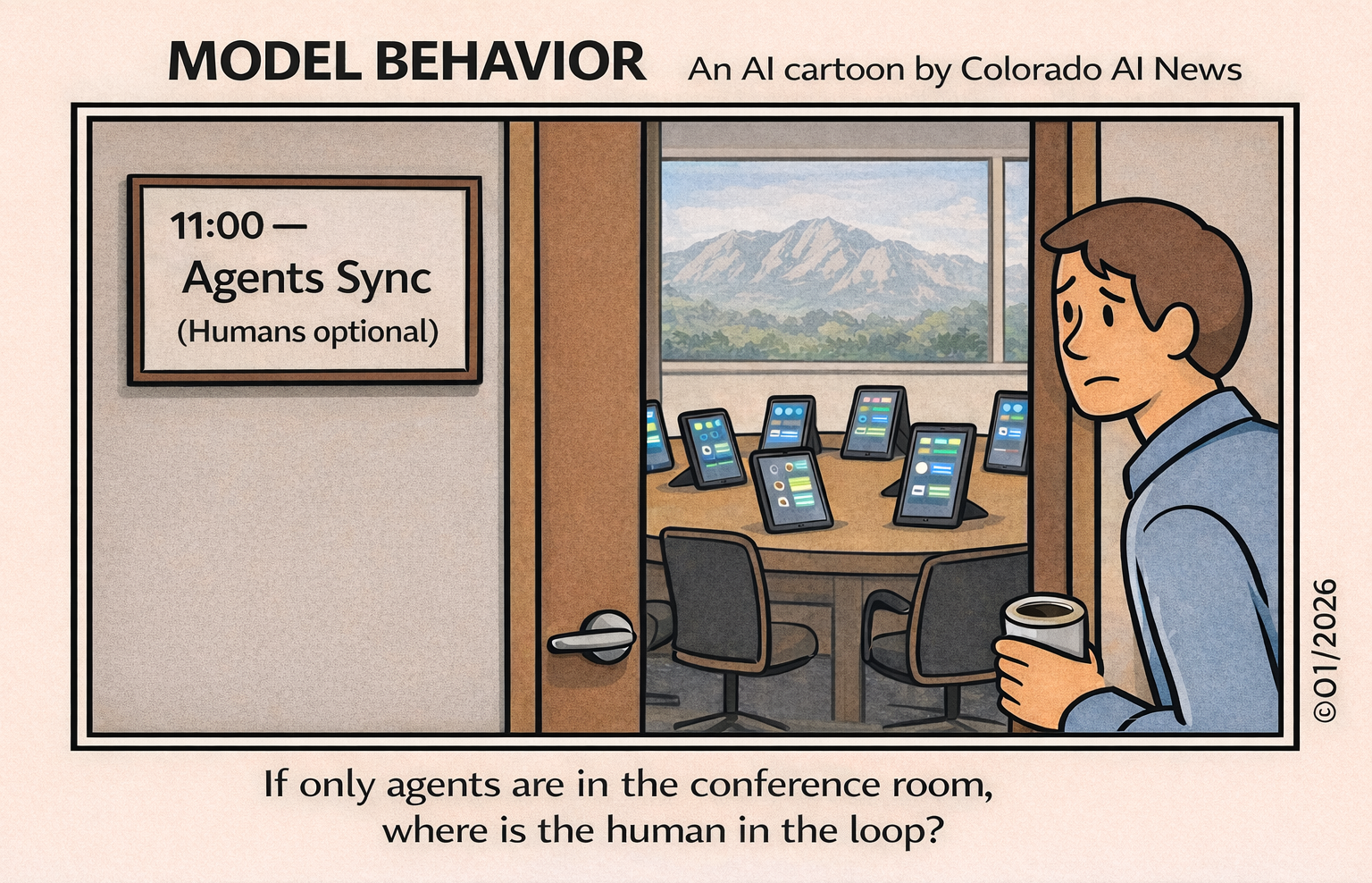
One pattern stands out: Four of the seven predictions are agent-related, spanning how companies pay for work, how long AI systems can run autonomously, and how the web itself may be redesigned for software acting on a user’s behalf. If Tunguz is directionally right, 2026 is when agents move from demos to default.
Agents and work
- Paying more for agents than people. Tunguz expects companies to pay a premium for AI agents once they factor in the full cost of hiring, training, and managing people. The key point is that agents start showing up as formal budget lines, not just tools. A similar “agent-as-staff” framing is already popping up in 2026 forecasts that describe “agent employees” with budgets and oversight.
- Agents running longer than a workday. Tunguz points to the idea that AI “time horizon” keeps extending until models can execute long workstreams without step-by-step human help. In practical terms, this means that once work runs unattended for hours, oversight becomes a requirement: monitoring, escalation paths, and audit trails. METR’s long-task research measures progress in terms of the length of time that AI agents can take to complete tasks, pointing out that this horizon has been rising quickly.
Agents and the web
- The web flips to agent-first design. The argument here is that more websites and documentation will be built for agents that retrieve answers, compare options, and complete actions, with humans using a secondary path. Tunguz's point is that “being findable” starts meaning “being usable by software acting for someone else,” and not just ranking in human search. Highlighting that trend, earlier this month Google announced an open standard and tools aimed at “agentic commerce,” and Axios reported that Mastercard has moved to shape rules for AI-driven checkout, both signs the shift is already underway.
AI budgets - and agents, again
- Scrutiny arrives. Tunguz expects the “experiment phase” to end as leadership teams push harder for measurable outcomes, lower costs, and clearer risk controls. The practical takeaway is that AI conversations move from demos to unit economics: what it costs, what it saves, and what breaks. Gartner has forecast that more than 40% of agentic AI projects will be canceled by the end of 2027 due to escalating costs, unclear business value, or inadequate risk controls.
The Google advantage
- Google pulls away via breadth. Tunguz’s view is that Google’s advantage is stack-wide: models, chips, distribution, and product surfaces moving together. The implication is that buyers may start choosing ecosystems over single “best model” comparisons. Reuters reported a multi-year Apple-Google deal to integrate Gemini models into a revamped Siri later in 2026, a concrete example of distribution leverage.
IPOs and exits
- A record year for exits. Tunguz expects the exit window to open wider this year, with more IPOs and acquisitions taking place as pent-up demand breaks. In practical terms, exits change behavior fast: Hiring picks up, budgets loosen, and competitive pressure rises. PwC’s 2026 capital markets outlook points to a larger backlog of IPO-ready companies, and PitchBook’s 2026 IPO outlook for U.S. venture capital also describes improving liquidity conditions.
Data centers, data centers, data centers
- The buildout hits “macro” scale. Tunguz predicts data center investment reaches about 3.5% of US GDP this year, comparing its scale to the nineteenth-century railroad expansion. The key point is that compute becomes a real-world constraint shaped by power, permitting, construction timelines, and financing capacity, not just model quality. Reuters reported JPMorgan’s estimate that data center spending could add roughly 10 to 20 basis points (one-tenth to two-tenths of a percentage point) to U.S. growth in 2026, underscoring how this buildout is not just a tech story, but also an economic one.
Taken together, Tunguz’s seven highlights sketch a simple 2026 storyline: Agents move from novelty to default, and everything around them tightens up. That means tighter budgets, clearer accountability, and more infrastructure constraints, alongside a platform race that may favor the biggest ecosystems and a healthier market for IPOs and exits. If even a good part of this plays out, the practical shift is less about model bragging rights and more about who can operate AI reliably at scale.