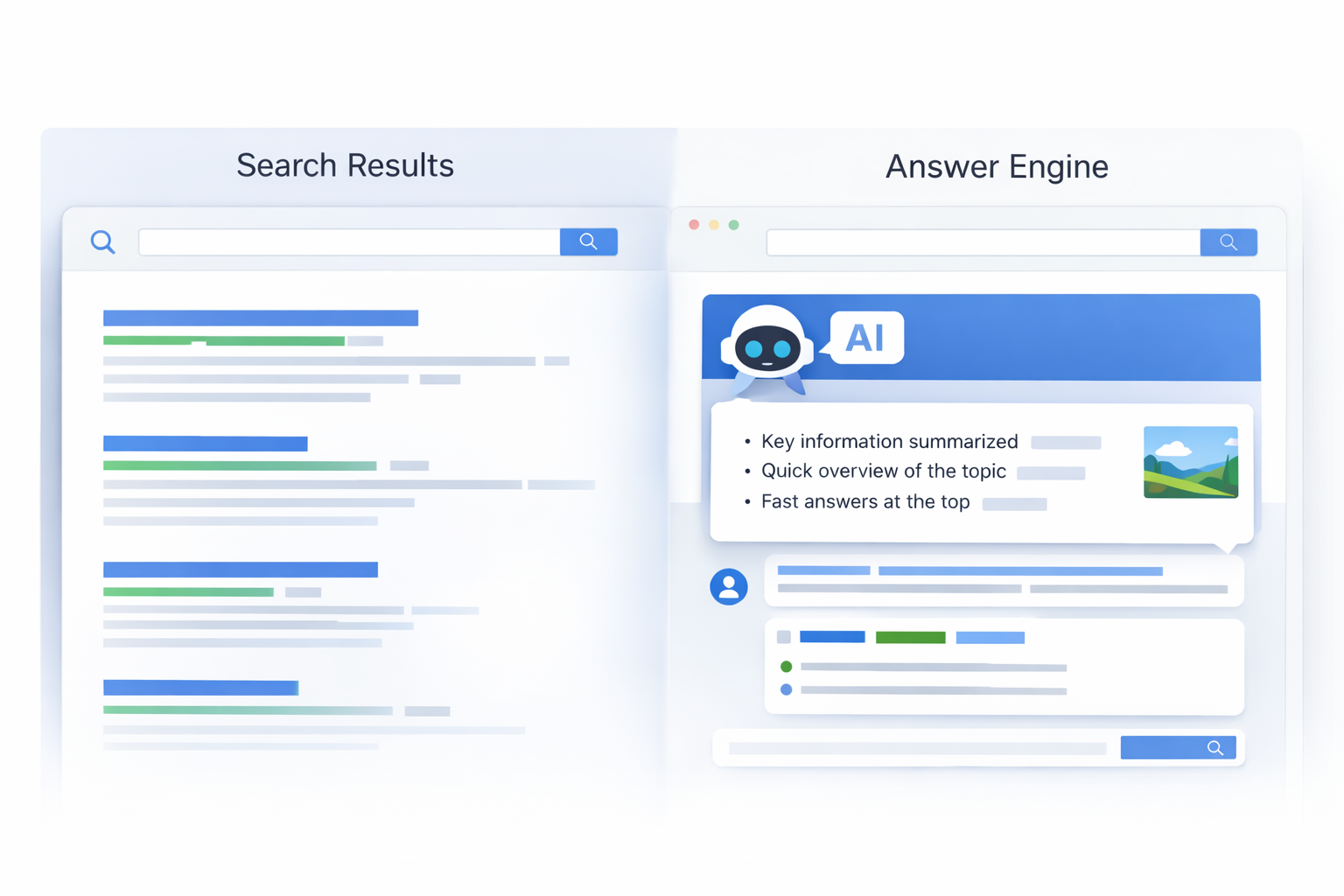
Over the past couple of years, Google has been rewiring the front door of the internet. The familiar pattern — type a query, scan links, click — is being replaced by something that often tries to answer first and send you elsewhere second.
The timeline tells the story: In May 2023, just six months after the launch of ChatGPT, Google began publicly testing a generative AI search experience through Search Generative Experience (SGE). AI Overviews followed a year later, in May 2024, and AI Mode arrived as a 2025 experiment that leans even harder into answers over links.
Ultimately, more queries now end with an answer displayed on the results page instead of resulting in a click to a website. That shift has consequences that go well beyond SEO, because it changes how marketing creates demand, how brands earn trust, and how business owners should think about growth.
This story is the first in a series of pieces looking at what “AI search” actually means for 2026 — including examining AI features inside Google search and other answer engines that summarize information before a user clicks through. The goal here isn’t to chase every new feature announcement, but to focus on the bigger pattern: What’s changing, what’s staying true, and how should smart teams adapt without overreacting?
A good starting point for our discussion is the SEOFOMO Organic Search Trends Survey, which captures how search professionals are thinking right now about the year ahead.
Published by SEOFOMO, a weekly newsletter curated by SEO consultant Aleyda Solís that reaches more than 40,000 subscribers, the survey gathers input from more than 60 SEO pros on where traditional and AI-driven search are headed in 2026.
Ultimately, the survey’s outlook is practical: Respondents expect more AI answers inside search results and fewer organic clicks, especially for quick informational questions. They also expect a growing premium on trust, clarity, and being referenced across the web, because those are signals that both people and AI systems lean on when it's decision time.
What the survey keeps coming back to
The SEOFOMO survey treats the basics not as going away, but as non-negotiable. At the same time, it’s clear about what’s changing: AI is taking up more space in search results, and that changes what marketers and business owners should expect from search.
What changes after the search: more answers, fewer visits
In the survey’s forward-looking responses, many SEO pros predict broader use of AI Overviews (Google’s AI-generated summaries) and more prominent AI-first experiences in search results. They also expect fewer organic clicks, especially for quick informational searches, with “impressions up, clicks down” becoming even more common.
For non-specialists, the point is simple: Your content can still appear in search, and yet send less traffic than it used to, because the platform is answering more of the questions up front.
Search becomes more of a decision tool
The survey also makes a distinction that’s easy to miss if you only focus on the “fewer clicks” headline.
Many respondents expect AI tools to handle more early discovery and quick synthesis, while traditional results become the place people go in order to confirm details, compare options, check sources, and take action. In this framing, classic search narrows in role, but becomes more important when someone is ready to choose.
That matters for marketing and business leaders because it shifts the goal: You don’t need to win every early question, but you do want to be the name that feels reliable when the decision gets real.
The measurement problem: visibility without a neat click trail
One of the most consequential parts of the survey is how respondents talk about measurement.
Many describe AI visibility as a new layer and explain why: They assume AI answers will drive little or no measurable traffic. As a result, they’re tracking mentions and citations, how often a brand is included in answers, and how it’s described compared with competitors.
They also describe a second shift: success metrics moving closer to business outcomes. In the survey’s “What are you doing next” section, measurement improvements show up as a priority. In a nutshell, less attention is paid to vanity metrics, while more attention is paid to lead quality, conversions, assisted impact, and overall lift.
There’s an honesty in the survey's responses, too. AI measurement is still messy, and the survey reflects that reality. To keep the results honest, some teams run the same broad, category-level questions in a clean browser session, then check whether their brand shows up naturally and whether the AI can cite real sources.
For anyone responsible for growth, this is the practical implication: You may need to judge “Is this working?” with a wider set of signals than you used to, because the old click trail is getting harder to follow.
The tools story: The foundations remain, with AI added to the mix
If you expected the survey to say everyone has replaced their SEO tools, it actually says the opposite.
Respondents describe keeping a core stack and adding AI where it clearly helps. The survey’s summary highlights Google Search Console and Google Analytics 4 as consistent essentials, in addition to technical tools that help teams understand what search bots can access and index, including site crawls and, in some cases, reviewing server logs.
Then there’s the newer layer: tools that track how brands show up in AI answers, plus hands-on checking across popular AI systems. The survey lists examples and describes internal tools some teams build to test prompts at scale.
The big point is not that a new software package has solved everything. It’s that marketers and business owners are trying to keep measurement grounded in data they trust, while adding ways to monitor how AI systems describe brands.
Where AI search is heading in 2026
The survey’s “AI search in 2026” section highlights a few themes that matter even if you never touch an SEO platform:
1 - AI gets woven into everyday search
Respondents expect AI to blend more seamlessly into search journeys, to the point where many users stop thinking of it as a separate mode.
2 - AI moves from answering to guiding multi-step tasks
A major prediction is that AI systems will increasingly help with multi-step tasks inside the interface: compare, shortlist, book, buy, and connect to other apps. The survey links this to fewer steps between question and decision, which often means fewer website visits along the way.
3 - Commerce and advertising push deeper into AI experiences
Respondents predict more shopping embedded in AI interfaces and more monetization through ads, paid placements, and commission-style models. Several mention the idea of a search-ads equivalent emerging inside AI search.
4 - Trust and safeguards become a bigger constraint
The survey respondents also expect pressure for better citations and stronger quality filters, especially in categories where accuracy matters most. Additionally, respondents expect an arms race between spam attempts and enforcement, because new visibility will invite bad behavior.
The 2026 strategic shift: Be the source people and systems rely on
In the survey’s “How to win in 2026” responses, the themes are consistent: trust, clarity, and being widely referenced. Respondents talk about strengthening brand reputation beyond a single website, improving content so it’s easier to summarize and cite, and tying search work more directly to real business outcomes.
One respondent puts the broader idea plainly: Marketers need to shape how brands show up across the whole web, spending less energy on mechanical output and more on credibility, visibility, and demand.
Stripped of industry phrasing, the shift is easy to understand: In 2026, being accurately described and widely trusted may matter as much as being highly ranked.
When does AI become the default search experience?
The survey’s timing question produces a grounded answer: The respondents do not expect a single switchover moment. The more common expectation is a gradual rollout, with AI-first experiences becoming standard in some situations earlier than others.
They point to constraints that shape the pace: monetization, cost, user trust, and legal, regulatory, and publisher risk.
On timing, the survey’s summary clusters many predictions around mid-to-late 2026 for “default in some segments,” with many pushing any universal default into 2027 or later.
What not to miss
Yes, “fewer clicks” is a headline takeaway. The deeper shift is what happens around those clicks. AI tools are expected to absorb more early-stage questions. Traditional search is expected to matter more when people want to verify, compare, and choose. Marketing teams are adjusting how they measure success because the old “rankings and traffic” story no longer tells the full truth.
In 2026, more decisions will be shaped by summaries and recommendations. The advantage will go to brands that are clearly described online, are trusted, and are built for a search experience that doesn’t always end with a website visit.
As noted, this piece is a broad view of what's ahead. In the next installment, I’ll zoom in on the strategies forming around AI search in 2026, and what they mean for brands that want to stay visible without having to chase every shiny object.

![AI Quote, Explained: Yoshua Bengio: "People demanding that AIs have rights [are making] a huge mistake...."](/content/images/2026/01/Bengio_16x9_black_bg_1920x1080--1-.jpg)