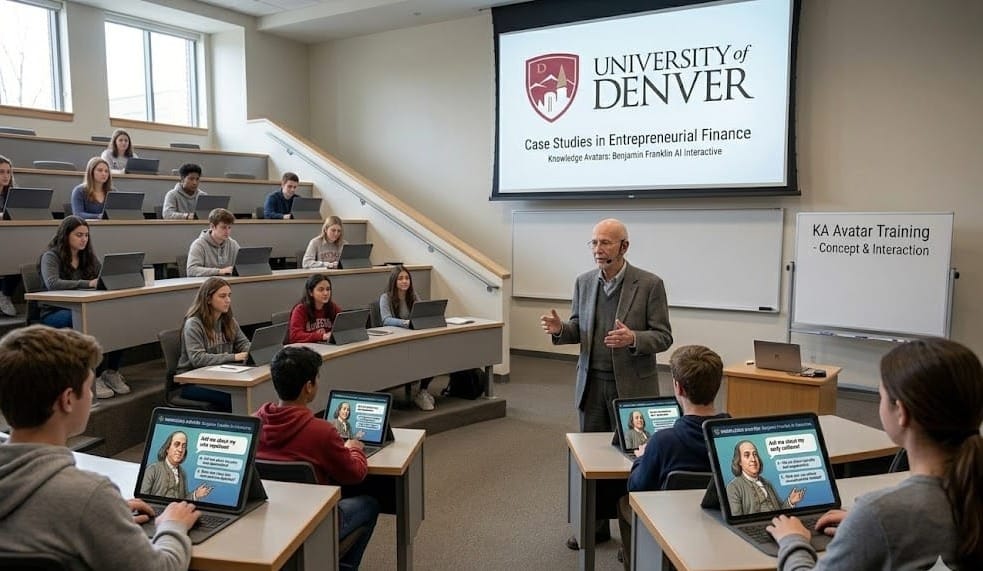
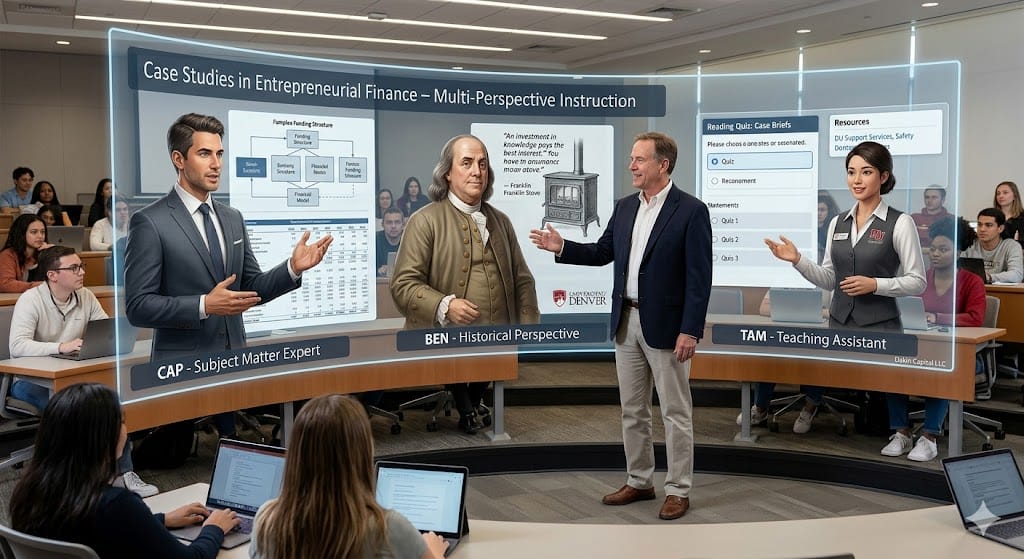
Last week, I walked into a classroom at the University of Denver with three additional instructors.
None of them was human. Before you jump to the conclusion that I have finally lost it, I am talking about AIs. Not ghosts, zombies or tales of the supernatural (well this may still qualify), but artificial intelligence avatars.
One of them was an AI avatar trained on entrepreneurial finance. Another acted as a teaching assistant, handling quizzes, structure, and student support. The third – and perhaps the most interesting – was a simulation of Benjamin Franklin, built to engage students as an “iconic entrepreneur” with his own perspective on business, risk, and capital.
This wasn’t a demonstration: It was the class. The world of education moved forward. Maybe just a step forward, and maybe it was a leap forward. Possibly even a paradigm change.
And within the first hour, something shifted. I was walking the students through an engagement with "TAM," my new AI avatar teaching assistant, in showing them how to answer questions that TAM was trained on. I had set up my engagement with TAM (purely professional, of course – not the slightly weird falling in love with an AI agent!) and keyed in a simple answer to the question.
One of my students mirrored my answer in their engagement with TAM and received a different response, bringing it to my attention. It became a learning moment to point out that every student in the class engaging with TAM was doing so in their own independent, however concurrent, conversation. I had achieved training 15 students at a one-to-one personalized tutoring level, all at the same time. There weren't any fireworks – like at a Denver Broncos game – except in my head!
AI is no longer a tool – it's a participant
We’ve spent the last few years talking about AI as a tool – something you use to write faster, code better, or analyze data more efficiently. That framing is already outdated. In this classroom, AI wasn’t assisting. It was participating.
And students weren’t just asking questions. Instead, they were:
- Testing their thinking against multiple perspectives
- Challenging assumptions in real time
- Exploring decisions from different angles
What emerged wasn’t just faster learning, but deeper learning. Concurrently.
What I’m seeing in real time
When you introduce AI into an environment as an active participant, three things happen almost immediately:
1. The number of “voices” in the room multiplies
Instead of a single instructor, students engage with multiple perspectives – each consistent, available, and informed. I believe in teaching with ‘depth perception’. A single point of view may misrepresent the situation. The more different views, the better to triangulate the facts into a true 360-degree, macro, omniscient look at what’s going on.
2. Learning becomes interactive, not observational
Students stop passively absorbing content and start working through problems dynamically. Asking a question is simple, and answering a question is harder. But explaining an answer is hardest of all. You can almost hear the brains gearing up.
3. The pace of exploration accelerates
Questions that would normally take hours – or go unasked – are explored instantly. But something else happens that’s less obvious. Students begin to realize that knowledge is no longer scarce or a misunderstood commodity. And that changes how they approach learning entirely. Learning is embedded, continuous, and unavoidable.
I’ve seen this before – and I haven’t
Over the course of 47 years in technology, I’ve seen this pattern repeat:
- The personal computer expanded access
- The internet expanded information
- The cloud expanded capability
Each wave lowered barriers and increased human potential. I have seen enough and worked through so many advances in technology that I am not surprised by change. As an entrepreneur hoping to make the world a better place, I embrace change. I am the person who sees a glass of water filled halfway to the top as neither half full, or half empty, but the wrong-sized glass.
And yet, AI is doing something different. It’s expanding interaction with knowledge itself. That’s not just a step forward. It’s a shift in how we think. This is not a linear, two-dimensional change, it is something more radical.
Where the friction is
As promising as this is, the challenges are real – and they’re not technical. They’re systemic:
- Education models are built for static content, not dynamic interaction
- Funding structures lag behind new methods of learning and delivery
- Institutions move slower than the environments students are moving into
- Education programs addressing innovation are falling behind
We’re trying to integrate a participatory intelligence into systems designed for one-way, one-to- many, industrialized instruction. That tension isn’t going away anytime soon. The long tail of AI and education may take decades, not years, to reach maturation.
What this means (depending on where you stand)
For educators:
You’re no longer the sole source of knowledge. You’re becoming the architect of learning environments. Although you may still be the smartest person in the classroom, you do not have to know everything. By the way, you can shift part of your over-burdened workload to an AI avatar.
For students:
The advantage is no longer access to information. It’s the ability to ask better questions and navigate complexity. An answer is not enough. It must be backed up with custom reasoning.
For founders:
AI-enabled education and training is not a niche – it’s an emerging category. The U.S. workforce training market is a vast, multi-billion dollar industry with total expenditures reaching roughly $103 billion in 2025. AI in education could disruptively replace a good part of this market with increases in speed, reductions in costs, and improvements in quality.
For investors:
There is a gap forming between where learning is going and how it’s currently funded. The Impact Finance Center and the Colorado Workforce Development Council are presenting a new webinar series where employees may gain needed training through offering investors a share of their earnings. The next webinar in the series is being offered on August 13.
For communities:
Workforce development may be one of the most important – and overlooked – applications of AI. With jobs being the centerpiece of economic development, action is needed to put AI to work in job creation and retention.
What people are missing
There’s a lot of discussion about AI replacing jobs. That may happen in some areas. But what I’m seeing is something more immediate: We don’t yet know how to train people for the roles AI is creating.
And the systems we rely on today aren’t built – or funded – for doing that. Moreover, this has been a problem for some time: I teamed with futurist Dr. Thomas Frey in 2005 in exploring what the future of new funding for workers might look like.
In addition to moving away from jobs training to skills training, and from staged education to continuous learning, investment in training people must position people as the assets and not the jobs. Like most major changes, the change must include everything for the full benefit to be realized.
Practical takeaways
- Start thinking of AI as a collaborator, not a tool
- Focus on environments where interaction matters (learning, decision-making, training)
- Pay attention to where existing systems no longer fit
- Look for opportunities where new models are needed, and not just new technology
Questions worth asking
If AI can participate in how we learn, what else can it participate in? And how do we build the systems – and the funding models – to support that shift?
After 47 years working through multiple waves of innovation, I’ve learned that the most important changes don’t come from the technology itself. They come from how we choose to use it. We’re just getting started!